
The cheapest insulation material is not always the cheapest completed retrofit. Labor, access, air sealing, thickness, protection, moisture conditions, equipment, finish restoration, and future service access can outweigh the material price. Compare fiberglass, cellulose, mineral wool, and spray foam as ways of completing an assembly—not as isolated bags, batts, or drums.
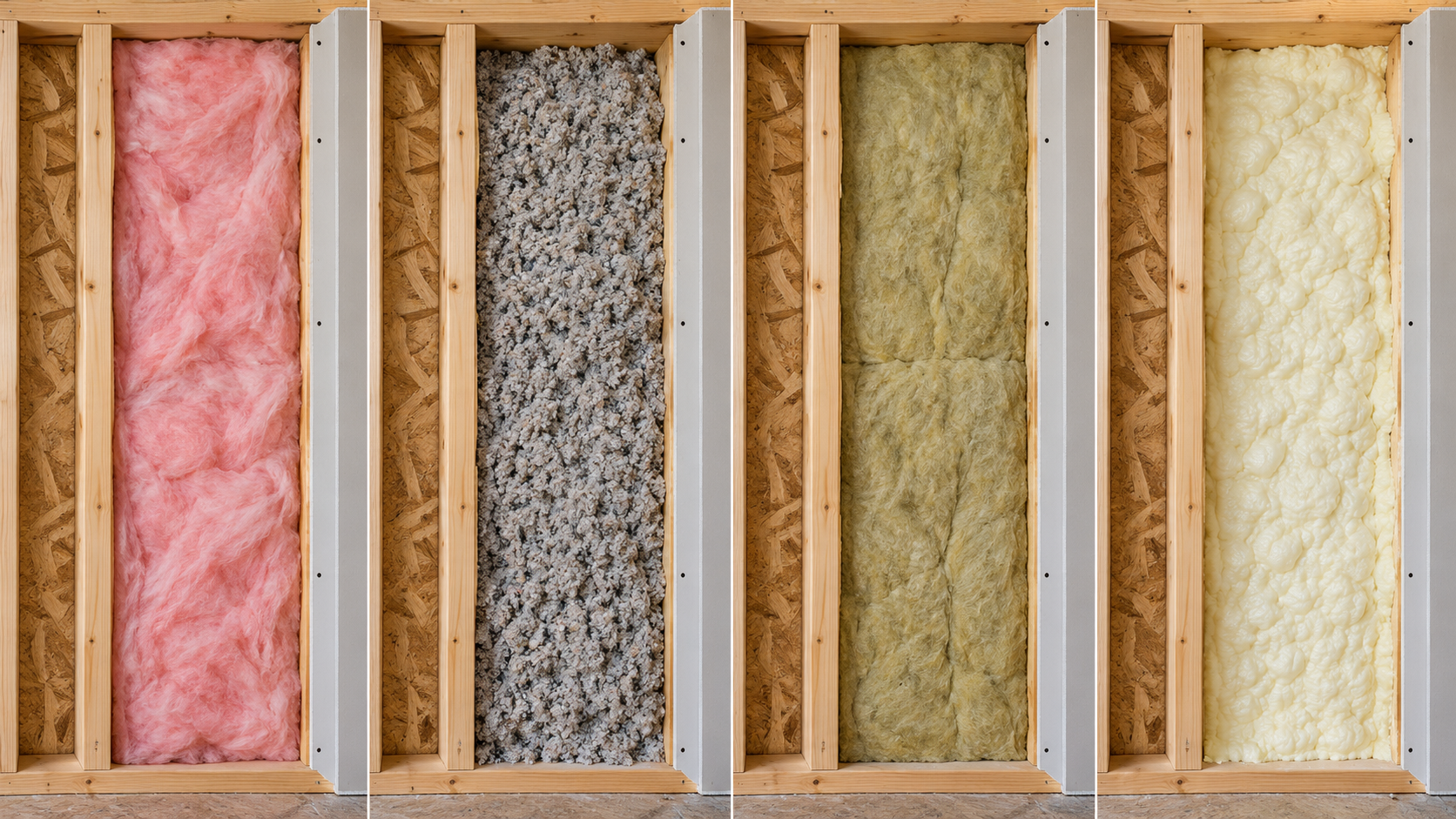
Illustrative planning scenario
For 1,000 square feet of accessible attic or wall area in the U.S., a material-and-installation comparison might start around $1,500–$4,000 for fibrous insulation, $2,000–$5,000 for mineral wool or cellulose in a suitable scope, and $4,000–$10,000 or more for spray foam. These are not interchangeable bids; air sealing, thickness, access, barriers, and restoration must be priced separately. Canadian buyers need local CAD quotes.
Fiberglass
Fiberglass batts or blown fiberglass can be economical in regular, accessible cavities and attic floors. Batts depend on careful fit around framing and obstructions; gaps and compression reduce the quality of the installed layer. Blown material can cover irregular attic floors efficiently when the installer can control depth and edge details.
Fiberglass does not automatically create an air barrier. Air sealing at penetrations, hatches, rim areas, and joints may be a separate step. Its value is highest when the assembly is open, dry, and easy to inspect.
Cellulose
Cellulose is commonly used as blown attic insulation or dense-pack cavity insulation. It can suit irregular spaces and closed-wall retrofit methods, but the contractor must account for cavity condition, fill density, moisture, and access. A closed wall may still contain voids or obstructions that are not visible from the finished side.
Cellulose should not be treated as a solution to active water entry or contamination. Ask how the installer verifies coverage and handles settling, damage, or a cavity that cannot be filled.
Mineral wool
Mineral wool products may be used in selected wall, floor, basement, or fire- and sound-sensitive assemblies. Their cost depends on product form, cutting and fitting labor, access, and the surrounding control layers. Do not infer fire, moisture, or code performance for a specific product without its documentation and the assembly in which it is used.
Spray foam
Spray foam can combine insulation and air-control functions in some applications, but it carries higher product and installation consequences. Open-cell and closed-cell products differ in permeability, density, thickness, and suitable uses. Roof-line foam may change ventilation; wall and rim applications may affect future access and moisture behavior. Current product and local requirements are essential.
What matters more than the headline R-value
Nominal R-value is only one part of an enclosure. Gaps, compression, thermal bridges, air paths, moisture, wind washing, and discontinuities at openings can dominate actual performance. A material with a higher listed value may not improve the house if it is installed in the wrong location or leaves the air-control layer broken.
Cost comparison method
Ask each bidder to state material, thickness or target, area, labor, equipment, air sealing, preparation, removal, access, supports, protection, cleanup, and restoration. A material-only unit rate is not comparable with an installed scope. Small projects may carry minimum charges; closed walls and roof lines may carry exploratory and finish costs.
For U.S. and Canadian projects, material availability and labor markets differ. The evidence provides directional U.S. and Canadian attic observations, not a complete cross-material table. Keep currencies separate and do not convert one market’s prices. Ask local contractors to price equivalent completed assemblies.
Match the material to the retrofit
Use an open, regular attic floor to compare fibrous options and air sealing. Use a closed wall to compare low-disruption filling against opening the wall. Use a re-siding project to evaluate continuous exterior insulation and weather details. Use spray foam only after the assembly and product requirements are clear. A basement or crawl space needs moisture and drying analysis before material selection.
Questions for a contractor
Ask which layer controls air, vapor, and bulk water; how the material fits around services; how gaps are checked; what happens if the assembly is wet; and how future access will be maintained. Ask for a lower-cost alternative and the reason the proposed material is worth its premium.
The best material is the one that can be installed continuously in a suitable assembly, with the necessary control layers and a price that includes the labor and detailing required to make the system work.
Questions that expose a misleading comparison
Ask whether the quoted area is the cavity, the finished wall, the roof plane, or the whole assembly. Ask whether the unit price includes air sealing, supports, removal, equipment, waste, protective barriers, access, and finish restoration. A material with a low per-square-foot figure may require more preparation or may leave another contractor to complete the air or moisture control.
Ask how future work will reach wiring, plumbing, roof penetrations, and inspection points. Ask what happens if the cavity is partly filled, damp, irregular, or smaller than assumed. These questions are particularly important for closed walls, roof lines, basements, and crawl spaces where the material cannot be easily inspected after installation.
The right comparison is between complete systems with similar assumptions. Keep any U.S. and Canadian market observations in their original currency and remember that installer availability can change the practical price as much as the material label.
Do not choose from a product table alone
Ask the installer to identify the assembly and the function each material performs. A material that looks inexpensive may require a separate air barrier, support, vapor-control detail, or finish repair. A premium material may save a separate labor step but create future access or product-verification needs. The quote should make those trade-offs explicit.
If two materials remain suitable, compare durability, repairability, availability, installer experience, and the cost of correcting an imperfect installation. A homeowner is buying an installed assembly, not a laboratory number. That distinction is especially important when the wall, roof, basement, or crawl space will be difficult to inspect later.
Compare complete installed systems
An installed-cost comparison should state the assembly, area, access, preparation, material quantity, labor, equipment, air sealing, protection, finish restoration, and cleanup. Fiberglass in an open attic is not directly comparable with spray foam in a roof line. Cellulose blown into a closed wall is not directly comparable with a fully opened wall that also receives new wiring, sheathing repair, or exterior insulation.
Ask each contractor to price the material and the completed function separately. Is the goal thermal resistance, air control, sound, fire performance, moisture management, access improvement, or a combination? A material that performs two functions may reduce separate labor, but only when the assembly and installation actually allow it. A low unit price can conceal that air sealing or detailing remains unpriced.
R-value is only one part of the decision
Nominal R-value does not describe the whole assembly’s continuity, air movement, thermal bridges, moisture behavior, or workmanship. An insulation that fits tightly and remains supported may outperform a higher-rated product with gaps, compression, wind washing, or poor transitions. That does not make material performance irrelevant; it means the quote should connect the product to the installed system.
Product-specific claims about permeance, barriers, fire protection, and compatibility require current manufacturer information and local review. Do not let a comparison table turn a general material class into a universal prescription for every wall, roof, basement, or crawl space.
When the premium may be rational
A higher-cost material may be reasonable where access is limited, air sealing is difficult, space is tight, or the assembly is already being redesigned. It may be poor value where a regular open cavity can receive a lower-cost suitable material with better future access. The relevant question is not which product is best in the abstract; it is which complete system meets the home’s need at the lowest responsible lifecycle cost.
Keep U.S. and Canadian price observations in their original currencies and scopes. Availability, installer familiarity, climate, and labor can change the ranking. Request a local, itemized quote before using a material comparison to make a purchase decision.
Compare installed outcomes
For each material, ask what preparation, equipment, thickness, support, protective layer, finishing, and inspection it requires. A material with a lower purchase price may need more labor or a different assembly, while a premium product may reduce access or future repairability. Compare the complete installed scope at the same location and intended performance rather than comparing packages by label alone.
Also consider what happens when the material is wet, disturbed, removed, or penetrated for later work. Ask whether the installer can document the product, coverage, and concealed transitions. A useful comparison acknowledges tradeoffs among thermal resistance, air control, moisture behavior, fire requirements, sound, durability, availability, and reversibility. The preferred material is the one that fits the assembly and can be installed and verified correctly in the actual house.