
Spray foam is priced by the area and thickness of the installed foam, often expressed as board feet, but the quote may also include preparation, access, masking, ventilation, removal, and finish or fire protection. Current specialist guides provide directional market observations, including a Canadian attic material range of roughly CAD 2.50–8.00 per square foot from HomeStars. That is not a universal installed price, and the range should not be converted into a U.S. number or treated as proof that foam belongs in the assembly.
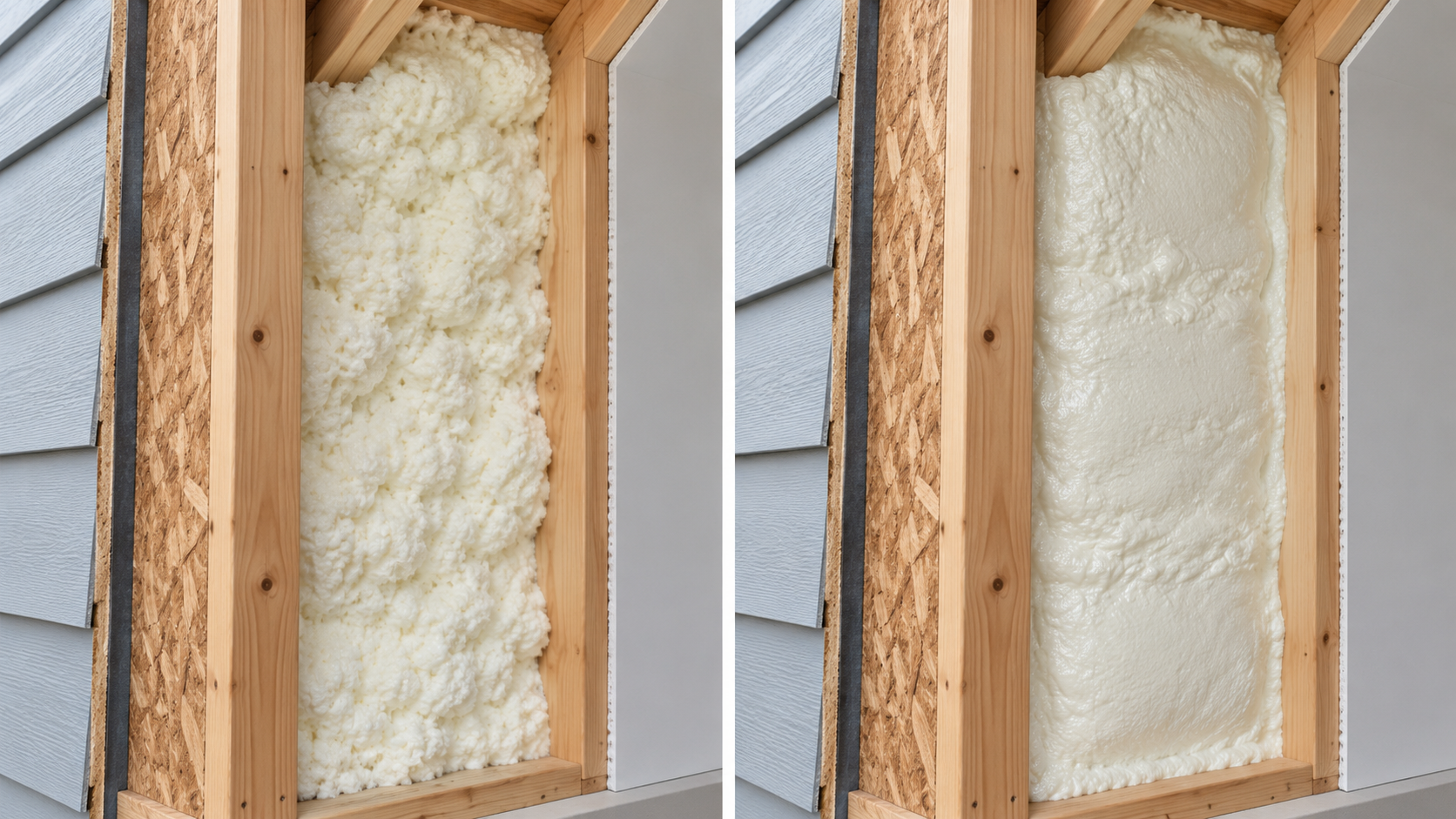
Open-cell and closed-cell are different decisions
Open-cell foam and closed-cell foam have different density, expansion, permeability, thickness, and application characteristics. The relevant choice depends on the assembly, climate, available cavity depth, moisture exposure, and the function the foam is expected to perform. The material label alone is not enough to determine suitability.
Spray foam can combine insulation and air-control functions in some applications, but it does not automatically solve every moisture or water problem. A roof-deck application can change attic ventilation and the roof’s drying behavior. A wall application can affect vapor movement and later access. Ask what the foam is intended to do and what remains a separate layer.
What the quote should measure
Ask whether the price is based on board feet, square feet at a stated thickness, or a complete project. A low unit price at a thin thickness is not comparable with a thicker assembly. The quote should state the product, thickness, area, substrate preparation, access, masking, ventilation during installation, waste, cleanup, and any required ignition or thermal barrier.
Minimum charges can matter for a small rim-joist or repair project. Difficult attics, crawl spaces, high walls, occupied homes, furniture protection, and multiple mobilizations increase labor. Removal of old insulation or correction of wet wood is separate unless included.
Where foam may be considered
Common applications include rim areas, irregular cavities, roof lines, limited-access walls, and places where air leakage is difficult to control with fibrous material. That does not make foam a universal upgrade. Fiberglass, cellulose, mineral wool, rigid insulation, or an air-sealing plus insulation sequence may deliver better value where the cavity is open and regular.
Product and assembly verification
Specific claims about permeance, thermal performance, ignition or thermal barriers, installation temperature, substrate moisture, and roof compatibility require current manufacturer documentation and local review. There is no universal spray-foam prescription: the correct product and application depend on the assembly, climate, product data, installer, and local requirements. NRCan specifically describes roof-line use as a qualified-contractor and approval-sensitive approach.
Do not cover wet sheathing, mold, rot, or unresolved roof leaks with foam. Do not use foam to conceal unsafe wiring, flues, or a ventilation path. If hazardous insulation or contamination is present, obtain the appropriate assessment before work.
Cost scenarios
A small targeted application may be dominated by minimum charge and setup. A typical attic or rim project includes preparation, spraying, trimming, and cleanup. A complex roof-line or wall retrofit may add removal, access, ventilation, barriers, electrical or HVAC coordination, and inspection. A conditioned-attic conversion is a different, larger assembly project even when spray foam is the selected material.
U.S. and Canadian market data are not directly comparable. Keep currencies and package definitions separate. Ask for a local quote and compare the total installed assembly, not a converted unit price.
Questions before signing
Ask for the product technical data, intended thickness, surface preparation, clearances, barriers, ventilation plan, warranty, access restoration, and what happens if the substrate is wet or damaged. Ask how the contractor checks coverage and whether future roof or wall repairs will require foam removal.
Spray foam can be worth its premium when it solves a difficult air-control or space constraint in a suitable assembly. It is poor value when it is selected for a dramatic product claim, applied without a roof or wall design, or priced without the preparation and protection that make the installation durable.
Compare foam with the complete alternative
The relevant alternative is not always “foam or no insulation.” It may be air sealing followed by fiberglass or cellulose, rigid insulation with a separate air-control layer, exterior insulation during re-siding, or a conventional attic-floor approach. Compare the complete installed assembly, including access, preparation, thickness, barriers, ventilation, finish, and future serviceability.
Open-cell and closed-cell products can differ in density, expansion, permeance, thickness, and intended application. A product’s marketing description does not establish whether it is suitable for a particular roof, wall, rim, crawl-space, or basement assembly. Ask for the current technical data and the installer’s method for verifying substrate condition and coverage.
When the premium is more defensible
Foam may earn a premium where irregular geometry, limited cavity depth, or difficult air control makes another approach impractical. It may also be considered at a rim area, roof line, or selected closed cavity where the complete assembly has been reviewed. The premium is harder to justify in a regular, accessible cavity where a lower-cost material can meet the thermal and air-control goal and remain easier to inspect or modify.
Avoid a foam proposal that treats the product as a cure for water entry, mold, rot, unsafe wiring, or an unresolved roof assembly. Those conditions need correction or qualified escalation before the application.
U.S. and Canadian context
The available Canadian market observation is a directional specialist range for attic material, not a universal installed price; comparable U.S. and Canadian package definitions are not established. Keep currencies and product scopes separate. Ask for a local quote that shows minimum charge, board feet or thickness, preparation, barriers, ventilation, access, cleanup, and warranty.
Spray foam is a system decision with a product price inside it. The right budget is the one that makes the assembly, safety, moisture, and future-repair consequences visible before the foam is installed.
A responsible foam quote
The proposal should identify the substrate, product, thickness, area, board-foot or square-foot basis, preparation, temperature and moisture assumptions, ventilation during installation, protective barriers, trimming, waste, cleanup, and future access. It should state what happens if the substrate is damp, damaged, contaminated, or not compatible with the product. Those details are part of the cost, not optional technical notes.
Ask how the installer will verify coverage and whether the work changes a vented roof or crawl-space assembly. Ask whether electrical, plumbing, flue, window, and finish work is included or excluded. If the foam is expected to serve as an air barrier or vapor-control component, request the product data and the assembly detail that supports that function.
The premium is defensible when foam solves a real geometry or air-control problem that another system cannot address as reliably. It is not defensible merely because the product is marketed as high performance. Compare the complete foam system with a lower-cost, serviceable alternative in the same assembly and keep U.S. and Canadian market observations in their original currencies.
Before signing, ask what the owner will receive: product information, installed thickness, coverage record, inspection notes, warranty limits, and any required approval or barrier documentation. Ask how future roofing, wiring, plumbing, or moisture investigations will reach the assembly. Foam can make a difficult space more efficient, but it can also make later discovery and repair more expensive.
Require a product-and-assembly record
Spray foam should be priced as part of an assembly, not as an isolated volume of material. Ask for the product type, intended use, target thickness, substrate preparation, temperature and moisture conditions, ventilation and re-entry plan, ignition or thermal barrier treatment, and areas that cannot be reached. The quote should also identify whether removal, trimming, overspray protection, electrical or mechanical relocation, and finish restoration are included.
At closeout, keep the product information, batch or installer record when available, photos before concealment, and the final thickness or coverage notes. Record where foam was intentionally omitted around services or inspection points. This documentation supports future repairs and helps a later specialist distinguish a product issue, an assembly issue, and a condition that was outside the original scope. A lower price is not a saving if it removes the information needed to inspect the work.
For a fair comparison, ask every bidder to price the same measured area and target thickness, then list separate allowances for substrate repairs, removal, ventilation, protective barriers, and finish work. Ask what happens if the substrate temperature or moisture is outside the product’s application limits on the scheduled day. A responsible proposal should say whether the crew will stop, reschedule, or use an approved alternative, and how a change affects the price. This keeps a low bid from depending on a condition the homeowner cannot verify after the foam is covered.