
A radiant barrier is a reflective surface intended to reduce radiant heat transfer. Its value depends on climate, sun exposure, orientation, installation, and the adjacent air space. It is not a universal replacement for conventional insulation. Before approving a quote, ask whether the project is addressing radiant heat gain or a more significant problem with conductive heat flow, air leakage, or moisture.
Illustrative planning scenario
For 1,000 square feet of accessible U.S. attic surface, a limited radiant-barrier installation might be modeled at $1,000–$3,500 before difficult access, removal, or repairs. The allowance does not imply a guaranteed energy saving and should be compared with air sealing or conventional insulation. Canadian homeowners should request local CAD pricing.
What a radiant barrier does
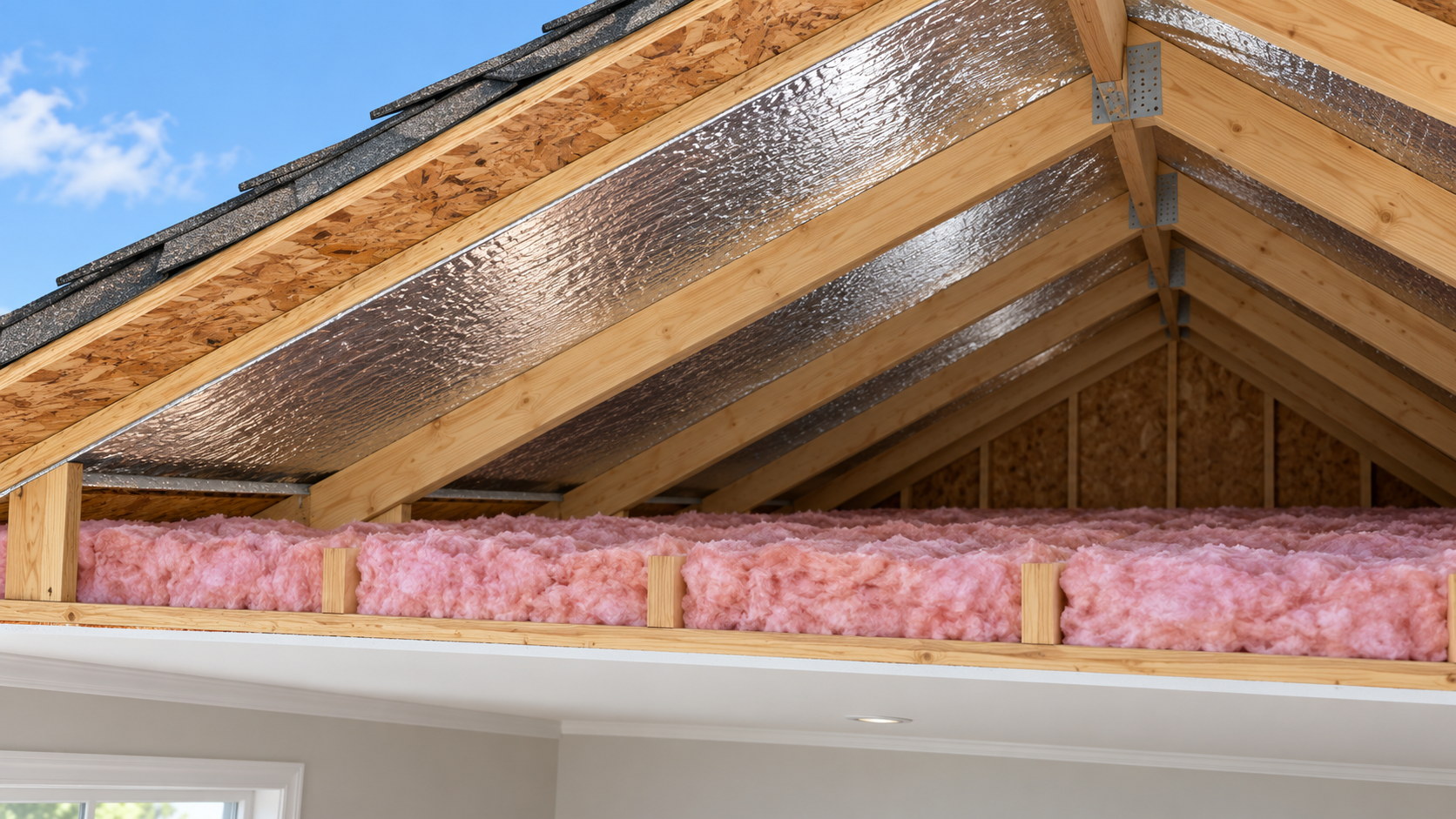
DOE guidance describes radiant barriers as reflecting heat and notes that they need an adjacent air space. That mechanism is different from the way fibrous or foam insulation slows conductive heat transfer. A reflective product laid tightly against another material may not perform like a system with the required air space.
Radiant barriers are more likely to be considered in hot, sunny climates or roof assemblies where radiant heat gain is a meaningful load. They may have less value in a cold-climate attic where the dominant issue is heat loss, air leakage, or inadequate conventional insulation. Climate is a decision factor, not a guarantee.
Cost structure
The installed price depends on product, area, access, attachment method, roof geometry, existing insulation, and whether the installer must remove or move material. An open attic is cheaper to reach than a finished roof line. Working around ducts, wiring, lights, trusses, and eaves adds time. The evidence does not establish a dependable national installed range, so compare a local quote with the alternative of conventional insulation and air sealing.
Ask whether the price includes preparation, removal, air sealing, supports, cleanup, and any repair to the roof or attic. A radiant barrier installed over a moisture problem or without its air space is not a bargain.
Why it does not replace all insulation
Radiant and conductive heat transfer are different. A barrier may reduce one part of the heat flow while leaving low insulation levels, thermal bridges, air leakage, or moisture unaddressed. If an attic has bypasses, damp insulation, roof leaks, or blocked ventilation, the priority may be diagnosis and correction rather than a reflective product.
Do not treat a marketing savings percentage as a project forecast. The available evidence does not establish a universal radiant-barrier savings magnitude. Energy results depend on weather, building orientation, attic ventilation, occupancy, HVAC operation, and the condition before the project.
Compare alternatives
Ask the contractor to price air sealing, conventional insulation, and the radiant option separately when all are plausible. A barrier may be part of a larger assembly, not a standalone cure. Compare upfront price, access, future service, expected comfort effect, and whether the material can be inspected.
For a cold attic, an air-sealing and insulation plan may address the actual heat-loss path. For a hot attic in a sunny climate, a radiant barrier may deserve consideration if its air space and installation details are real. For a moisture problem, correct the source first.
U.S. and Canadian context
Climate differences are especially important. The U.S. DOE guidance is technical orientation, not a Canadian code or savings promise. Local construction, attic design, labor, and product availability vary. Obtain a market-specific quote in the local currency and do not convert a U.S. price into Canadian pricing.
Questions before signing
Ask what heat-transfer mechanism is being addressed, where the air space is, how the barrier is installed around penetrations, what conventional insulation remains, and what result will be measured. Ask what happens if the attic contains wet, contaminated, or damaged material.
A radiant barrier can be a reasonable targeted component in the right assembly. It is poor value when used to avoid diagnosing leakage or moisture, when it is presented as a universal insulation substitute, or when the quote does not explain the air space and the intended result.
A better quote comparison
Ask each bidder to identify the attic surface, air space, orientation, existing insulation, and expected heat-transfer problem. One proposal may install a reflective layer during a roof project; another may propose more conventional insulation or air sealing. Those are not interchangeable prices. Compare the complete installed system, including access, preparation, support, penetrations, dust, and the risk that later work will cover the reflective surface.
Do not use a radiant barrier to avoid investigating a roof leak, wet insulation, missing attic insulation, or a large air bypass. If the main problem is winter heat loss, cold surfaces, or drafts, a radiant layer may be the wrong first spend. If the main problem is summer radiant gain in a suitable hot-climate attic, it may be a reasonable targeted component, but the benefit should be described as climate- and assembly-dependent.
The owner should leave the quote knowing what is being reflected, what remains insulated, how the air space is maintained, and how the result will be judged. Without those answers, the product’s low unit price says little about value.
A final value check
Ask whether the proposed barrier is replacing another measure or supplementing it. If it replaces attic insulation, air sealing, or moisture correction, the comparison is probably incomplete. If it supplements conventional insulation in a hot, sunny, suitable assembly, ask how much of the expected benefit depends on roof orientation, ventilation, occupancy, and weather.
The quote should also state what happens if the barrier becomes dusty, is pierced by later work, or cannot maintain the intended air space. A product that is difficult to preserve may have less value than a simpler durable improvement. Keep performance claims qualified and ask for local, assembly-specific support before using an exact savings or payback number.
The installation condition controls the value
Radiant systems work by reflecting radiant heat and require an adjacent air space. They do not provide the same function as ordinary cavity or continuous insulation, and they do not stop air leakage through a gap. In a hot, sunny attic with a suitable exposed surface, they may be a targeted option. In a cold-climate attic where the main problem is heat loss through the ceiling, adding conventional insulation and air sealing may be the more relevant spend.
Ask whether the proposed barrier will remain exposed to the required air space after installation, whether dust or later work will cover it, and how penetrations, edges, and ventilation paths are handled. A product placed against another material without the intended space may not deliver the claimed effect. The quote should describe the assembly, not just the reflective product.
Compare the alternative use of the budget
Before approving a radiant barrier, compare air sealing, attic insulation, shading, roof work, HVAC improvements, and moisture correction where those are plausible causes of the complaint. A radiant barrier should not be used to conceal wet insulation, a roof leak, inadequate insulation depth, or an attic air bypass. If the problem is a hot room, determine whether the heat is solar gain, roof conduction, air leakage, or HVAC distribution.
Savings and payback are particularly sensitive to climate, roof orientation, attic ventilation, operating patterns, and energy prices. The available evidence supports the mechanism and hot-climate context but does not establish a universal savings percentage. Treat any precise promise as a request for assumptions and supporting calculations.
Timing and price comparison
The barrier may be cheaper to install during roof, attic, or re-roofing work when the relevant surface is already open. It may also create access and future-maintenance questions. Keep product, labor, access, insulation, air sealing, and restoration separate in the quote. U.S. and Canadian prices are not interchangeable; use a local scope in the local currency.
A radiant barrier is worth considering when it addresses a verified radiant-heat problem in an assembly with the needed air space. It is not a substitute for selecting the correct thermal and moisture-control strategy.
Verify the air space and exposure
Before pricing a radiant barrier, identify where it will be installed and whether the reflective surface will face the required air space after construction. Dust, compression, contact with insulation, stored items, and later alterations can change the intended behavior. The estimate should show the area, fastening method, edges, penetrations, access, and any attic ventilation or insulation work that must happen first.
Ask the contractor to explain the expected benefit in the specific assembly and season. A radiant barrier in a roof assembly is not the same decision as adding bulk insulation at an attic floor, sealing ceiling bypasses, or correcting a duct problem. Keep photographs and product information after installation, including locations that could not receive the material. This makes later roof or attic work less likely to remove a small layer whose purpose was never documented.