
Removing attic insulation adds labor, handling, cleanup, and disposal to the cost of the new insulation. A routine non-hazardous removal-and-replacement project is often a low-thousands decision for a modest, accessible attic, but the price can rise quickly with deep blown material, low access, finished spaces below, moisture, pests, or difficult disposal. Current evidence supports treating specialist price guides as directional market observations rather than a dependable national range, especially for Canada.
Illustrative planning scenario
For a 1,000-square-foot U.S. attic with accessible, non-hazardous material, HomeGuide’s current guide lists roughly USD 1,000–2,000 for ordinary removal and USD 2,000–6,000 for removal and replacement, including disposal. The combined range is not added on top of the removal-only amount. Ask the contractor to price air sealing separately or show where it is included. HomeGuide does not establish a price for every difficult attic; request a separate written estimate when hand removal, debris, contamination, or restricted access changes the scope. This is a U.S. planning example, not a Canadian allowance.
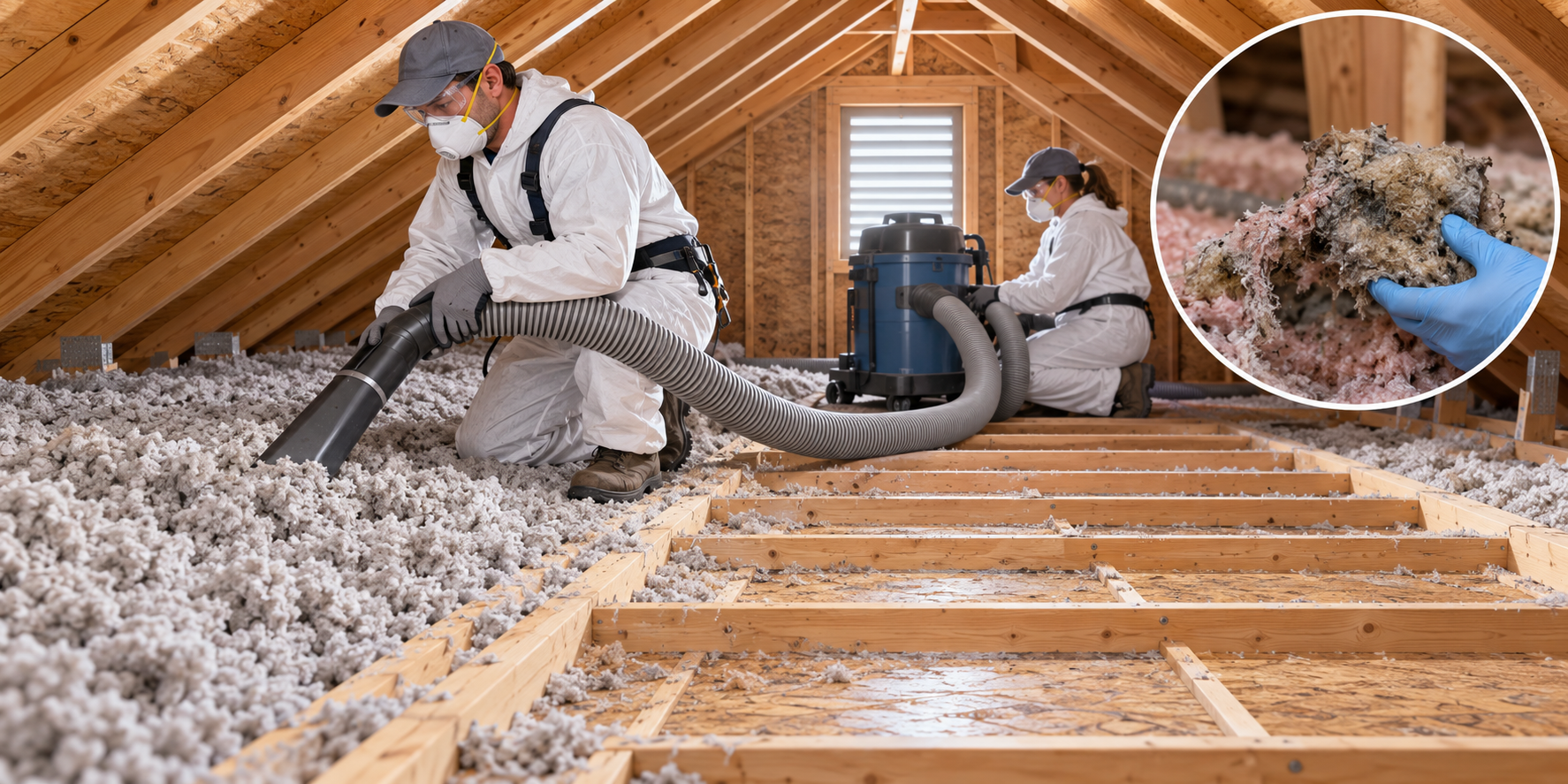
When removal is justified
Removal may be worthwhile when material is wet, heavily compressed, badly contaminated, uneven enough to prevent a competent retrofit, or positioned over leakage paths that must be repaired. It can also make sense when a contractor needs a clean surface to change the assembly or when previous material prevents inspection of important details.
Removal is not automatically an improvement. Dry, undamaged insulation may remain if it has adequate coverage, does not hide a moisture problem, and can be supplemented safely. Ask for a written reason for removal and a comparison with moving, leaving, or topping up the existing material.
Routine removal versus escalation
The core scope here is ordinary, non-hazardous insulation. Vacuum removal of loose blown material and hand removal of batts may have different labor and access requirements. A routine quote should identify containment, equipment, bags or bins, travel, disposal, cleanup, and preparation for new work.
Do not treat suspected vermiculite, asbestos, mold, extensive pest waste, fire loss, or sewage contamination as routine removal. Those conditions can require testing, specialized containment, remediation, or restoration. They may also require a different contractor and a different budget. The right answer is to pause and obtain the qualified assessment rather than bury the material under new insulation.
What drives cost
Expect the price to change with:
- attic area, insulation depth, and material type;
- hatch size, attic height, and distance to the disposal point;
- whether the installer uses a vacuum or manual handling;
- protection for finished rooms and contents below;
- access through low eaves, knee walls, or multiple attic zones;
- air sealing, hatch repair, baffles, or fixture clearances after removal;
- disposal charges and local waste rules;
- the cost of new insulation and finish restoration.
Deep material can take longer to remove than to install. A rural or remote project may pay for travel and disposal transport. A small attic may still carry a contractor minimum charge because setup, protection, and cleanup are fixed tasks.
The correct sequence
Removal is often most valuable because it exposes the attic floor for inspection. Correct roof leaks, exhaust termination, wet framing, unsafe wiring, and other prerequisites before new insulation is installed. Air sealing is generally easier before the new material covers the work. The contractor should also preserve intended ventilation at the eaves and keep access to equipment.
Wet insulation should not be covered while the source remains unresolved. A moisture stain can reflect a roof leak, interior air leakage, indoor humidity, or exhaust problem. If mold or structural damage is present, ordinary insulation replacement is not the whole repair.
Replacement options
After removal, the quote should identify the replacement material, coverage, target or design basis, depth or thickness, air sealing, edge treatment, and any baffles. Blown-in fibrous insulation may suit an accessible attic floor. Batts may fit open regular areas but can leave gaps around obstructions. Spray foam is a different assembly strategy and requires product and local suitability checks. No material is universally best.
How to compare two quotes
Request a scope with separate lines for removal, disposal, air sealing, preparation, new insulation, restoration, and testing. Ask what happens if the crew finds wet wood, suspect insulation, pests, damaged wiring, or a roof defect. Compare whether the quote includes cleanup and whether it protects finished surfaces.
For U.S. and Canadian jobs, keep local currency and market assumptions separate. A U.S. removal guide does not establish a Canadian price, and a Canadian attic-insulation observation does not establish removal cost. Use local quotes that state the actual access and disposal assumptions.
Removal is worth its premium when the existing material blocks necessary work or represents a real condition problem. It is wasteful when it is performed only to make a new layer look cleaner. The decision should connect the removal to a repair, a verified assembly need, or a meaningful improvement in the quality of the new installation.
A removal decision should answer three questions
First, what condition makes removal necessary? It may be wet material, severe gaps, compressed areas, contamination, poor access to air bypasses, or a planned change in the assembly. Second, what will the crew do after removal? The sequence may include drying, roof or exhaust repair, air sealing, clearance work, and preparation. Third, what will remain outside the scope? Hazard abatement, pest treatment, mold remediation, structural repair, and post-loss reconstruction should not be hidden inside an ordinary removal allowance.
If a contractor cannot explain the reason for removal, ask whether a targeted inspection or a leave-and-top-up option is possible. Dry, sound insulation can sometimes remain in place. The decision depends on coverage, depth, contamination, access, and the intended retrofit—not on the fact that the material is old or unattractive.
Removal-only, replacement, and escalation
Removal-only work may leave the homeowner with an open attic that still needs air sealing and new insulation. Removal and replacement combines those scopes, but the quote should show whether the new material is included and what target or method is intended. Escalation occurs when the material is wet, pest-contaminated, mold-affected, suspect vermiculite, asbestos-containing, or related to a fire or water loss.
The price can change after the first section is opened. Ask how the contractor will document concealed conditions, whether disposal is by bag or vacuum, how the home will be protected, and how change orders are approved. A contingency is more useful when it states a unit and a triggering condition than when it is an unexplained percentage.
Access and disposal often dominate
A large hatch, a clear attic floor, and ordinary loose-fill material support a more predictable scope. Low eaves, narrow access, finished ceilings, multiple insulation layers, and difficult travel increase labor. Disposal rules and facility fees vary, especially for material that may be contaminated or classified as hazardous. Keep disposal, transport, cleaning, and restoration visible in the quote.
If the project is combined with air sealing or a top-up, compare the total with a staged option. Removing material may improve access to the control plane, but it may also create a second mobilization or expose roof, wiring, or framing issues. The least expensive sequence is the one that avoids covering a problem and then reopening the attic.
Safety and reader boundaries
Do not disturb suspect vermiculite, asbestos, mold, or heavily contaminated material without the appropriate assessment. Do not treat a contractor’s statement that material “looks fine” as a hazard clearance. Similarly, do not cover wet framing, unsafe wiring, hot flues, or an exhaust problem with new insulation.
Ordinary insulation removal is an envelope cost decision. Hazardous-material abatement, pest exclusion, and restoration after a loss are different professional scopes. Keeping them separate makes both the estimate and the next decision more reliable.
For paid U.S. work, check lead-safe requirements if the project will disturb painted access or repair surfaces in covered pre-1978 housing or a child-occupied facility. EPA’s guidance includes some weatherization access work; any minor-repair exception is based on the area of paint disturbed, not the amount of insulation removed. Confirm applicability and any stricter local requirements with the contractor. This does not establish lead in a particular home or Canadian requirements.
Before the new insulation is installed, ask for a record of the cleaned attic, air-sealing work, clearances, moisture condition, and areas that remain untreated. Confirm how the new material will be supported or distributed and how future inspection will be possible. A replacement job is complete when the reason for removal has been addressed, not merely when the old material is gone.
Make the replacement measurable
The estimate should distinguish removal, bagging, transport, disposal, cleaning, surface preparation, air sealing, new insulation, and restoration. If contamination or a regulated material is suspected, the scope should pause for the appropriate assessment rather than burying an allowance inside ordinary insulation work. Ask how the contractor will protect the home during removal and how dust, debris, and loose material will be kept out of living areas.
At completion, retain photos of the cleared attic and the new work before access becomes difficult. Record the approximate installed depth or thickness, the material and product information, clearances, ventilation paths, and any bays left untreated. This documentation helps a future owner understand why the material was replaced and gives a later inspector a baseline for deciding whether a new stain, pest trail, or compressed area is recent or pre-existing.