
Attic air sealing is usually a targeted labor project at the ceiling plane below an attic. A simple, accessible attic may be priced as a small service job, while a cramped attic with deep insulation, finished ceilings below, wiring, flues, moisture, or difficult eaves can become a larger retrofit. The available evidence does not establish a dependable national U.S. or Canadian installed range. Use the quote structure—locations, access, preparation, sealing method, insulation handling, and verification—to compare proposals.
Illustrative planning scenario
For a modest U.S. attic with dry insulation and accessible penetrations, a planning model might allow $1,000–$3,500 for inspection, targeted air sealing, insulation movement, and cleanup. Low eaves, finished ceilings, flues, removal, or follow-up testing can raise the scope. Canadian homeowners should request a local CAD quote rather than convert this allowance.
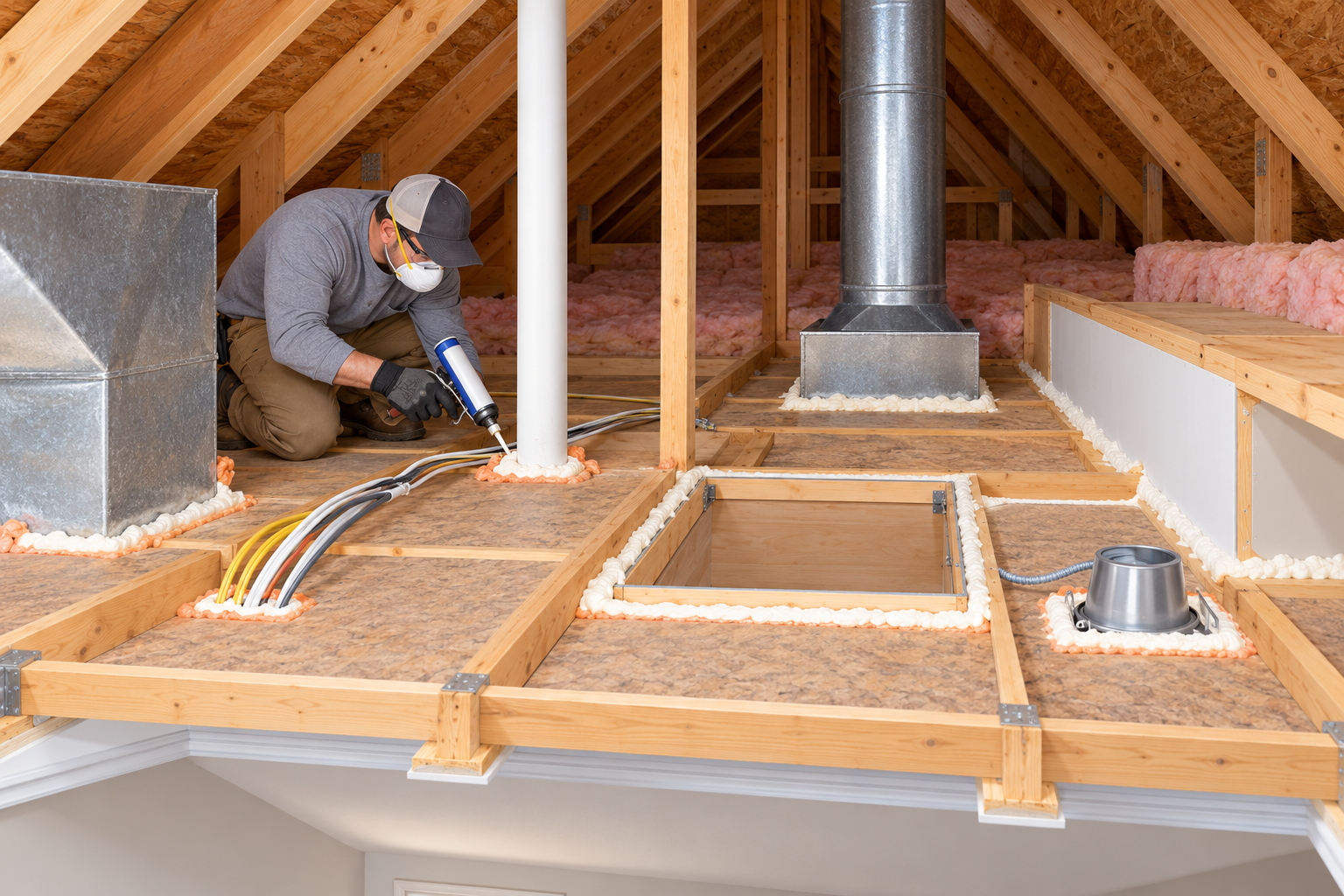
What the contractor is sealing
The work commonly targets penetrations for plumbing, wiring, ducts, and pipes; dropped soffits; ceiling boxes; the attic hatch; open framing joints; and gaps around chases. The goal is continuity at the attic-floor air-control plane. Adding insulation over an unsealed bypass can hide the opening while leaving heat and moisture transport unchanged.
The contractor should also identify places that are not ordinary sealant work. A hot flue, combustion appliance, recessed light, electrical hazard, wet insulation, moldy or rotted rafter, or exhaust outlet in the attic needs an appropriate professional decision. The sealing scope should not cover a condition that has not been corrected or safely detailed.
Simple, typical, and complex scopes
A simple scope may include an accessible hatch, a small number of visible penetrations, and minor movement of clean insulation. A typical scope can involve a blower-door-informed search, many penetrations, soffits, plumbing stacks, wiring paths, and restoration of disturbed insulation. A complex scope may require temporary removal, crawling in low areas, protection of finished rooms, careful work near fixtures and flues, or coordination with roofing, electrical, HVAC, or remediation contractors.
Contractor minimum charges matter. A small attic may not cost proportionally less if the mobilization, setup, protection, and cleanup are the same as for a larger job. Ask whether the price is for an hour of sealing, a defined list of locations, or a complete attic-floor scope.
What changes the quote
Expect the price to move with:
- attic height, floor area, and the number of roof sections;
- insulation depth, condition, and whether it must be moved or removed;
- the number and size of bypasses and penetrations;
- access through a small hatch or a finished ceiling;
- clearances around lights, wires, pipes, flues, and combustion equipment;
- need for a blower-door or infrared investigation;
- protection, cleanup, and minor restoration;
- subsequent insulation top-up or replacement.
Attic air sealing is often bundled with insulation because the attic is already open to the installer. That can reduce duplicated mobilization, but do not let a bundled price hide whether sealing is actually included. Ask for separate line items so you can compare a seal-only option, a seal-plus-insulation option, and any removal or remediation option.
Moisture and ventilation checks
Air leakage can carry warm, moist indoor air into a cold attic. Other causes of attic moisture include roof leaks, flashing failures, exhaust that terminates in the attic, high indoor humidity, and ventilation conditions. A moisture stain is not proof that air sealing alone is the cure. Wet insulation should not be covered until the moisture source is corrected and the material is dry.
The project may also interact with intentional ventilation and combustion safety. Do not block a designed ventilation path, alter a flue clearance, or seal around a fixture from a generic instruction. The installer should document what was checked and identify any work belonging to roofing, HVAC, electrical, or environmental specialists.
How to evaluate an air-sealing quote
Ask for a location map or room-by-room description, the material and method, access assumptions, insulation handling, protection, cleanup, and exclusions. Ask whether the contractor will test before and after, and what result the test can actually establish. A lower leakage number does not guarantee a fixed energy saving or eliminate the need for suitable ventilation.
If the quote says “seal all attic leaks,” ask how inaccessible areas are treated. If it promises to fix condensation or ice dams, ask which competing causes were considered. Roof repairs, exhaust relocation, mold removal, and structural repair may be separate scopes.
U.S. and Canadian pricing
The U.S. and Canada share the air-sealing sequence but not necessarily labor rates, climate conditions, code requirements, or contractor terminology. The evidence supports the principle of sealing before adding attic insulation, not a universal price or a universal material prescription. Request market-specific quotes in the local currency. Do not convert a U.S. allowance into Canadian dollars and present it as Canadian evidence.
Attic air sealing is worth budgeting separately because it can determine whether later insulation work performs as intended. The best quote describes the air boundary, reaches the important paths safely, corrects prerequisites first, and makes clear what the price does not include.
What a complete attic scope should show
Ask for a simple attic sketch or marked-up description. It should identify the ceiling plane, dropped soffits, knee-wall transitions, hatch, plumbing and wiring penetrations, ducts, flues, recessed fixtures, and places where insulation will be moved. The point is not to promise that every microscopic gap will be found. It is to show that the installer has a method for prioritizing the paths most likely to transport air and moisture.
The scope should also say how the installer will protect the rooms below, walk on the framing, manage dust, and restore disturbed insulation. A contractor who prices only “foam and caulk” may not have included the labor that makes a difficult attic workable. A contractor who prices a complete job should identify the assumptions that would pause work, such as wet insulation, rotted framing, suspect vermiculite, or unsafe wiring.
Low, typical, and high-complexity examples
The low-complexity example is a reachable attic with a large hatch, dry insulation, a small number of visible penetrations, and no unusual utilities. The typical example includes many ceiling penetrations, open chases, an attic hatch, edge details, insulation movement, and a diagnostic-informed search. The high-complexity example includes low eaves, finished ceilings, multiple roof sections, contaminated material, combustion equipment, or restoration after access.
These are scope classes, not promises about a national price. A small home can be expensive if the work is difficult; a larger open attic can be efficient if the same details are reachable. Contractor minimums, travel, setup, and protection make a strict price-per-square-foot comparison unreliable.
Verification after sealing
Ask how the completed work will be checked. A visual inspection can confirm that listed locations were reached. A blower-door test can compare measured airtightness when the test conditions and scope are comparable. Infrared or smoke investigation may help identify remaining paths, but no test guarantees a specific utility-bill result.
If the quote promises to eliminate drafts, condensation, or ice dams, ask which other causes were considered and what remains outside the work. A roof leak, exhaust termination, high humidity, HVAC issue, and opening defect require different corrections. A good completion check describes the result without turning an uncertain symptom into an absolute guarantee.
When not to proceed as ordinary sealing
Pause and obtain the right specialist when insulation is wet, rafters are moldy or rotted, an exhaust fan terminates in the attic, a flue or combustion appliance is involved, knob-and-tube wiring is present, or the attic has suspect vermiculite. Those conditions can affect safety, fire, health, moisture, and assembly design. They are not simply higher-priced versions of the same sealing task.
Attic air sealing is most valuable when the quote connects the diagnosis, safe access, control-layer detail, insulation sequence, and completion check. That chain is what makes the price meaningful.
Compare the project by sequence
Ask the contractor to show the order of operations: inspect the attic and combustion appliances, protect the work area, seal accessible bypasses, correct exhaust-duct terminations, verify clearances, install or redistribute insulation, and inspect the finished work. A low quote that skips the inspection or completion check may leave the homeowner paying for insulation over an open bypass. A higher quote may be justified when it includes difficult access, removal and replacement, electrical corrections, or repairs at the ceiling plane.
The final scope should name areas that cannot be reached and conditions that would stop work. It should also say how the owner will know whether the dominant leakage paths were treated. Photographs before insulation is placed, a marked attic plan, and notes about remaining openings make the result easier to verify and help prevent the same bypasses from being reopened during later roofing, wiring, or ventilation work.