
“Weatherization” does not describe one standardized product. It may mean a small package of draft control and attic work, a government or utility program with defined measures, or a private whole-house retrofit that combines air sealing, insulation, testing, and repairs. That is why two weatherization quotes can have very different prices while both use the same word.
Illustrative planning scenario
For a 1,500-square-foot U.S. house, a priority weatherization package might be modeled at $3,000–$8,000 for assessment, attic air sealing, and one insulation area; a broader multi-assembly package might be $8,000–$20,000 before major repairs, HVAC work, or finishes. Program scopes vary. Canadian homeowners should obtain a local CAD quote.
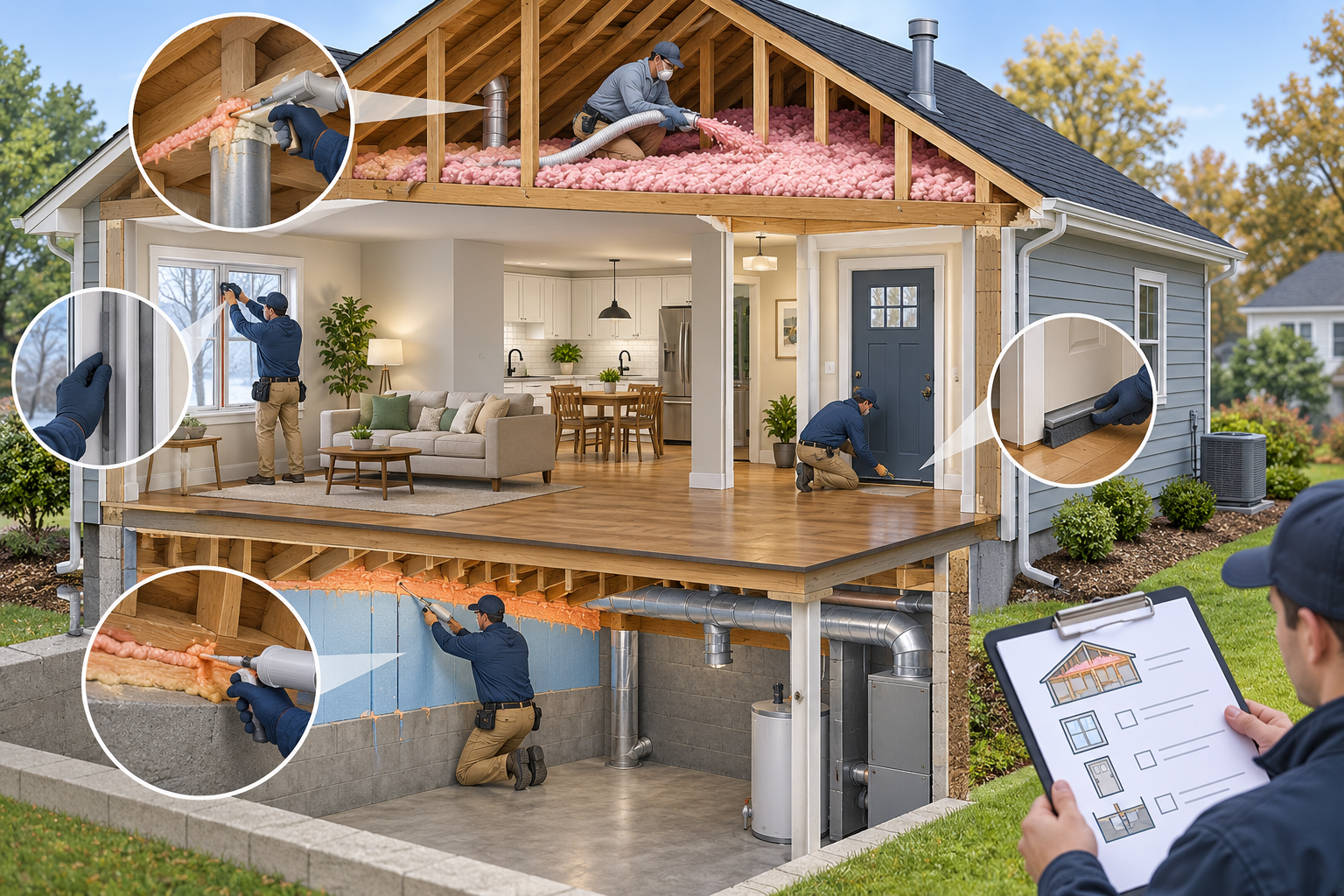
A useful way to budget the package
Think in tiers rather than one national average. A limited package may address an attic hatch, obvious bypasses, weatherstripping, and a modest insulation top-up. A mid-sized package may add blower-door-guided air sealing, attic work, rim or basement transitions, and insulation at one or two priority assemblies. A major package may include multiple assemblies, removal, finish restoration, moisture correction, diagnostic testing, and several visits.
The available evidence does not establish a comparable U.S. and Canadian whole-home weatherization price. The Canadian attic observations in the research are not a whole-home total, and a U.S. attic figure is not a Canadian allowance. Ask for a local scope in the applicable currency and treat any program estimate as program-specific.
What may be included
A clear package may list:
- assessment, utility-bill review, blower-door or infrared testing;
- attic-floor air sealing and insulation;
- rim-joist, basement, crawl-space, or floor work;
- weatherstripping and caulking at selected openings;
- minor access, protection, insulation movement, cleanup, and disposal;
- post-work testing or a report.
It should also list what is excluded. Window or door replacement, roof repairs, siding, structural work, mold cleanup, hazardous-material removal, major HVAC changes, electrical corrections, and below-grade drainage are not automatically weatherization. A broader retrofit may coordinate them, but the homeowner should see separate scopes and prices.
Why sequence affects cost
Air leakage, insulation, moisture, and ventilation interact. A contractor may recommend investigating leakage before adding insulation, correcting a roof or exhaust problem before covering wet material, or addressing a water problem before insulating a basement or crawl space. The cheapest sequence is not always the lowest first invoice; it is the sequence that avoids removing newly installed work.
Bundling can save mobilization when the same attic or wall is already open. It can also increase risk if a simple package becomes a collection of unverified repairs. Ask which work is essential, which is optional, and which is a contingent allowance if an opening reveals damage.
Program scope versus private scope
Government, utility, nonprofit, and contractor programs can define weatherization differently. They may restrict income, property type, measures, contractors, inspections, or eligible costs. Natural Resources Canada currently says the federal Canada Greener Homes Grant is closed, while other provincial, territorial, utility, or local programs may have different status and rules. Verify current eligibility directly with the program authority. Do not treat a program’s measure list as a universal building-science prescription.
Major price drivers
The size of the building is only a starting point. Costs move with:
- the number of assemblies and transitions;
- attic and crawl-space access;
- finished walls or ceilings that need protection and restoration;
- insulation depth, contamination, moisture, and disposal;
- diagnostic and reporting requirements;
- travel, rural location, and contractor minimum charges;
- electrical, flue, HVAC, roof, or structural coordination;
- whether work is performed during another renovation.
A package that sounds comprehensive may still exclude the expensive parts. Ask if the price includes lifting or removing insulation, patching drill holes, extending trim, restoring drywall, relocating exhaust, or correcting the water source.
How to compare a bundled quote
Request three views where possible: a priority-only scope, a coordinated package, and a larger multi-area option. For each, identify the assembly, area, method, target or design assumption, tests, expected result, and exclusions. Compare the work sequence and the unresolved conditions, not just the total.
Avoid guaranteed savings claims. Energy use depends on weather, occupancy, fuel and electricity prices, equipment efficiency, controls, and pre-retrofit conditions. Comfort and durability can be valuable even when payback is slow, but they should be discussed as benefits rather than converted into a promised percentage.
When weatherization is the wrong label
If the urgent issue is active water entry, mold, unsafe wiring, a failing HVAC system, a roof leak, or a structural defect, solve that dominant problem first. A weatherization package can follow, but it should not conceal the reason the house is wet, unsafe, or out of balance. Similarly, a whole-home energy transition with service capacity and equipment changes belongs with a broader energy-retrofit plan.
Weatherization is economically useful when it is a defined sequence of enclosure decisions. Ask the contractor to show which measures address leakage, which address heat flow, which correct prerequisites, and which simply become possible because the building is already open.
How to test whether a package is complete
Read the quote from the building outward. It should say what was assessed, which assemblies are included, what existing insulation or moisture conditions were found, how air sealing connects to insulation, and how work at openings, roof lines, floors, and foundation transitions is handled. It should also state what is excluded: roof repair, siding, replacement windows, major HVAC work, structural repair, hazardous materials, water management, and finish restoration may all be separate.
Ask for a priority-only option and a coordinated option. The priority scope may address the attic and largest leakage paths. The coordinated scope may add rim, crawl-space, floor, or wall work while access is available. A comprehensive option should show whether the additional work produces a meaningful result or only increases the quantity of material.
Program terms are not universal project definitions
A utility, nonprofit, government, or private contractor may use “weatherization” to mean a different set of measures. A program can limit income, property type, contractor, inspection, or eligible work. In the United States, the Department of Energy’s Weatherization Assistance Program is administered locally; households must check their state, territory, or Tribal administrator for current eligibility and a local provider. In Canada, Natural Resources Canada’s Canada Greener Homes Affordability Program page currently lists participating provincial routes for no-cost retrofits for eligible low- to median-income households. Applications go through the relevant provincial or territorial program, not the federal site, and the listed pathways can change. Check the official U.S. WAP application route or Canadian CGHAP pathways before assuming a program will cover an assessment or measure. Never put unconfirmed assistance in the base project budget.
Keep indoor air and safety in the work sequence
Energy upgrades can change how air and moisture move through a home. DOE Building America guidance puts safety and durability before fresh air, moisture protection, draft reduction, and thermal comfort. EPA’s retrofit guidance highlights that tightening or disturbing materials can affect combustion, ventilation, pollutants, and moisture. Ask whether those conditions were assessed before the package was priced and which specialist handles any issue outside the weatherization crew’s scope. These are screening frameworks, not instructions for DIY hazard work or a guarantee that a program’s measure list fits a particular building.
When a bundled package improves value
Bundling can reduce travel and setup, avoid reopening a finished surface, and make it easier to connect air and insulation layers. It can be especially useful when a roof, siding, basement, or interior project is already scheduled. It can also create coordination risk if different trades do not share a wall or attic detail. Put the sequence, handoffs, weather protection, inspection, and restoration responsibilities in writing.
Do not accept a guaranteed bill reduction from a package with no baseline or measurement plan. Comfort, durability, and reduced drafts may be meaningful benefits, but energy savings are affected by the house and the people using it. The strongest weatherization budget is a transparent set of scopes that can be approved, deferred, or compared separately.
A package should have a stopping point
Ask what work is essential to the package, what is an optional improvement, and what is contingent on opening an assembly. The quote should identify the point at which the contractor stops for owner approval rather than allowing a routine weatherization job to absorb roof, structural, environmental, or HVAC work without a new decision.
Ask how the work will be checked: a visual inspection, a measured airtightness comparison, documented insulation coverage, a moisture check, or another defined result. The check should match the promise. If the package is sold for comfort, explain which rooms and surfaces are expected to change. If it is sold for energy, state the assumptions and avoid a universal savings guarantee.
Weatherization is most useful when it turns several related measures into a sequence the homeowner can understand. It is least useful when the word replaces a scope.
Ask for a measure-by-measure plan
The phrase “weatherization” may cover an assessment, air sealing, insulation, duct work, moisture correction, ventilation, minor repairs, or several of these together. Ask for each measure to be listed with its location, reason, quantity or allowance, trade, safety dependency, and completion check. This makes a bundled quote comparable with separate proposals and shows whether a low-cost repair should happen before a larger insulation measure.
The plan should identify conditions that stop or change the work, including wet assemblies, unsafe wiring, combustion concerns, pest damage, inaccessible areas, or a roof or drainage defect. Keep the assessment, scope, photos, materials, and follow-up notes together. A staged weatherization project can be effective, but its value depends on making the sequence and the limits visible to the homeowner.