
Ice-dam prevention can involve attic air sealing and insulation, roof ventilation or membrane work, drainage, snow management, or several of these at once. This guide focuses on the envelope-side work that addresses heat loss and heat movement into a cold roof space. Roof coverings, roof membranes, and roof-system ventilation remain a roofing scope when they are the dominant intervention.
Illustrative planning scenario
For a modest U.S. home, a winter diagnosis and targeted attic correction might be modeled at $1,500–$5,000 for air sealing, insulation adjustment, and edge detailing. Recurring snow or ice removal, roof repair, membrane work, and major ventilation changes are separate scopes. Canadian homeowners should obtain local CAD quotes rather than convert this allowance.
Why ice dams lead to several possible quotes
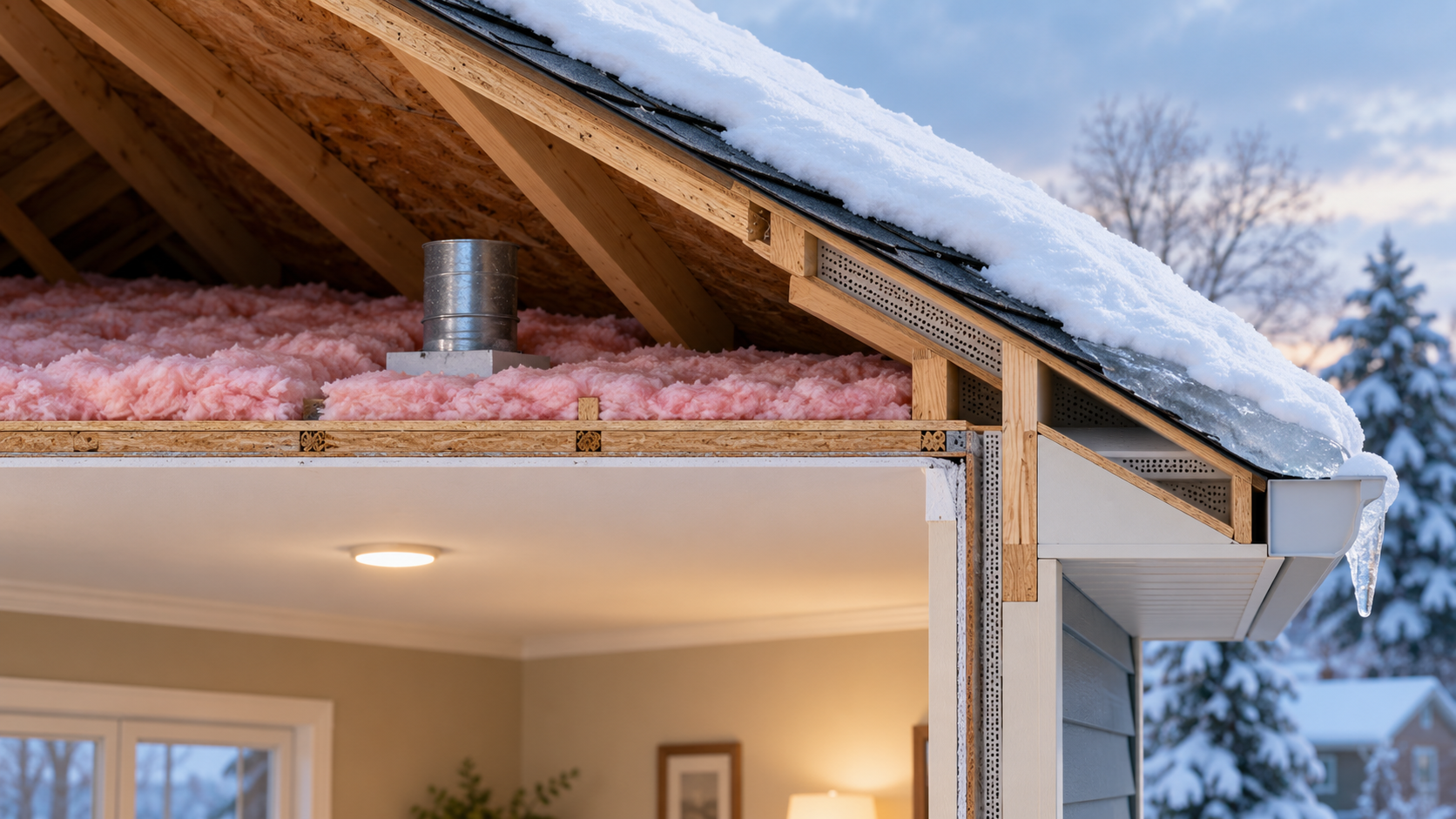
An ice dam forms when snow on a roof melts and refreezes near a colder roof edge, but the conditions behind that pattern can vary. Heat loss through the ceiling, air leakage carrying warm air into the attic, insulation gaps, thermal bridges, roof geometry, ventilation, snow exposure, and weather can interact. A roof leak or failed flashing can create water damage that looks related but needs a different repair.
ENERGY STAR identifies attic air sealing and insulation as measures that can help reduce heat loss and ice-dam risk. That is not a guarantee that every ice dam is caused by one attic bypass or that enclosure work alone will solve it. The quote should state which cause is being addressed and which roof conditions remain outside the project.
The diagnostic and correction sequence
A useful first step may be a roof-and-attic inspection that looks at insulation distribution, ceiling penetrations, roof leaks, flashing, exhaust termination, ventilation, and difficult eaves. A blower-door or infrared investigation can help locate heat or air movement when conditions are suitable. The diagnostic scope should distinguish evidence from an assumption based only on a visible roof edge.
If air leakage is found at the attic floor, sealing normally precedes adding insulation. Dry, sound insulation may be redistributed or topped up. Wet or contaminated insulation should not be covered until its source is corrected and it is handled appropriately. The work may require a roof repair, exhaust correction, or environmental assessment before the insulation project can proceed.
Cost tiers
A limited envelope correction may include an accessible hatch, obvious penetrations, and minor insulation adjustment. A typical project can include diagnostic work, multiple bypasses, edge and knee-wall details, and an attic-insulation top-up. A complex project may involve finished attic ceilings, narrow eaves, removal and disposal, roof-side access, finish restoration, or coordination with a roof replacement.
The available market observations are directional rather than a universal ice-dam price. Ask for separate prices for diagnosis, attic air sealing, insulation, insulation removal, roof-system work, snow or ice treatment, and restoration. A lower quote for heat cables or roof raking is not a substitute for an enclosure correction; it addresses a different decision and may be recurring or weather-dependent.
Attic access and difficult assemblies
An open attic floor provides the most direct access to the ceiling plane. A finished half-story, cathedral ceiling, or shallow roof assembly may require interior demolition, roof-side access during re-roofing, dense-pack methods, or a designed roof-deck conversion. The cost can rise because the installer must preserve ventilation or redesign the assembly, extend finishes, protect rooms, and restore surfaces.
Do not assume that more insulation can be blown into every roof edge. Baffles, eaves, penetrations, flues, recessed lights, wiring, and existing damage affect the feasible scope. A contractor should explain how the proposed work maintains clearances and the intended air and moisture control layers.
When roof work is also required
Roof coverings, flashing, underlayment, roof ventilation, and membrane details belong with the roofing category when they are the main repair. They may still be coordinated with insulation and air sealing because a roof replacement can create temporary access to the roof assembly. A combined quote should separate the two scopes so that the homeowner can tell whether the ice-dam strategy is enclosure correction, roof-system correction, or both.
If the roof leaks, the leak source takes priority over adding insulation. If an exhaust fan terminates in the attic, the route must be corrected before the symptom is treated as a purely thermal problem. If mold, suspect vermiculite, rot, or structural damage is found, the project needs qualified escalation rather than a generic prevention allowance.
How to judge the result
Ask whether the contractor will document the corrected air paths, insulation coverage, roof details, and any unresolved conditions. No envelope contractor can promise identical snow behavior under every storm. Roof geometry, wind, shade, snowfall, and temperature can still produce localized ice. The useful result is a better-defined and more durable roof-and-attic condition, not a claim that one product eliminates weather risk.
Roof-edge details that change the scope
Eaves are difficult because the roof, attic, ceiling plane, insulation, ventilation path, and exterior drainage meet in a limited space. A quote should say whether the crew will inspect from the attic, remove roof material, or open an interior finish. Each access method has different protection and restoration needs. If the attic-floor insulation is adjusted, ask how the intake path and required clearances will remain open; if the roof deck is changed, ask for the assembly detail and the intended drying strategy.
Roof geometry can limit a standard correction. Valleys, dormers, kneewalls, shallow slopes, cathedral ceilings, and inaccessible corners may need separate details rather than a uniform square-foot allowance. The estimator should mark the areas that can be reached and identify those that require a second trade or a planned opening. Request separate prices for roof-covering work, flashing, attic air sealing, insulation, baffles, and interior restoration so the owner can compare the actual cause being corrected.
A good proposal also states what is not included: snow removal, emergency water protection, gutter changes, damaged roof sheathing, or environmental cleanup. Those are not necessarily part of an insulation or air-sealing price. If a concealed condition changes the work, require photographs, a unit or time allowance, and written approval before the crew proceeds. This makes the contingency useful without turning the project into an open-ended roof repair.
If water is entering now, ask for an immediate protection plan and a separate permanent-repair scope. Temporary measures may limit damage while weather prevents roof work, but they should not be described as proof that the attic heat-loss path has been corrected. Keep the emergency visit, permanent repair, and any interior drying or restoration visible as separate decisions.
U.S. and Canadian pricing
Ice-dam physics is shared, but winter exposure, roof construction, labor, code requirements, and contractor markets vary. The evidence does not support converting U.S. insulation or sealing figures into Canadian prices. Keep local currencies and equivalent scopes separate. Ask for a market-specific quote that shows assumptions and exclusions.
The strongest prevention budget treats the ice dam as a clue about the roof-and-attic system. It pays for the correction that matches the cause and keeps roof work, ventilation equipment, hazardous materials, and restoration in their proper scopes.
Sequence the roof and attic decision
Start by recording where ice forms, whether water enters, which roof areas are involved, recent weather, and any prior roof or attic work. Then ask for an inspection that considers the roof covering and flashing, attic insulation, ceiling penetrations, exhaust routes, ventilation, and difficult roof geometry. An enclosure correction cannot repair an active roof leak, and a roof repair cannot correct a large attic bypass by itself.
If the evidence points to heat loss and air leakage, compare attic air sealing and insulation with the existing roof and ventilation conditions. If a contractor recommends roof work, require that scope to be priced separately from the enclosure work. A recurring treatment such as roof raking or heat cables may address immediate exposure but has different maintenance and performance limits from a durable correction. No approach can promise identical snow behavior under every storm.
Specify the roof-edge work and its check
The estimate should identify the mechanism addressed and list the relevant eaves, valleys, penetrations, gutters, baffles, exhausts, insulation, and roof details. Separate snow or ice removal, roof repair, ventilation changes, air sealing, insulation adjustment, and interior restoration. State how wet or contaminated material, rot, wiring, or concealed roof defects pause or change the work, and how the owner approves a change.
Request photographs of the attic-side transitions before they are concealed and record the locations of prior dams and the weather conditions. After work, have the contractor document the corrected air paths, insulation coverage, roof details, and unresolved conditions. The follow-up should say what symptoms may remain and when another check is appropriate; it should not promise that a single inspection removes all weather risk.