
“Worth it” can mean different things: a better resale position, fewer maintenance risks, safer access, daily comfort, or avoiding a larger repair later. A bathroom remodel does not have a universal return, and modeled cost-versus-value figures are observations for defined projects and markets—not a promise about one home.
Define the payoff before the project
Write down the problem the remodel should solve. A failed shower, poor circulation, recurring moisture, inaccessible tub, or damaged floor has a different value case from a purely cosmetic update. Then identify the minimum scope that solves it and the optional improvements that make the room more enjoyable.
| Main objective | What to compare |
|---|---|
| Prevent damage | Source correction, waterproofing or finish scope, concealed-condition risk, and the cost of delay |
| Improve usability | Layout, storage, controls, bathing access, and daily disruption |
| Prepare for aging in place | Current needs, likely future needs, structural backing, circulation, and adaptable fixtures |
| Prepare for sale | Condition, buyer expectations, local comparables, timing, and whether over-improvement is likely |
| Update appearance | Refresh or partial remodel versus the cost and risk of opening sound assemblies |
Resale numbers need context
Remodeling value studies use a defined project, year, and market. They do not guarantee that a homeowner will recover a fixed amount. Local housing supply, buyer expectations, finish level, workmanship, remaining defects, and time to sale can change the result. A modeled return also does not include every disruption, financing cost, or maintenance outcome.
The 2025 JLC/Zonda report offers a U.S. comparison across defined project models. Its modeled costs and Realtor-estimated resale values were:
| Report-defined project | Modeled cost (USD) | Estimated resale value (USD) | Reported cost recouped |
|---|---|---|---|
| Midrange bathroom remodel | 26,138 | 20,915 | 80% |
| Universal-design bathroom remodel | 42,183 | 25,812 | 61% |
| Upscale bathroom remodel | 81,612 | 34,000 | 42% |
The report combines indexed project-cost data with Realtor estimates across 119 U.S. markets; these are modeled benchmarks, not recorded sale results for a particular home. The midrange scenario specifies an update to an existing 5-by-7-foot bathroom, while the other rows have their own defined scopes. They do not forecast Canadian value, a current local quote, or what a buyer will pay for your project.
Use resale evidence as one input. Do not choose a premium fixture or a complete gut solely because a national percentage suggests a return. A clean, functional, appropriately scoped bathroom may be a better decision than an expensive finish package that does not fit the home.
Condition changes the decision
Deferring cosmetic work may be reasonable when the room is functional and dry. Deferring a known leak, recurring moisture, failed waterproofing, or deteriorating substrate can increase damage and reduce future choices. EPA guidance treats fixing leaks and controlling moisture as distinct from appearance work. A professional assessment is appropriate when the visible symptom does not reveal the failed layer.
Accessibility and long-term use
NAHB guidance identifies features such as wall support for grab bars, curbless showers, seating, handheld controls, maneuvering space, and slip-resistant surfaces. These are planning examples, not a universal prescription or private-home code. Their value depends on the occupant’s capabilities, caregiving needs, and the room’s structure. A targeted bathroom adaptation can be worthwhile even when resale value is uncertain because it changes daily use.
Three decision scenarios
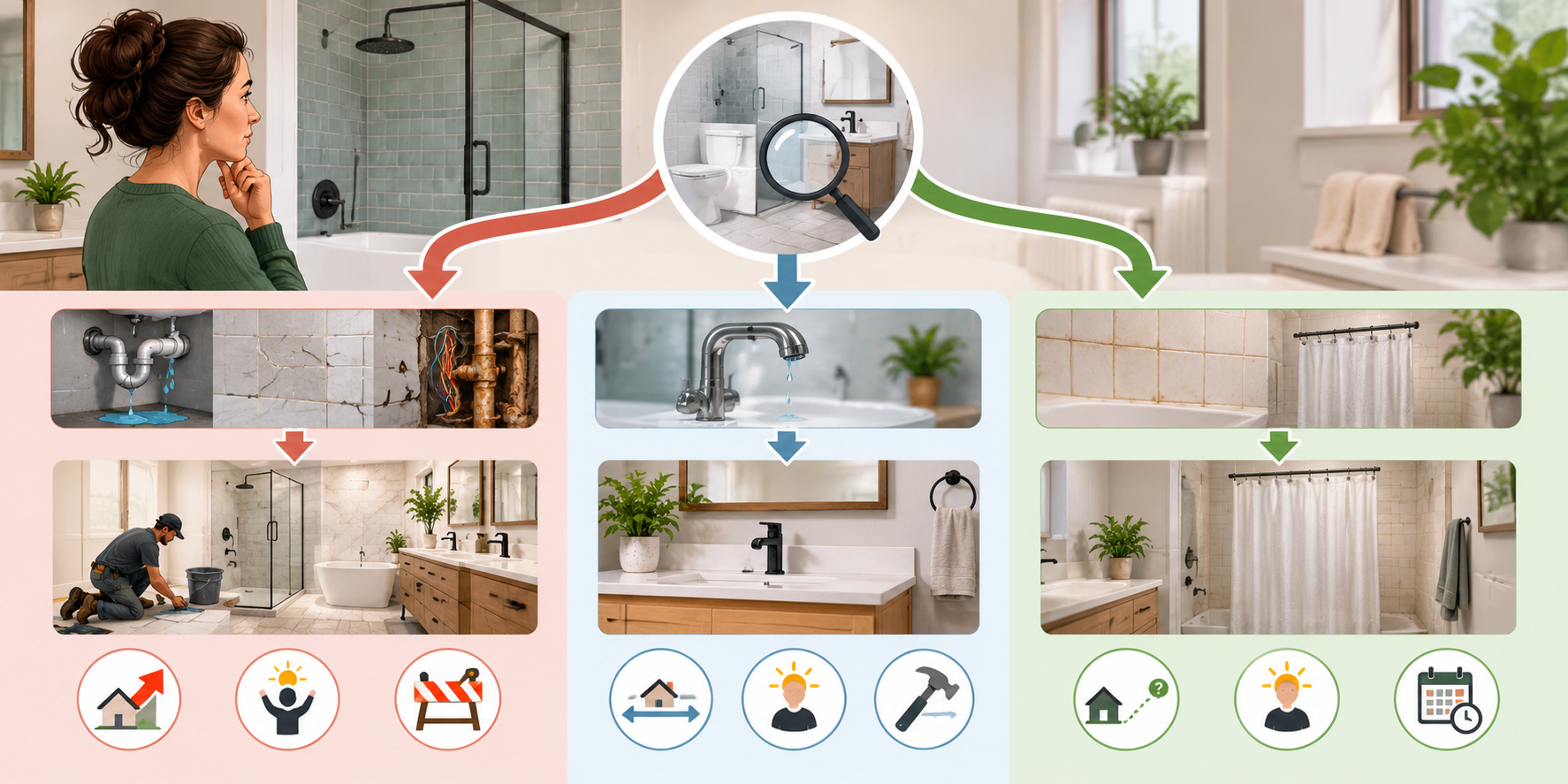
Remodel now: A functional or safety problem is active, several systems are already being opened, or the household expects to use the room long enough to benefit from the improvement.
Limit the scope: The wet area and layout are sound, but finishes or one fixture no longer fit the budget. Price a refresh or partial remodel and retain capital for the system that actually needs work.
Defer with a plan: The problem is cosmetic and the future project is likely to change the layout. Document the condition, monitor active moisture, and avoid installing finishes that will be removed soon.
The remodel is worth considering when its defined outcome matters more than an abstract return percentage. Compare base scope, concealed risk, disruption, ownership horizon, and the cost of doing the same work later.