
There is no national remodel-cost threshold that tells every household when to move. Compare the home’s physical constraints, the work required, the cost of a suitable alternative, and the life the household wants to lead. A financial spreadsheet can organize the decision, but it cannot assign a reliable dollar value to community, routine, privacy, or the emotional meaning of home.
Calculate the cost of staying
List current work and likely follow-on work separately. Include assessment, design, permits, construction, equipment, temporary accommodation, maintenance, and a contingency for concealed conditions. Map the whole routine: parking, entry, bedroom, bathroom, kitchen, laundry, and the route between them. A low-cost isolated change may not solve the important route; a substantial project may be avoidable if essential living can move to one floor.
Request local quotes against a defined scope. Ask what assumptions depend on opening a wall or floor and whether the work affects structure, drainage, utilities, egress, or shared property. Compare a minimum workable phase, a broader remodel, and any addition or lift that serves the same daily activities.
Calculate the cost of moving
Estimate transaction expenses, moving, storage, repairs needed before sale, carrying costs, and the purchase price or rent of a genuinely suitable home. Include the cost of changing location: transportation, services, support network, taxes, insurance, and recurring maintenance can matter as much as the asking price.
Inspect the actual alternative rather than relying on a listing label. Check the entrance, bedroom and bathroom routes, thresholds, turning areas, usable shower, storage, parking, and space for anyone who provides support. Ask whether modifications would be allowed and whether a condominium or rental approval process affects the plan.
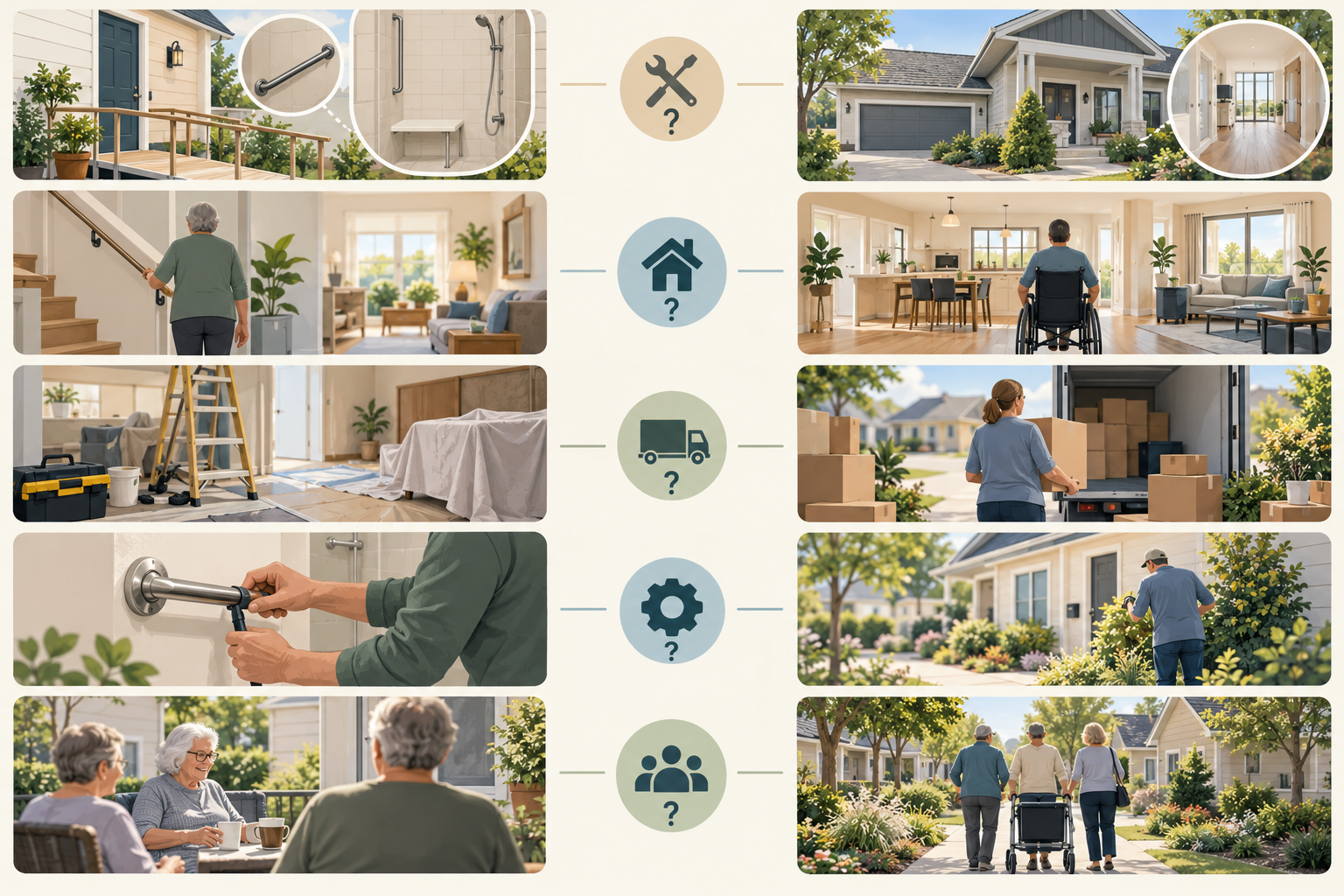
Compare scenarios over time
Use the same planning horizon for each option and identify what is included. A short horizon may emphasize transaction costs and immediate construction; a longer one may include maintenance, future room changes, or resale uncertainty. You can compare:
- a limited safety and usability phase;
- a larger retrofit that supports more of the daily routine;
- an addition or first-floor conversion;
- a move to a home that fits the desired activities; and
- a temporary bridge while a longer decision is made.
Do not turn these scenarios into a false break-even point. Quotes are estimates, future needs are uncertain, and suitable homes may not be available at the modeled price. Show which assumptions would change the decision, such as a second bathroom renovation, a major structural discovery, or a change in caregiver availability.
Include nonfinancial constraints
Consider disruption during construction, the ability to remain at home, the loss of a room, privacy, the household’s willingness to maintain equipment, and access to family or community. Moving may reduce building constraints but introduce a new location and support burden. Staying may preserve routine but require ongoing work.
A useful decision can be “stay for now and reassess after this phase.” Set a review trigger, such as a planned bathroom remodel, an unreliable temporary solution, or a change in the household’s ability to use stairs. Document the assumptions so the comparison can be updated when real quotes and housing choices are available.
Talk with the household members affected, obtain professional input for uncertain building conditions, and compare only homes and remodels that serve the same routine. The better option is the one that meets the household’s priorities with a workable plan for cost, disruption, and future change.
Write down the assumptions that matter
A comparison is easier to revisit when its assumptions are visible. Record the quote date, the work included, expected schedule, room availability, and whether the estimate depends on concealed conditions. For a home search, save the floor plan and inspect the routes and rooms rather than relying on an accessibility label. Keep transaction costs, recurring housing costs, and likely adaptations in separate lines.
Test what happens if the preferred option changes. If the remodel reveals structural work, could a smaller phase still solve the most important activity? If a suitable home becomes available, which costs or timing assumptions would have to be updated? If moving would disrupt a support network, what would replace that support?
There may be no final answer until a home is inspected and bids are received. A decision to remain temporarily while collecting quotes can be reasonable when the household has a workable interim arrangement. Set a date or event to revisit the comparison so that “later” does not become an unexamined default.