
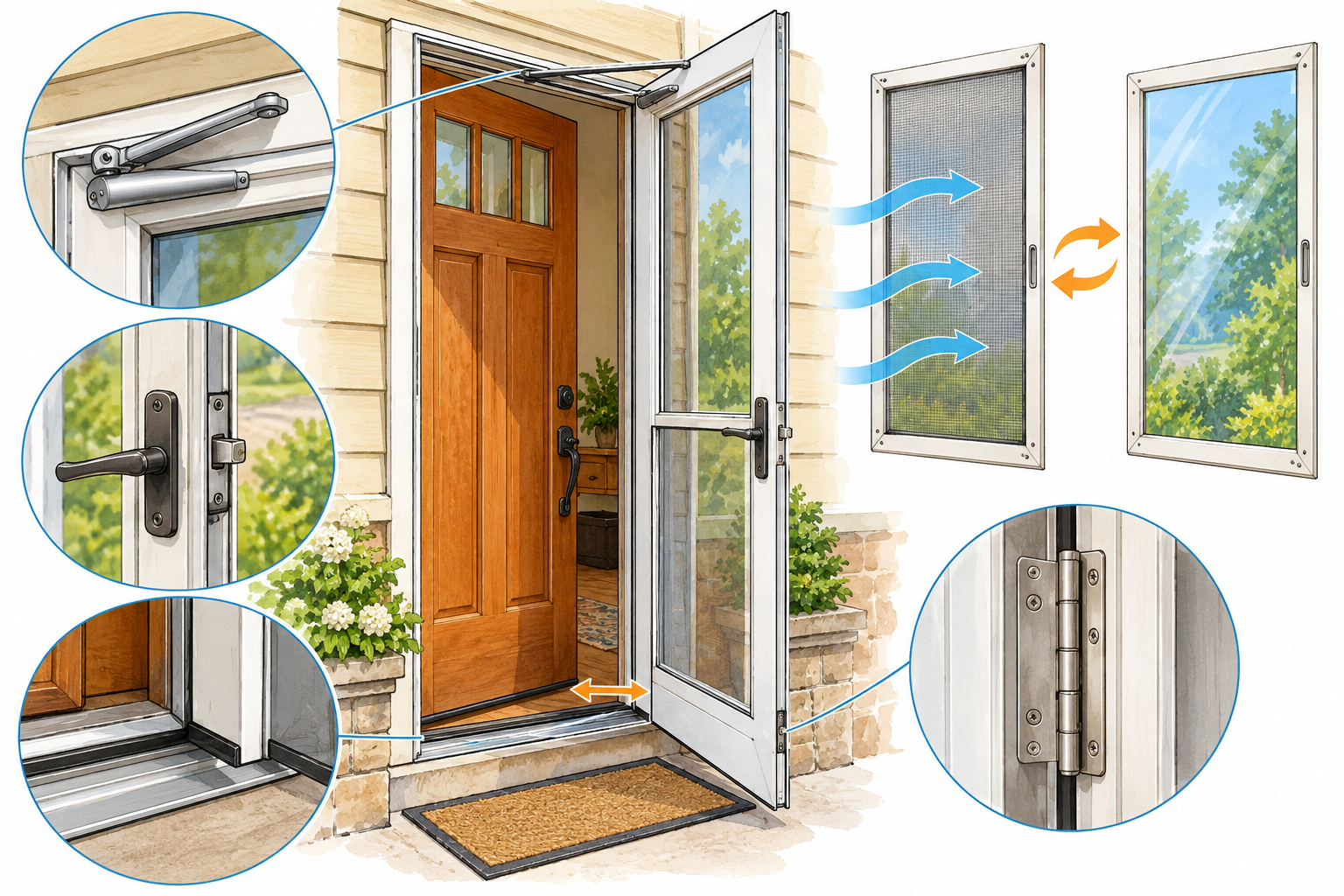
A storm door or screen door is a secondary assembly mounted outside a primary exterior door. It can provide seasonal ventilation, insect control, weather buffering, or a way to use interchangeable screen and glass panels. It is not automatically hurricane or impact protection.
Define the product
Ask whether the unit is a conventional storm door, screen door, interchangeable glass-and-screen product, security door, or a tested impact assembly. Product names can imply protection beyond what the assembly is designed or certified to provide. Do not use an ordinary storm door as a substitute for a product with documented high-wind or impact performance.
Cost components
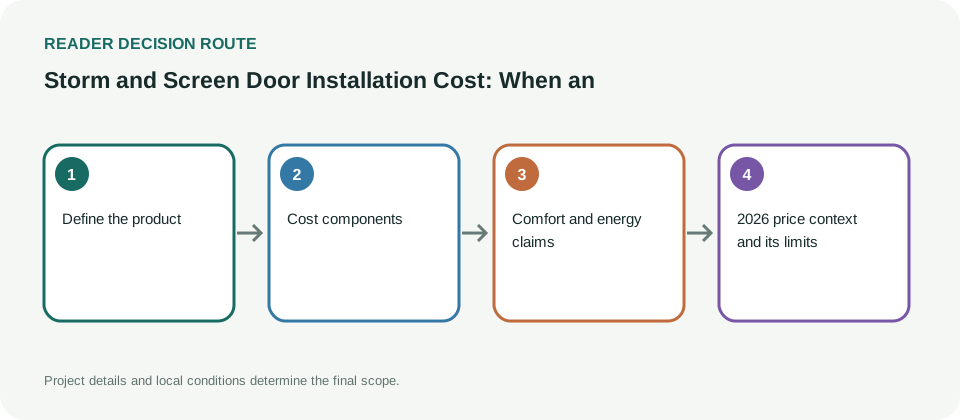
- product, glass or screen, finish, closer, latch, handle, and hardware;
- measuring and fitting the existing frame;
- mounting surface, trim, sill, threshold, and swing clearance;
- labor, removal of an old add-on door, disposal, and adjustment;
- weatherstripping, drainage, and finish repair if the primary opening is damaged.
The primary door must remain operable and able to latch. Building America guidance treats exterior doors, thresholds, weather seals, and flashing as part of the wall water-management system. An add-on door does not repair a leaking or rotten primary frame.
Comfort and energy claims
A secondary door may change drafts, shade, or solar exposure in some conditions, but the result depends on the primary door, fit, orientation, ventilation, and installation. Ask for a tested claim for the actual product rather than assuming a general energy saving.
2026 price context and its limits
Angi’s 2026 U.S.-oriented guide reports an average storm-door installation amount of $435 from 1,298 verified Angi Pro projects, with a reported range of $187–$683 for most homeowners. It says door type, materials, glass, and whether an old door must be removed affect the total. HomeStars’ 2026 Canada-focused door guide lists storm-door installation at $350–$800 and describes its door table as including both the unit and labor, but the page does not identify the currency code. Keep these as separate publisher observations: do not average them, label the HomeStars amount CAD, or assume either range covers a damaged frame or a custom security assembly.
The Angi article also reports that storm-door materials can vary widely, and gives a separate model-type table whose figures exclude labor. Those product-only rows should not be added automatically to its average installed figure. The two sources use different methods and may define “storm door” differently. A local written quote should establish whether it covers the door, installation, removal, fitting, hardware, and disposal before the homeowner compares it with either guide.
What moves the quote beyond a basic fit
A straightforward installation assumes the primary frame is square and secure, the opening matches a stocked storm-door size, the mounting surface is sound, and the new unit can be fitted without changing the entry door. A more involved job may need repair to brickmould or trim, a custom size, removal of an old add-on door, a different hinge side, a closer or latch upgrade, or correction of water damage around the primary frame. The quote should identify which condition applies rather than bundle it into a generic “installation” line.
Product choices also affect price. High-view, mid-view, and full-view designs differ in glass coverage; self-storing and retractable-screen systems add mechanisms; decorative or special glazing changes the product; security doors can be a different assembly entirely. Ask whether replacement screens or glass are available, how seasonal panels are stored, and what maintenance or warranty applies to the closer, latch, and finish.
Compare a storm door with a screen door
A screen door prioritizes airflow and insect control. A storm door can add a glass or plastic panel and provide a seasonal weather layer. Neither repairs a leaking, rotten, insecure, or badly aligned primary door. Check that the secondary unit can open fully, does not interfere with the entry door’s swing or handle, and leaves the primary door’s seals and drainage path functioning.
Do not treat an ordinary storm door as hurricane or impact protection. If windborne debris protection is the purpose, verify that the exact assembly has the required tested documentation and installation for the local hazard. An untested product name or heavier material is not proof of impact performance. Similarly, do not assume a secondary door will deliver a particular energy saving; orientation, exposure, fit, and the primary door affect the result.
Before approval, have the estimate identify the model, size, material, glass/screen configuration, closer, latch, removal, fitting, sealing, finish repair, labor, taxes, and warranty. If the primary opening is damaged, get a separate repair or replacement quote. This makes clear whether the add-on door is a narrow comfort or ventilation project or whether the entry itself needs work first.
Match the estimate to the product type
An installed average does not tell you whether the product is a full-view glass door, a self-storing design, a retractable-screen unit, a security door, or a simple screen. The Angi and HomeStars observations are useful starting points only after the homeowner confirms the type and inclusions. Ask the retailer whether the price includes the frame, handle set, closer, screen/glass panels, and delivery; ask the installer whether removal, fitting, sealing, and cleanup are included.
A basic replacement may fit a sound primary door frame with minor adjustment. A custom opening, out-of-square mounting surface, brickmould repair, or a heavier security unit may require different hardware and more labor. A double or unusual entry configuration may need two secondary panels or a different closure arrangement. Keep those cases separate from the typical single-door figure.
The household’s goal also changes which product is appropriate. If the goal is ventilation, screen area and how panels change seasonally matter. If the goal is weather buffering, check that the primary door remains operable and that the secondary unit does not trap moisture or interfere with drainage. If the goal is security, compare a product designed and documented for that purpose rather than assuming a standard storm-door latch provides it.
Confirm compatibility with the primary door
Before ordering, record the primary door’s swing, handle position, frame depth, sill, trim, and any nearby light or railing. The storm or screen door must open without striking the entry door, handle, steps, or adjacent wall. Confirm hinge side, closer placement, latch reach, and the manufacturer’s requirements for the mounting surface. If the primary frame is soft, rotten, or loose, repair that opening first or include reinforcement in the project.
Ask how the finished unit will be tested: full opening, self-closing behavior, latch engagement, screen/glass changeover, and clearance to the primary door. A product-only amount cannot establish that the assembly fits the house. Include any adjustment visit after installation and the warranty contact in the final paperwork.
A quote should also state whether the new storm door affects the primary door’s manufacturer instructions or warranty. Some frame systems place conditions on adding a secondary door, especially where heat can build up between assemblies. This is a product-specific check, not a universal prohibition. Ask the supplier to identify the relevant written condition for the exact primary door and the proposed add-on.
Compare ownership and replacement parts
A lower-priced storm door may use a screen or glass panel that is difficult to replace later. Ask the seller whether those panels, closers, latches, and handles remain available and what their current replacement cost is. This is especially useful for retractable or self-storing systems with proprietary components.
Confirm how often the homeowner will need to change or store panels and whether that task is manageable without tools. If the unit is exposed to strong sun or wind, ask what the manufacturer says about operation and maintenance. Do not infer that a product is designed for severe weather from the word “storm” in its name.
If the existing frame is out of square, ask for the measured gap and the adjustment proposed. A door that self-closes in the showroom may not close properly on the installed opening.
At handoff, verify that the primary door can still open and latch without interference and that the storm door closes and locks. Ask who to contact if the closer pulls the frame out of alignment or the screen panel fails.
Before ordering a special color or size, confirm the lead time and whether a standard unit can be adjusted to fit. Custom manufacturing can increase cost and make later replacement less convenient. The quote should identify the exact size and finish rather than rely on a verbal selection.
If a pet door or security feature is included, list it separately and confirm its effect on the product warranty and latch operation.
When it makes sense
An add-on door can be a reasonable narrow project when the primary frame is sound, the opening has a suitable mounting surface, and the goal is seasonal ventilation or an additional weather layer. Repair or replace the primary door first when it is distorted, insecure, rotten, or leaking. Verify the product, labor, hardware, finish, warranty, and future screen or glass availability before comparing quotes.