
The jamb, sill, threshold, brickmould, and adjacent wall form the opening around an exterior door. Damage there can make a repair more extensive than replacing a latch or slab. Water source, concealed rot, frame alignment, security, trim, and flashing should be visible in the scope.
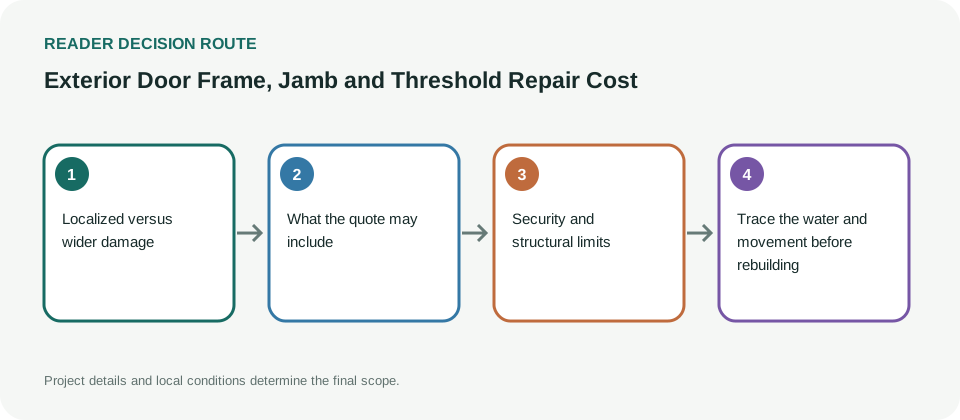
Localized versus wider damage
Localized jamb repair or threshold replacement may work when sound material remains, the slab can be rehung, and the water path can be corrected. Full-frame work is more plausible when both jambs are deteriorated, the sill has allowed water into the wall, the opening is out of square, or trim and cladding must be removed.
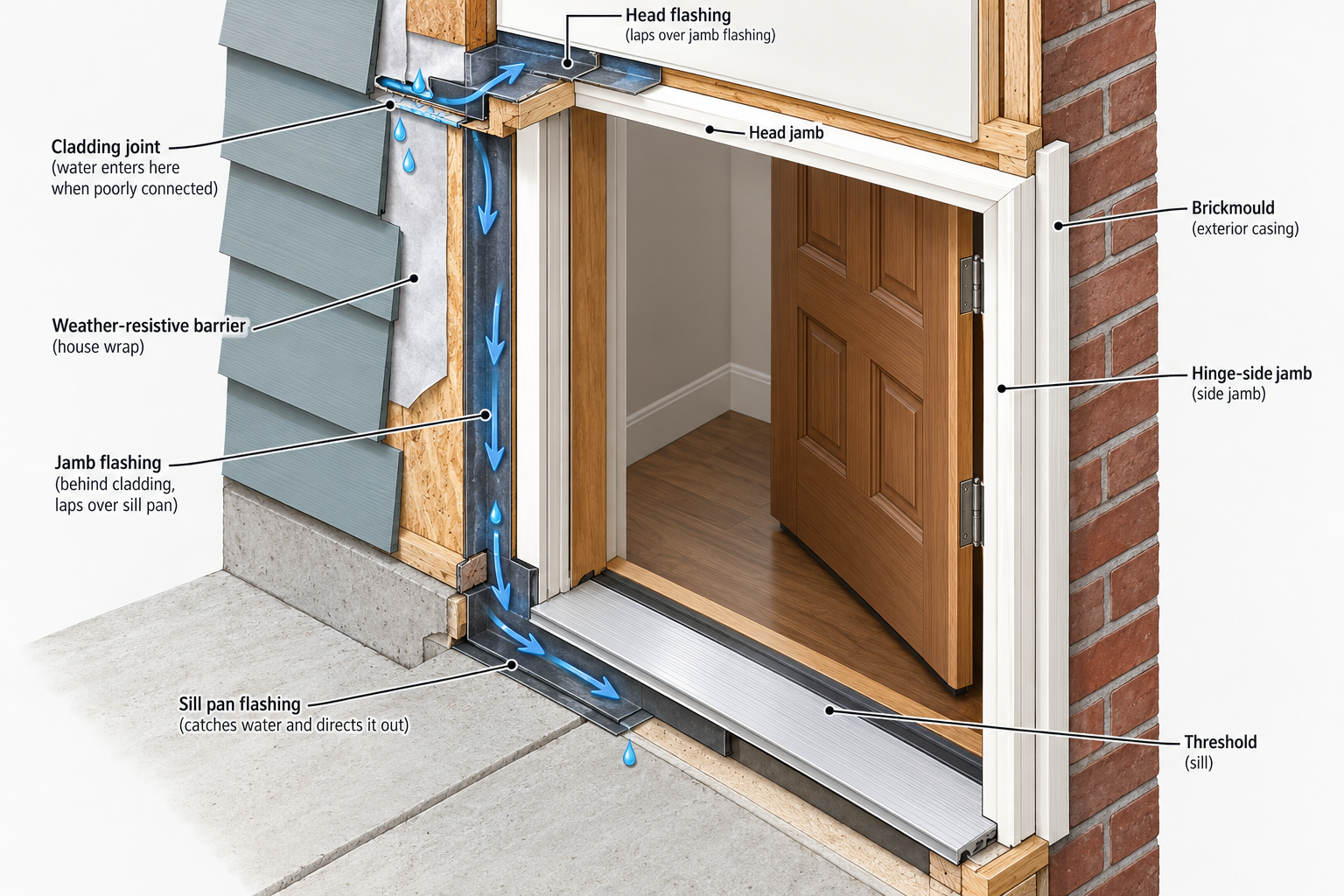
Building America treats door sill or pan flashing, side or jamb flashing, head flashing, and integration with the wall drainage plane as connected details. A replacement jamb over a continuing leak can fail again. Water may also enter at cladding or a transition above the door and appear at the threshold.
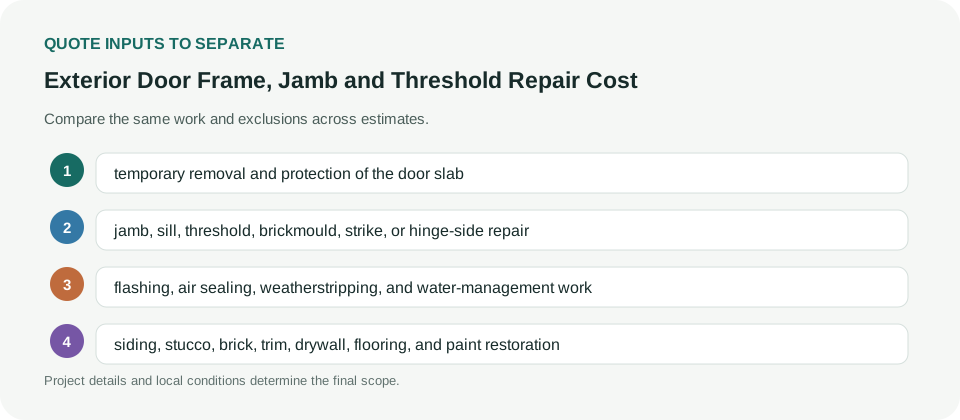
What the quote may include
- temporary removal and protection of the door slab;
- jamb, sill, threshold, brickmould, strike, or hinge-side repair;
- flashing, air sealing, weatherstripping, and water-management work;
- siding, stucco, brick, trim, drywall, flooring, and paint restoration;
- wall or sheathing repair if damage extends beyond the frame;
- re-hanging, alignment, lock and strike adjustment, testing, and cleanup;
- disposal, access, older-home material precautions, and conditional work.
Ask what was opened and inspected and what remains concealed. Do not accept a vague “replace rotten wood” allowance without a boundary and trigger.
Security and structural limits
A repaired frame should close, latch, seal, and support the specified door hardware, but the result should not be described as a tested security or structural rating without evidence. If movement, settlement, or broader wall damage affects the opening, obtain qualified assessment. A frame repair is not automatically a structural repair.
EPA’s current U.S. RRP guidance can apply when paid work disturbs paint in pre-1978 housing. Canadian guidance warns that older homes may contain lead paint and asbestos-containing materials; appearance and construction date do not prove whether a particular material is hazardous. Include qualified assessment and current local requirements.
Trace the water and movement before rebuilding
A damaged jamb or threshold is often an opening-interface problem rather than an isolated piece of wood. Look for where staining begins, whether it appears after rain, whether the slab still aligns, and whether water can drain away from the sill. Water can enter at the head, cladding, flashing, threshold, or an opening above and travel into the frame. Movement can arise from the slab, frame, wall, foundation, or hardware.
Ask the contractor to distinguish observed damage from a conditional allowance. Note whether casing, brickmould, siding, stucco, brick, drywall, flooring, or insulation must be removed to inspect the opening. “Replace rotten wood” is not a complete scope unless the quote states the repair boundary and what happens if the wall or sheathing is damaged.
Repair scenarios and cost drivers
A localized jamb repair may preserve the slab and trim when sound material remains and the water source is corrected. A threshold replacement can add sill, pan, seal, flashing, and floor-transition work. A full-frame repair may require temporary slab removal, new jambs, hardware adjustment, trim, and exterior restoration. A prehung replacement may be more coherent when most of the frame and weather boundary need work.
Major cost drivers include the frame material, extent of rot, opening size, wall and cladding type, access, disposal, drying, finish matching, hardware, strike alignment, and whether the opening must remain protected overnight. Masonry, stucco, historic trim, and custom profiles can make restoration more labor-intensive than the frame component suggests.
Building America guidance treats sill or pan, jamb, head flashing, weather seal, and wall drainage as connected. A new jamb installed over a continuing leak can fail again. Ask how the repair reconnects the water and air controls and how the completed opening will be checked.
Set a stop point before opening the frame
Frame repair can start as a small trim or sill job and expand after the assembly is exposed. Before work begins, agree on what is included in the first scope and what condition would require additional authorization. The contractor can photograph the exposed area, identify the damaged boundary, and provide a price for each next step rather than treating every concealed possibility as an automatic change order.
A good repair sequence addresses water entry before rebuilding the finish. Depending on the opening, work may involve removing brickmould or casing, replacing a sill or jamb section, correcting the threshold or pan, reconnecting cladding and flashing, and restoring trim or paint. The proposal should state whether the existing slab and hardware will be reused and what adjustment is included after the frame is repaired. If a strike or hinge repair is proposed, ask whether the surrounding material can securely hold it.
Compare localized repair with replacing the door as a prehung unit. Local repair may preserve a distinctive slab, custom finish, or sound glass, but it can be difficult to match the existing profile and may leave adjacent aging components. A new prehung unit may simplify alignment of frame, threshold, and weather seal, while increasing removal and finish work. If the water source is outside the door assembly, neither option is complete without correcting that source.
The quote should separate the visible opening work from possible wall repairs, cladding, electrical or utility adjustments, access, disposal, and interior restoration. Ask whether the price includes drying or protection if the area is wet, and whether the contractor will stop if unexpected structural damage is found. A contingency tied to a named condition is more useful than an unexplained allowance.
Where there is movement, extensive decay, or a door that no longer latches securely, have a qualified professional assess the opening rather than relying only on a cosmetic repair. The decision should account for weather protection and security, but the estimate should not imply that a new lock alone repairs a compromised jamb.
A threshold repair should also identify the floor and exterior interface. The work may need to preserve an accessible transition while preventing water from collecting at the sill. Ask whether the quote includes adjusting the slab after the threshold is changed and how the weatherstrip will contact the new height. If the exterior landing slopes toward the door or runoff is entering from nearby cladding, a threshold replacement alone may not stop the problem.
If only the exterior trim is being replaced, confirm whether the proposal also repairs the underlying frame and reconnects the water-management layer. New trim can hide a damaged jamb without correcting the entry point. Conversely, visible paint peeling may not mean that the frame is structurally unsound. Ask the contractor to separate cosmetic restoration from the repair that restores support, operation, and weather protection.
If the home has repeated water at the entry, ask whether the contractor inspected nearby roof runoff, porch surfaces, and cladding joints. The frame may be the visible collection point rather than the first entry point. The written scope should say what surrounding conditions were checked and which are outside the repair boundary.
At closeout, ask the contractor to demonstrate that the door closes and locks against the repaired frame and that the threshold seals along its full length. Keep photographs of the repaired area before final trim covers it.
If replacement is recommended, ask for a side-by-side price that includes the same finish and disposal. A repair quote that stops at the jamb cannot be compared with a complete prehung installation unless the threshold, trim, and paint are aligned.
Before accepting the repair, ask whether the quote includes the final paint or stain and whether the repaired profile will match adjacent trim. If matching is not possible, price a broader finish area as an alternate. This keeps cosmetic expectations separate from the structural and water-management repair.
Compare with a complete prehung unit
Repair is attractive when the slab and most of the frame are sound, the profile can be matched, and the water source is bounded. A prehung replacement may be better when both jambs, the threshold, hinges, weatherstripping, and trim are failing or when a complete warranty and new assembly are valuable. Compare removal, flashing, air sealing, cladding, interior finish, disposal, and the remaining service horizon.
Older homes require a disturbance check. EPA’s U.S. RRP guidance generally covers paid work disturbing paint in pre-1978 housing. Health Canada warns that older homes may contain lead paint and asbestos-containing materials. Confirm assessment and current local requirements before removing trim, paint, caulk, siding, plaster, or insulation.
Before signing, ask for photographs or measurements, the exposed and concealed boundary, water-management detail, expected result, finish inclusions, conditional trigger, warranty, and disposal. The right comparison is the cost of a durable, aligned, weather-tight opening, not a low line for a replacement jamb.
Repair may preserve a sound slab and finish when deterioration is bounded. A prehung replacement may be simpler when the frame, threshold, hinges, and weather seal all need work. Compare removal, flashing, trim, interior and exterior restoration, disposal, and the remaining service horizon. The cheapest frame line is not the cheapest completed opening if the water source or alignment problem remains.