
There is no universal lowest-cost vacancy strategy. Keeping heat on creates fuel, delivery, monitoring, and outage exposure. Full shutdown creates closing, reopening, freeze-damage, and system-restart exposure. A hybrid approach may fit a well-insulated property with monitoring and reliable visits, while another property may need a different plan.
Compare the strategies
| Cost and risk | Keep heat on | Fully or substantially winterize |
|---|---|---|
| Regular cash cost | Fuel, electricity, delivery, monitoring, visits | Closing service, access, periodic checks, and reopening |
| Freeze exposure | Depends on heat, power, controls, and response after failure | Reduced only if the shutdown is complete and appropriate |
| Outage exposure | Heat, pumps, alarms, and pipes may be affected by a long outage | Reopening and damage discovery still depend on access |
| Equipment limits | Some systems or spaces cannot simply be shut down | Some systems need qualified drain-down or protection |
| Insurance | Policy may require heat, inspections, alarms, or another condition | Policy may require documented winterization and visits |
| Restart | Fewer startup tasks, but failures can occur unattended | Controlled reopening and possible repairs |
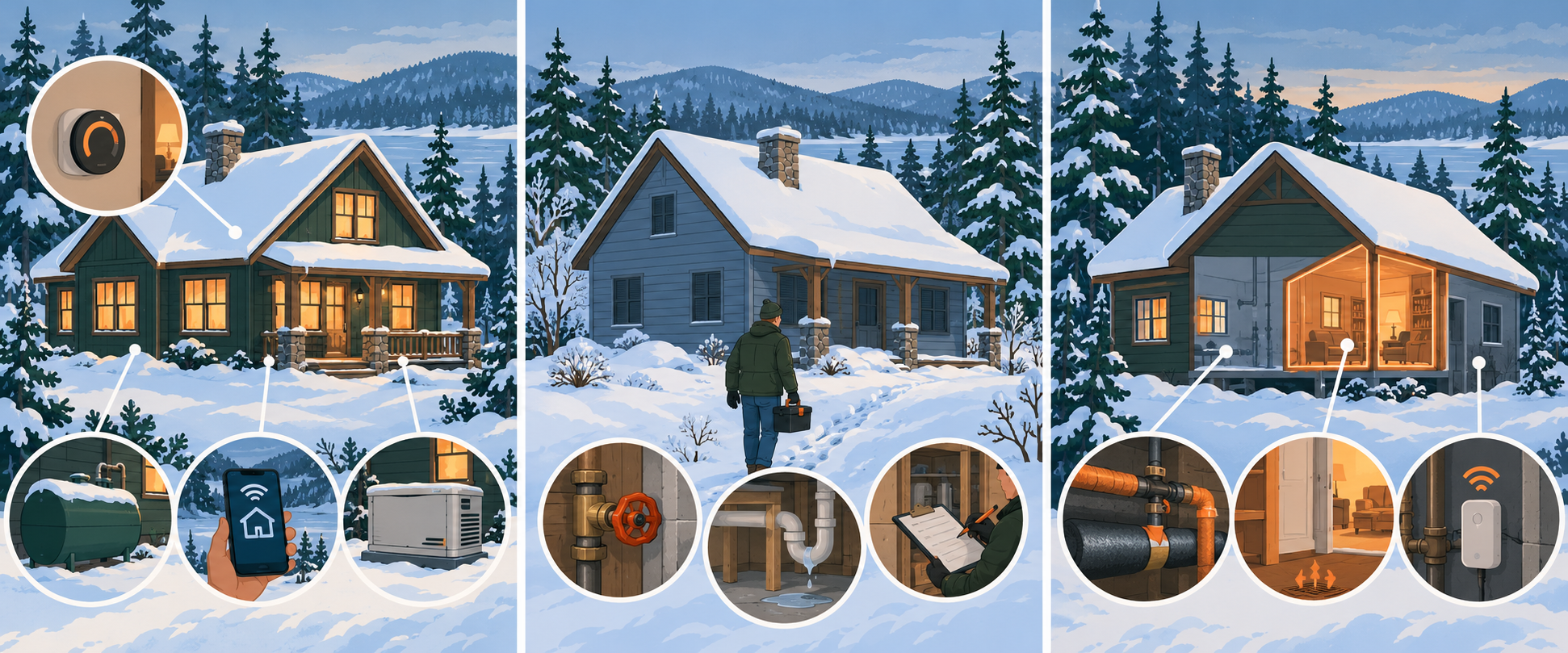
Build a scenario model
Use the actual vacancy duration, climate, envelope, heating source, plumbing layout, water system, fuel delivery, outage history, road access, monitoring, and visit frequency. Price the base plan plus a severe-outage or blocked-access scenario. Include the cost of a human response when an alarm reports low temperature, water, power, or fuel.
Water alarms can provide early notification and some systems can trigger an automatic shutoff, but an alarm does not diagnose the cause or replace an inspection. Canadian federal winter-storm guidance also treats backup power, backup heat, frozen pipes, and carbon-monoxide precautions as distinct concerns.
Treat insurance as a contract question
Consumer and insurance guidance indicates that extended absence and frozen-pipe losses can be subject to policy conditions. Ask the insurer exactly what heat, inspection, alarm, winterization, and documentation requirements apply to the property and vacancy period. Do not copy a condition from another policy or jurisdiction.
The best strategy is the one whose fuel, visit, closing, reopening, outage, damage, and insurance assumptions are visible. Revisit it when occupancy, equipment, climate, access, or coverage changes.
Local regulator advice is useful as a prompt, not a thermostat setting for every home. Washington’s insurance regulator advises above 60°F in winter and above freezing for long absences; D.C.’s regulator notes that some policies require a specified temperature and suggests shutting off and draining systems when an unheated vacant property can be prepared that way. These examples do not create a universal insurance clause, required visit schedule, or safe system procedure. Price the policy’s actual heat, inspection, and shutdown terms with qualified advice for the installed plumbing and heating.
Compare three operating strategies
Build the decision around the property’s actual systems. A continuous-heat plan may include fuel, electricity, routine furnace service, remote temperature monitoring, alarm subscriptions, and periodic inspections. Full winterization may replace part of that spending with a professional closing, water-system service, opening and testing, storage or shutdown tasks, and additional maintenance when the home reopens. A hybrid plan could keep heat in selected areas while isolating vulnerable plumbing, but only where the equipment and layout support it and qualified professionals approve the arrangement.
For each strategy, record the expected absence dates, thermostat or shutdown assumptions, fuel delivery access, backup power, monitor coverage, visit frequency, and response time. Identify whether water is supplied by a well, cistern, municipal line, or another system and how that system behaves during a power interruption. If a generator supports heating or monitoring, include its fuel, testing, and service in the plan. A monitor can report a problem but cannot restore heat, reach the home, or repair a leak.
Use a scenario worksheet
Compare the same period, such as one winter or a full year. Include the routine cost for each plan, but keep uncertain damage exposure visible as a separate scenario rather than assigning an unsupported expected-dollar value. A practical worksheet can track:
| Cost or condition | Heat-on plan | Winterized plan | Hybrid plan |
|---|---|---|---|
| Heating fuel and electricity | Estimated from recent bills and vacancy setting | Residual or none, as applicable | Zone-specific estimate |
| Closing, opening, and system service | Inspection and monitoring visits | Shutdown and recommissioning | Defined trade work plus monitoring |
| Monitoring and response | Alarm and local responder | Property checks and emergency visit | Check the systems left active |
| Access and backup | Fuel, snow, generator, service travel | Opening access and emergency visit | Both sets of requirements |
| Insurance conditions | Confirm in writing | Confirm in writing | Confirm in writing |
The table is a way to organize a quote, not an assumption that every listed service is required. Ask providers to identify actual work and the insurer to confirm the policy conditions. Compare the base case with a difficult case such as a power outage, delayed fuel delivery, unusually cold period, blocked road, or failed monitor. The point is to see which strategy remains workable when a normal assumption fails.
Consider the cost of reaching the property
Remote owners sometimes choose continued heat because they cannot arrange dependable water-system service, or choose full winterization because fuel trucks cannot reach the home in midwinter. A long drive, locked gate, seasonal road, and limited contractor availability may affect the strategy more than the home’s size. Price keyholding, travel, storm access, after-hours callouts, and a safe backup location separately. Confirm whether a local caretaker can respond during severe weather and what training the person has.
Before a property purchase or policy renewal, provide the insurer with the intended vacancy plan, heat setting, monitoring, inspection schedule, and winterization method. Ask what evidence is required if there is a claim. Recheck those terms when the household changes its travel pattern, heating equipment, or service provider. The decision should be a documented operating plan with clear costs and responsibilities, not a choice made from one heating bill.
Check whether the building supports each option
Inventory plumbing location, insulation, heat zones, water source, foundation or crawlspace, sump equipment, and the equipment that cannot be fully shut down. A home with pipes in unheated spaces may need a different plan from one where all plumbing lies within a reliably heated envelope. Ask a qualified professional to identify vulnerable runs and systems before assuming a low thermostat setting is adequate or that ordinary winterization will remove all freeze risk.
For a heat-on plan, include service for the heating appliance, power, fuel supply, thermostat, alarm, and any backup source. Define who checks the property after an alarm and how quickly that person can reach it. For winterization, confirm how toilets, traps, appliances, water treatment, pressure equipment, and any other installed systems are handled. Some equipment requires manufacturer-specific steps or ongoing power. The work plan must account for those exceptions and the reopening procedure.
Compare costs over the same dates and service level. If one option assumes two local visits and the other includes only an opening contractor, add equivalent inspections before comparing totals. Keep repairs found during an opening separate from predictable seasonal service. Note who owns each task, when it occurs, and what evidence records completion.
Review the choice before every long vacancy if weather, fuel availability, occupancy, equipment, or road access changes. A plan that worked in a mild winter may no longer be suitable after a remodel moves plumbing or a provider leaves the area. Update the written insurer guidance and contractor instructions rather than relying on memory.
Assign responsibilities before departure
If the home has a crawlspace, basement, attached garage, or water equipment in an unheated shed, include those areas in the professional’s vacancy review. The visible thermostat reading inside the living area may not describe conditions around exposed pipes or pumps. Record the limits of any temperature sensor and where it is installed.
Name the person who receives temperature or water alerts, the person who can reach the property, and the professional responsible for heating, plumbing, fuel, or alarm equipment. Give each person current contact details and define who can authorize a return visit. If the property is shared among family members, record who pays for routine service and who decides on emergency work. Ambiguous authority can delay a response even when the monitoring system works.
Save recent service records and the current operating plan where the responding person can retrieve them. Identify the main shutoffs, alarm panel, generator, access gate, and equipment that must remain on. Do not ask an unqualified caretaker to operate unfamiliar machinery; the purpose of the record is to help the right professional respond with useful information.
Set a review date before the next vacancy begins. Confirm that alarm batteries, cellular service, backup power, fuel delivery, and contractor contacts are still current, then update the comparison if any provider or system has changed.
Revisit the choice when use or equipment changes
A new appliance, added bedroom, altered plumbing route, different heating fuel, or longer winter absence can change the cost and feasibility of the vacancy plan. Recalculate the routine service and access requirements using current provider quotes, then ask the insurer whether the revised plan affects policy conditions. Keep the previous comparison for reference but identify the new assumptions and effective date. If the property’s response team or road access changes, verify that someone can still act on alarms. A written plan should describe the current equipment and household schedule, not simply repeat last year’s heat setting.