
Low-slope coating projects often budget in the low-to-mid single digits per square foot, while extensive preparation, reinforcement, detail repair, premium products, or small-job minimums can move higher. Full replacement typically costs more upfront, but coating is valuable only when the existing assembly is an eligible substrate.
The economic decision begins with condition assessment, not coating color.
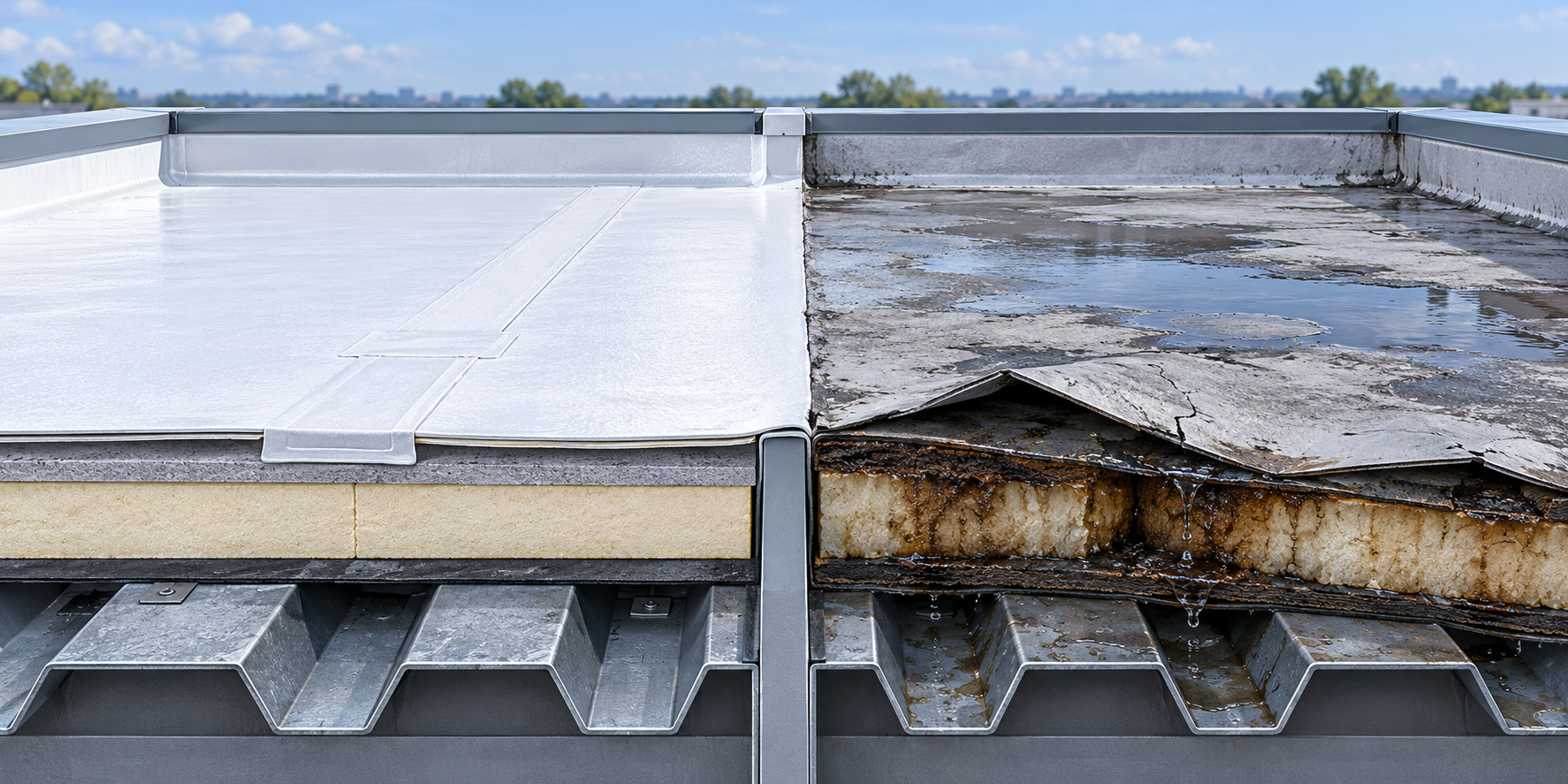
What restoration includes
A credible restoration scope can involve cleaning, adhesion testing, removal of failed material, seam and fastener repairs, reinforcement at details, correction of isolated wet areas, primer, field coating at specified coverage, and treatment of walls, drains, curbs, and penetrations.
Simply rolling a thin layer over dirt, moisture, or unstable membrane is not equivalent.
Candidate conditions
Restoration is strongest when the roof is structurally sound, reasonably dry, well attached, drainable, and compatible with the proposed product. Localized defects must be repairable. The owner should understand which conditions were tested and what area was examined.
Core cuts, infrared or other moisture investigation, adhesion tests, and manufacturer review may be appropriate depending on the system. No single test establishes every condition.
Conditions that weaken the case
- widespread wet insulation or deteriorated decking;
- unstable, badly split, or poorly attached membrane;
- chronic ponding caused by slope or structural issues;
- failed flashings and details requiring broad reconstruction;
- incompatible existing coatings or contaminants;
- too many layers or local rules preventing recover;
- a warranty proposal whose preparation requirements are not in the quote.
Coating can waterproof some surfaces and improve reflectance, but it cannot restore structural capacity or make wet insulation dry.
Cost drivers
Field area matters, but detail density, cleaning, repairs, reinforcement, product chemistry, specified thickness, number of coats, access, and weather windows can dominate. Small roofs have high unit prices because mobilization and details remain.
Ask for product, primer, coverage rate, dry-film requirements where relevant, reinforcement, repair quantities, excluded wet areas, and how application thickness will be documented.
Recoating and lifecycle
Some systems can be recoated, but timing and preparation are product- and condition-specific. Do not turn a warranty term into guaranteed service life. Model at least:
- restoration now plus future inspection and possible recoat;
- restoration now followed by replacement if performance is shorter than hoped;
- tear-off and replacement now.
Include future tear-off of added layers and the cost of capital. A lower initial spend can be rational even if it does not last as long, provided the eligibility and risks are honest.
Reflective value
A white or reflective coating may reduce surface temperature and cooling loads in favorable climates. ENERGY STAR notes the greatest energy benefit generally occurs in hot sunny climates and less-insulated buildings, while cold-climate heating effects and building conditions matter. Use rated product data and building-specific analysis; do not claim universal payback.
Scenarios
Dry serviceable membrane with aged surface: Repair details, prepare, and apply a compatible restoration system. This is the strongest coating case.
Localized wet areas: Remove and rebuild bounded wet sections, then coat the eligible remainder if the manufacturer supports it. Price the repairs separately.
Widespread moisture and ponding: Coating hides symptoms without correcting the assembly. Replacement and drainage/slope work are more credible.
Short ownership or capital constraint: A properly designed restoration may bridge timing, but it should still be durable work—not an undisclosed temporary patch.
Quote checklist
Require assessment method, moisture findings, substrate, preparation, repair quantities, exact coating system, primer, reinforcement, coverage/thickness, weather limitations, drainage work, warranty, inspection, and future maintenance. The value of restoration is extending a suitable roof at lower disruption and cost. If suitability is not established, the low bid is simply a wager on concealed conditions.
Separate repair from coating price
Request line items for cleaning, seam/fastener/detail repairs, wet-area replacement, reinforcement, primer, field coating, and optional reflectance. This reveals whether one bidder is applying more coating or simply including more necessary repair.
If repair quantities are unknown, use allowances or unit prices with photographs and authorization. Do not let “prep as needed” become an unlimited change order.
Coverage and quality control
Product coverage rates depend on substrate and specified finished system. Ask how material quantities, wet-film checks, dry conditions, and multiple coats will be documented where the product requires them. Leftover pails alone do not prove correct application.
Warranty economics
Manufacturer or contractor warranties may require inspections, repairs, drainage maintenance, approved applicators, or specific thickness. Compare remedy, exclusions, and who performs future inspections. A longer warranty can add coating and inspection cost; evaluate whether that scope also adds physical value.
Alternatives and timing
Focused membrane repair may be enough if the field remains sound. Recover can add a new membrane without full tear-off. Full replacement removes wet and unsuitable layers. A coating/restoration sits between them when eligibility is documented.
For owners planning later equipment or solar changes, confirm whether penetrations will disturb the restored field. Coordinating them now can avoid premature patchwork.
Reserve for the next intervention
Restoration defers replacement rather than eliminating it. Continue a capital reserve, keep product and application records, and inspect drainage/details. If the roof performs longer than the conservative scenario, the deferral creates additional value; do not spend that value in advance through optimistic lifespan claims.
Build an eligibility package before pricing the field
Document the existing membrane or substrate, roof area, age if known, leak history, moisture findings, adhesion or compatibility testing where required by the product, drainage, seams, flashings, penetrations, repairs, and rooftop equipment. The contractor should state which conditions make the roof eligible and what finding would instead require recover or replacement.
Separate investigation and preparatory repairs from coating area and application. This shows whether a low field price depends on leaving important details untreated. It also prevents owners from comparing a maintenance coating over a sound field with a restoration system that includes reinforcement, repairs, primer, multiple coats, and documented finished thickness.
Normalize restoration proposals
Compare cleaning and preparation, moisture work, repair quantities, reinforcement, primer, exact product, specified application quantity or finished-system requirement, number of coats where relevant, detail treatment, drains, access, weather assumptions, quality-control records, warranty inspections, exclusions, and cleanup. Ask how additional wet or incompatible areas are measured and authorized.
A price per area is only the field component. Small detail-heavy roofs can carry high preparation and flashing costs. A larger simple field may spread mobilization efficiently. Solar, equipment, parapets, and difficult drainage fragment production and future inspection.
Low, typical, and ineligible cases
A low-complexity candidate is dry, compatible, well-drained, and generally sound, needing bounded preparation and detail work. Restoration can defer tear-off with limited uncertainty.
A typical candidate needs seam and flashing repairs, localized moisture removal, drainage maintenance, and careful preparation before the field system. The economic decision depends on the combined repair-plus-coating total, not the coating allowance alone.
An ineligible or complex roof has distributed wet materials, unstable substrate, structural drainage problems, incompatible contamination or layers, or details that cannot be restored reliably. More coating does not cure those conditions. Price recover or replacement rather than financing repeated applications.
Test the deferral value
Compare restoration with focused repair, recover, and full replacement over a conservative planning horizon. Include investigation, preparation, required inspections, localized future repair, disruption, and the capital project still expected later. Do not count deferred replacement as eliminated cost; value the time gained and retained use of the current assembly.
Restoration is economically strong when eligibility is evidenced, the all-in project is meaningfully below a suitable replacement, and the owner can maintain drainage and monitor details. It weakens when the coating mainly hides unresolved moisture, when equipment changes will soon puncture the field, or when warranty conditions create service costs the owner will not follow.
Set a stop threshold during preparation. If wet area, adhesion failure, or repair quantity exceeds it, pause and compare the fallback. A responsible contract makes ineligibility an anticipated decision rather than an expensive surprise after much of the coating budget is committed.
Read coating quote language
“Apply two coats” is incomplete without exact product/system, prepared substrate, total material/application requirement, detail treatment, cure and weather assumptions, and quality control. “Repair all leaks first” needs mapped repairs and an uncertainty rule. “Warranty included” needs eligibility, inspections, maintenance, exclusions, and remedy.
Ask whether drains, penetrations, seams, flashings, curbs, and ponded areas receive reinforcement or other system-specific work and whether these quantities are fixed. Field-area rates can hide the labor that decides whether restoration is coherent.
Example: cheap coating versus documented restoration
A low quote may wash and coat visible field while excluding moisture work and details. A higher quote may investigate, remove bounded wet material, repair seams and flashings, prime, reinforce, apply the specified system, and document application. They are not two prices for the same outcome.
Normalize both to the candidate requirements. If the all-in documented restoration approaches a suitable recover or replacement, compare the residual assembly, future intervention, and disruption. If it remains materially lower and eligibility is strong, the deferral case becomes credible.
Closeout evidence
Keep test and moisture findings, repair maps, batch/material quantities, application and weather records, detail photographs, quality-control checks, warranty and inspection schedule. Future recoating or repair depends on knowing what was applied and where. Documentation is therefore part of lifecycle value, not administrative filler.
Ownership scenarios after restoration
A short-horizon owner may value lower disruption and documented water control without assuming the coating premium is recovered at sale. A long-horizon owner should budget inspections, detail repairs, drainage service, and the eventual recover/replacement while preserving product compatibility records. A residential roof with equipment changes should include future penetration repair in either case.
Restoration is complete as a decision when candidate evidence, all-in preparation and repair cost, conservative deferral value, fallback threshold, and future service are explicit. Additional coating-area prose cannot compensate for uncertainty in those five items.
Low, expected, and difficult totals
The low total assumes documented dry compatible field, limited repairs, straightforward access, and standard detail preparation. The expected total carries mapped seam/flashing repairs, localized wet-material removal, primer or reinforcement required by the exact system, and inspection/quality control. The difficult case crosses the agreed eligibility threshold and switches to recover or replacement rather than applying more coating.
Present that fallback before work. Money spent on investigation and eligible preparation is not automatically wasted if it prevents coating an unsuitable roof, but the contract should state which work credits or carries into the next path.
Final economic threshold
Proceed when candidate evidence is strong, preparation and detail repair are fully priced, the conservative deferral is meaningful, and the owner can meet inspection and maintenance terms. Switch to recover or replacement when eligibility fails or restoration approaches their cost without buying a comparable new water-control layer.