
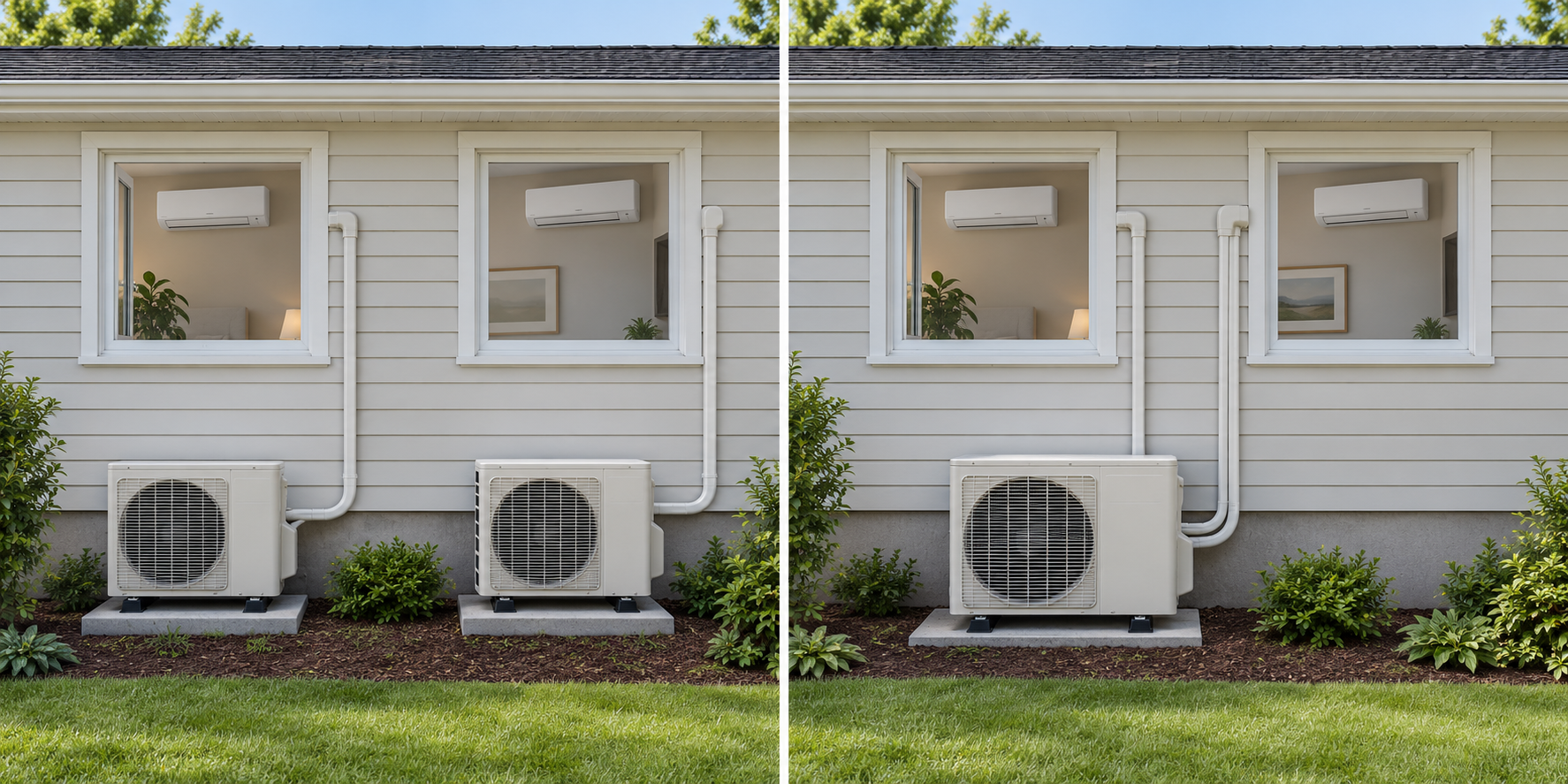
The choice is between one outdoor heat-pump unit per zone and one outdoor unit serving multiple indoor heads. A multi-zone layout may reduce outdoor equipment and some installation duplication, while separate single-zone systems can provide independent capacity and redundancy. Neither architecture is universally cheaper or more efficient; model selection, room loads, line routing, climate, and use patterns matter.
Illustrative planning scenario (CAD, September 2026)
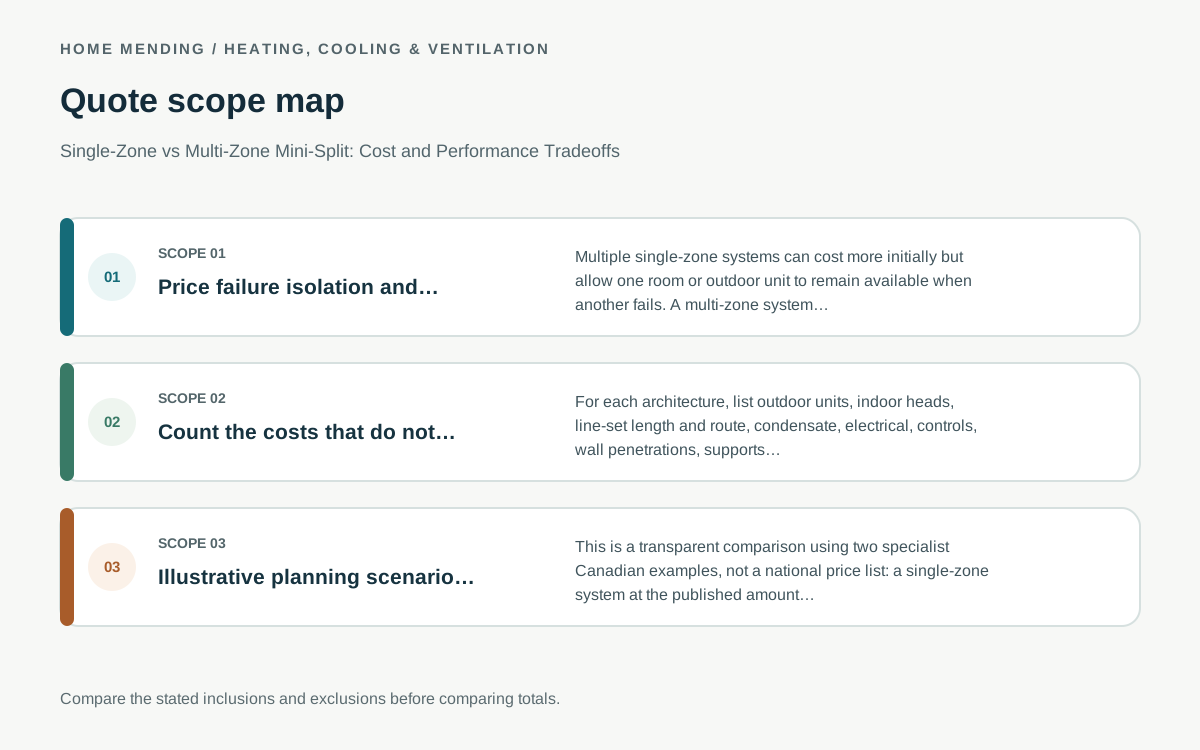
This is a transparent comparison using two specialist Canadian examples, not a national price list: a single-zone system at CAD $4,500–$8,500 versus a three-head system at CAD $8,000–$15,000. The ranges have different equipment and installation scopes, so compare zone count, line-set routing, electrical work, and commissioning before treating the difference as savings.
Price failure isolation and future work
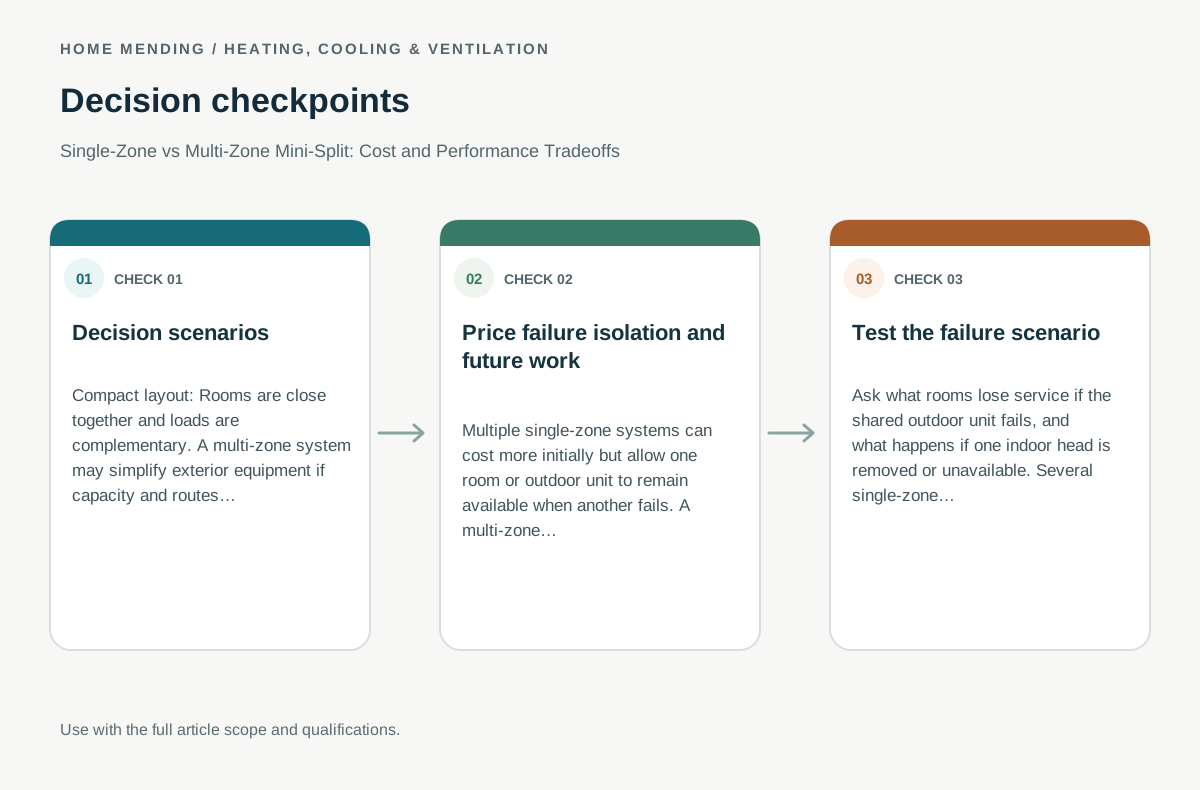
Multiple single-zone systems can cost more initially but allow one room or outdoor unit to remain available when another fails. A multi-zone system can consolidate equipment while making the outdoor unit, capacity allocation, and controls more central to the home’s comfort. Ask how a future compressor, head, line set, or control repair would be accessed and priced.
Include the existing system that remains, rooms not served, filters, coil cleaning, noise, visible line covers, condensate, electrical, and future replacement. Compare the architecture over the intended ownership period rather than assuming fewer outdoor units means lower total cost.
Count the costs that do not appear on the head
For each architecture, list outdoor units, indoor heads, line-set length and route, condensate, electrical, controls, wall penetrations, supports, finish restoration, commissioning, service clearances, and the existing equipment that remains. A multi-zone proposal may reduce outdoor-unit count while increasing capacity allocation and control complexity. Several single-zone units may cost more initially while providing independence and easier failure isolation.
Then test actual use: one room calling, several rooms calling, unserved rooms, doors closed, and one component unavailable. Compare redundancy, appearance, noise, filters and coil service, future replacement, and the cost of a second mobilization. The right answer is not the fewest heads; it is the architecture that serves the intended rooms at an acceptable installed and lifecycle cost.
A multi-zone quote includes one outdoor unit, several indoor heads, branch or line-set routing, controls, mounting, electrical, condensate, testing, and commissioning. Several single-zone systems include repeated outdoor units, pads or mounts, connections, line sets, and startup work. The cheaper total depends on equipment pricing, access, and the number and location of zones.
Canadian specialist examples for ductless work vary materially by configuration, which is why a per-head multiplication is misleading. Ask for a complete zone map and total installed scope.
Capacity and diversity
Indoor heads do not simply add their nameplate capacities into one guaranteed outdoor output. The actual equipment’s capacity allocation and operating limits determine what can happen when several rooms call at once. Ask the contractor or manufacturer documentation to show that the proposed system covers the intended simultaneous loads.
Oversizing or creating too many heads can add cost without solving comfort. A room may need envelope or airflow work rather than another indoor unit.
Redundancy and maintenance
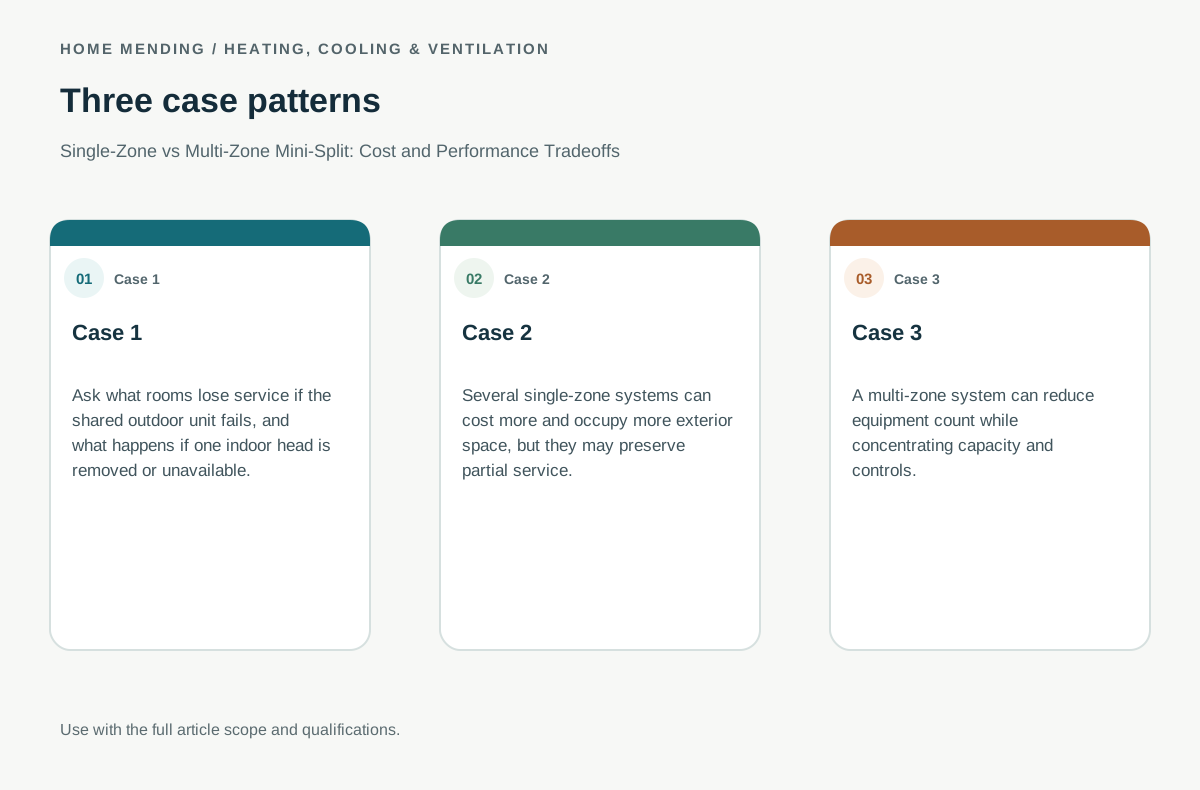
Several single-zone systems can preserve partial heating or cooling if one outdoor unit fails, though they create more equipment to clean, service, and eventually replace. A multi-zone system may have fewer outdoor units and a cleaner exterior, but a central failure can affect multiple rooms. Maintenance access, filter cleaning, line-set inspection, and warranty terms should be considered in the ownership budget.
Layout and appearance
Long line sets, concealed routes, exterior covers, multiple wall penetrations, and difficult mounts can erase an apparent multi-zone savings. Separate systems may require more exterior equipment but allow shorter routes and more flexible placement. Indoor-head placement affects air throw, noise, furniture, and visual impact.
Decision scenarios
Compact layout: Rooms are close together and loads are complementary. A multi-zone system may simplify exterior equipment if capacity and routes are suitable.
Separated rooms: Long routes or different floors make several single-zone systems competitive. Installation access and finish repair may dominate.
Critical or uneven loads: Independent systems can offer redundancy and room-specific capacity, but extra maintenance and equipment cost are real. A multi-zone system may be more coherent when equipment documentation supports the load pattern.
How to compare bids
Require the same rooms, coverage, heating/cooling role, low-temperature performance, outdoor capacity, line-set lengths, electrical work, condensate, mounting, controls, removal, testing, warranty, and exclusions. Ask what happens if one zone is turned off or one unit fails.
Choose the architecture that fits actual room loads, access, service strategy, aesthetics, and ownership horizon. Count complete systems and future service, not just outdoor-unit quantity or the number of indoor heads.
Test the failure scenario
Ask what rooms lose service if the shared outdoor unit fails, and what happens if one indoor head is removed or unavailable. Several single-zone systems can cost more and occupy more exterior space, but they may preserve partial service. A multi-zone system can reduce equipment count while concentrating capacity and controls.
Test the low-load scenario
Ask how the proposed equipment behaves when only one small room calls and when all zones call together. The answer is model-specific; do not generalize efficiency or capacity from one system to another. Confirm line lengths, control interactions, defrost, and maintenance access in the proposal.
The best comparison gives each architecture the same rooms, climate role, electrical scope, access, testing, warranty, and service assumptions.
Compare initial and future mobilization
Several single-zone systems may require more outdoor pads, electrical connections, and exterior maintenance. One multi-zone system may reduce those items but concentrate failure risk and require longer line routes. Ask what work can be serviced independently and how replacement will occur when one head or outdoor unit reaches end of life.
Test the layout in actual use
Map rooms, closed doors, schedules, and simultaneous loads. A design that is efficient when all rooms call may behave differently when one small room calls. These interactions are model-specific, so ask for manufacturer-backed capacity and control information rather than a generic claim that multi-zone is always more efficient.
The winning architecture is the one that delivers the intended rooms with acceptable access, appearance, redundancy, and lifecycle cost.
Test the partial-use case
Ask how each architecture behaves when only one room needs heating or cooling, when several rooms call together, and when one indoor head is unavailable. A multi-zone outdoor unit can consolidate equipment but may introduce capacity-sharing and control interactions. Multiple single-zone systems can add outdoor equipment and installation, yet may provide independence and simpler failure isolation. Neither is automatically cheaper over the ownership period.
Map every proposed room, line-set route, drain, electrical connection, filter, service clearance, and future replacement path. Then price the unserved rooms and any existing system that remains. If one option looks cheaper only because it excludes a room, a difficult route, or the cost of maintaining retained equipment, it is not a like-for-like comparison.