
An attached garage door is a large opening in the wind envelope. If it fails, internal pressure and wind-driven rain can increase damage elsewhere. The decision may be to reinforce the existing door, improve tracks and attachment, repair the opening framing, or replace the assembly with a wind-rated product. Reinforcement is not appropriate for every door or substrate.
Inspect the complete opening
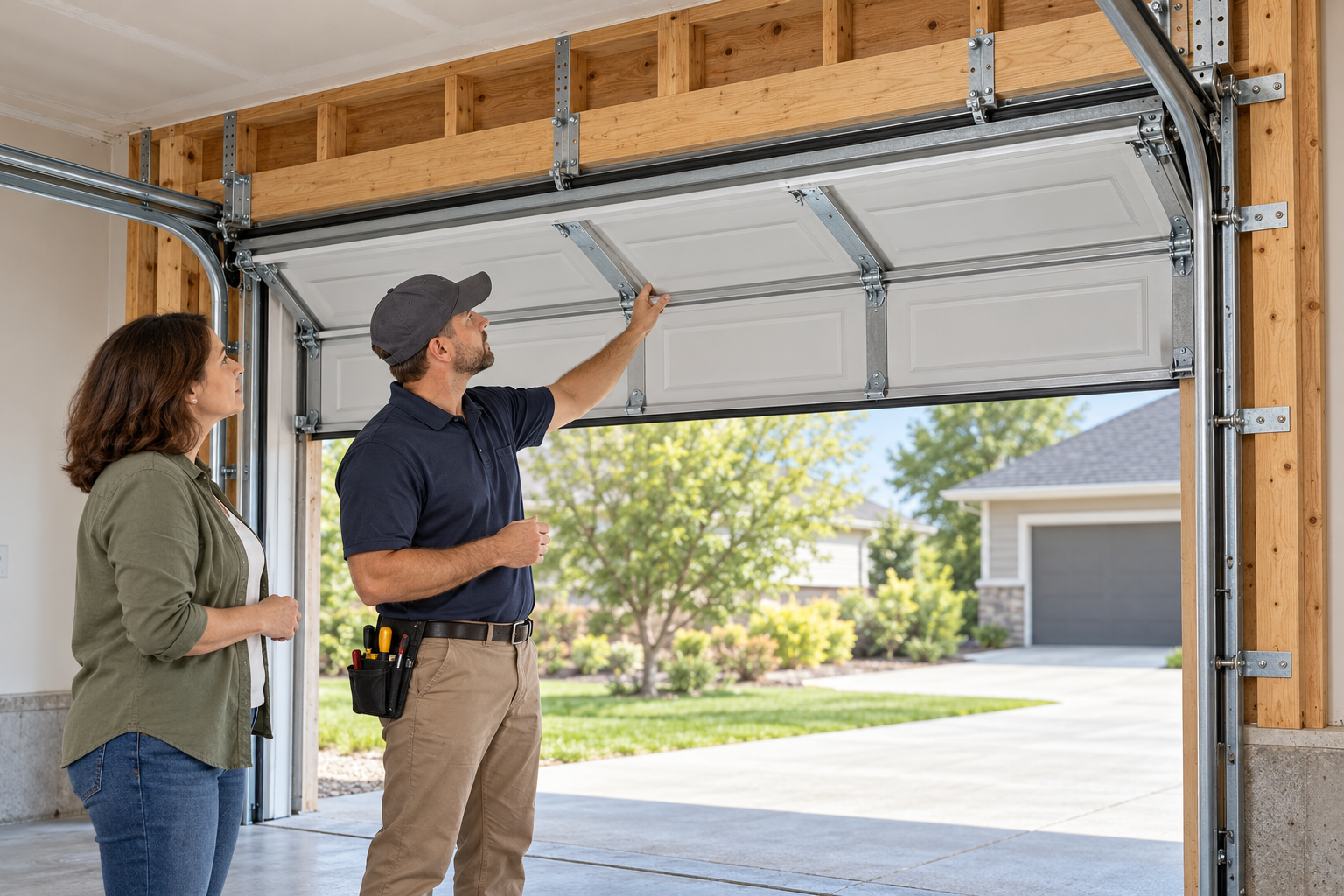
The door, tracks, rollers, hinges, jambs, header, wall framing, fasteners, and surrounding foundation work together. Ask whether the existing model has a manufacturer-approved bracing or retrofit path. A reinforcement kit designed for one door type may not fit another, and stronger tracks do not solve a weak wall or deteriorated opening.
The inspection should also consider manual operation, emergency access, seals, water entry, and how the door interacts with the broader roof and wall load path. A garage door that appears solid at rest may not have the documented design pressure or attachment required for the home’s exposure.
Reinforce or replace
Reinforcement can be a smaller project when the door is in good condition, the manufacturer supports the approach, and the opening framing can carry the loads. It may include braces, upgraded tracks, anchors, jamb or header work, and labor to verify alignment. The finish may be disturbed around the attachment.
Replacement may make more sense when the existing door is damaged, obsolete, poorly sealed, incompatible with approved hardware, or near the end of its ordinary life. A new wind-rated assembly may include the door, track, rollers, anchors, seals, and documentation as one tested or approved system. It still needs correct installation into the actual opening.
Cost drivers
Price depends on door width and height, material, wind exposure, product approval, track and anchor design, framing condition, opener compatibility, access, removal, disposal, and finish work. A product-only comparison misses delivery, installation, reinforcement, inspection, and restoration. Ask for a line-item quote and a statement of the design assumptions.
Local requirements and product approvals vary. Confirm the current jurisdictional wind criteria and exact manufacturer documentation. FEMA wind guidance establishes why openings matter but does not approve a generic kit. Canadian projects need their own local and product context; a U.S. rating or program reference cannot be assumed to apply.
Put the door in the whole-home budget
If the roof, windows, shutters, and roof-to-wall connections remain vulnerable, the garage door may not be the highest-value first project. If the garage is the dominant opening or the house has a documented wind weakness, it may be a priority. Coordinate with siding, framing, or ordinary garage-door replacement to reduce repeated access and finish work.
Do not use a wind-rated door as a guarantee that the house will remain safe. Ask what happens to the wall, roof, and contents if surrounding components fail, how the door will be maintained, and what the household must do before a storm. The right price is the cost of a compatible, documented, properly installed assembly—not just the advertised door panel.
Questions for a reinforcement quote
Ask whether the existing door model, track, rollers, hinges, jambs, header, and opener are identified. Confirm that the proposed braces or tracks are approved for that door and the applicable wind exposure. Ask who verifies the wall and foundation attachment and whether a structural professional is needed. A kit that stiffens the door panel cannot compensate for loose jambs or weak framing.
Include removal, disposal, installation, alignment, seals, opener compatibility, electrical work if relevant, product documents, inspection, and finish restoration. If the garage contains a living area above it or a shared wall, coordinate the opening decision with the structural and seismic questions rather than treating it as ordinary maintenance.
Operation after the retrofit
The door must remain usable for normal access and emergency needs. Ask how manual operation works during a power outage, how hardware will be inspected, and whether corrosion or impact requires replacement. Keep the product and installation records with the home’s resilience file.
If the quote relies on insurance treatment or a local approval, verify the current written requirement. A wind-resistant garage door reduces one opening vulnerability; it does not establish that the rest of the house has a continuous load path.
Compare reinforcement with replacement timing
If the door is sound and a documented reinforcement path exists, reinforcement may preserve the ordinary replacement schedule. If the door is damaged, obsolete, poorly sealed, or incompatible with approved hardware, replacement may avoid paying twice for tracks, anchors, labor, and restoration. Ask for both scopes when possible.
Include the opening frame, jambs, header, foundation, and surrounding wall in the review. A wide garage opening may be a structural or seismic question, not just a door product decision. The quote should explain how the new or reinforced assembly transfers loads and what happens to adjacent finishes.
Keep inspection records and hardware information. Recheck seals, tracks, anchors, corrosion, and manual operation after severe weather and before the next season.