
Flood barriers protect a defined opening or perimeter. They do not automatically make a house floodproof, and a barrier that cannot be deployed before water arrives may provide no practical protection. The cost decision is therefore about the product, the opening, the storage and deployment plan, the water forces, and the other pathways that remain.

What can be protected
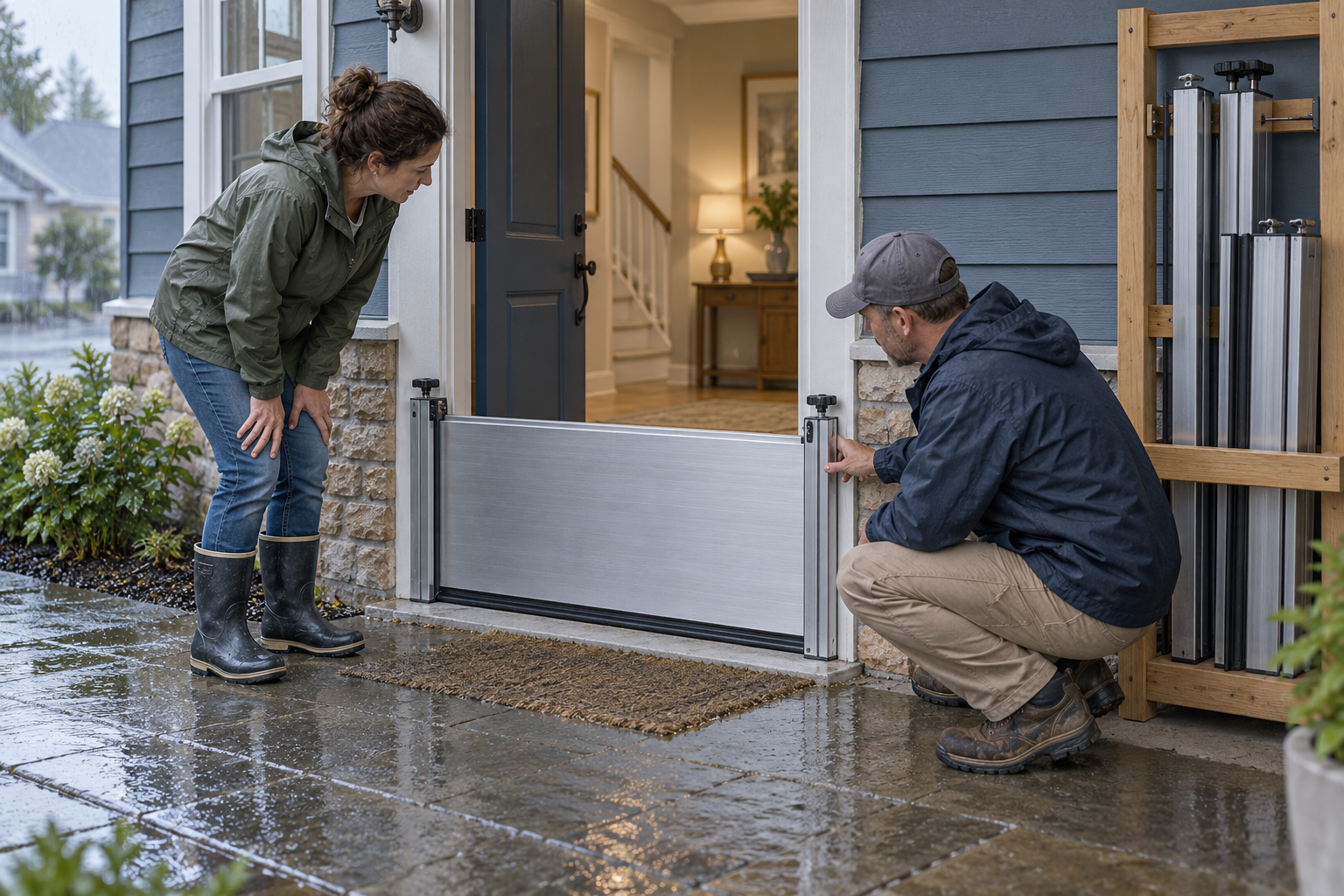
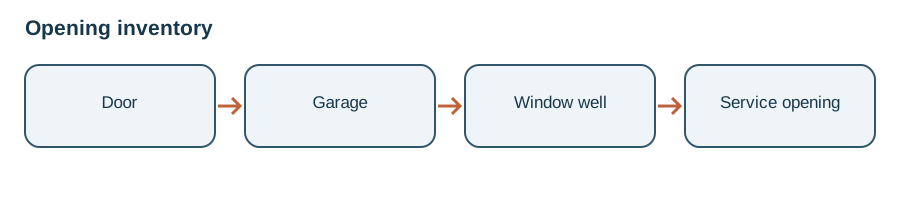
Common targets include exterior doors, garage doors, basement windows, window wells, low vents, and selected service openings. A removable panel may be stored and installed when a warning arrives. A permanently mounted track, gasket, panel, door, or deployable system may reduce setup time but can cost more and alter appearance, access, or maintenance.
The opening substrate matters. Brick, concrete, wood framing, cladding, a deteriorated sill, an uneven threshold, and an attached deck do not provide the same anchor or seal. The system must cover the full opening and maintain the wall, frame, threshold, and surrounding construction’s ability to resist the expected conditions.
A practical cost structure
Small removable products may appear inexpensive when priced by panel or linear foot. Installed systems can move into the thousands per opening after tracks, anchors, gaskets, engineering review, access, and finish work. Large garage openings, multiple doors, window wells, uneven masonry, and custom fabrication increase the budget. Storage racks, labeling, handling equipment, and labor to install before an event are real ownership costs.
Do not compare a product-only price with a contractor-installed permanent system. Ask for separate line items for measurement, product, anchors or tracks, substrate repair, installation, testing, storage, training, and restoration. Confirm whether the quote covers every opening or only the most visible one.
Performance and human limits
Pressure, depth, velocity, debris, duration, and hydrostatic or hydrodynamic forces matter. Use manufacturer performance data for the exact product and opening, and obtain engineering or local approval when required. A marketing label is not the same as site-specific suitability. Do not assume a barrier rated for one depth or wall condition works at another.
Deployment is a failure mode. Someone may be away, injured, late, unable to find the parts, or unable to assemble the system in rain and darkness. A temporary barrier can be reasonable as one layer when the warning time, storage, access, and training are reliable. It should not create confidence that the home can safely withstand a rapidly rising or moving flood.
When a different project is better
If water can enter through foundations, walls, drains, utilities, or adjacent structures, a door barrier alone may have limited value. Compare a barrier with backwater protection, sump redundancy, utility elevation, flood openings, wet or dry floodproofing, and structural elevation. Dry floodproofing has technical and structural limits; wet floodproofing changes how a space can be used; flood vents allow water to pass in suitable enclosures rather than blocking it.
Confirm floodplain, permit, insurance, and maintenance requirements locally. A U.S. federal flood guide is not a Canadian approval and an approved product in one jurisdiction may not be approved in another. Keep source-specific performance statements tied to the product and installation conditions.
The best barrier quote describes the water scenario, protected openings, deployment time, storage, testing, maintenance, and residual risk. The lowest material price is not necessarily the lowest-cost flood decision.
Include the deployment plan in the price
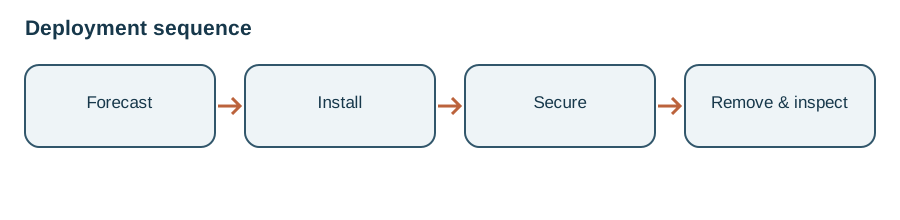
Ask who will inspect the components, transport them to each opening, install them, remove them, dry them, and store them after the event. A household may need a second person, lifting equipment, lighting, or a contractor callout. Include the time and cost of annual practice. If a barrier requires a warning of several hours but the site’s water can rise faster, its practical value may be lower than the product brochure suggests.
Label every panel and fastener by opening. Keep the installation instructions with the system, and check that future landscaping, siding, decks, or door replacement will not change the substrate or track. Ask the installer how the opening will be inspected after a repair and whether replacement gaskets and anchors are available.
Consider the failure after the opening is protected
Water can bypass an opening through the foundation, a floor drain, a wall joint, an unprotected vent, or a neighboring structure. A barrier may also redirect water toward another part of the building or create an access problem. The professional scope should describe the boundary of protection and whether pumps, alarms, backwater measures, or utility protection are part of the larger plan.
For repeated or high-force flooding, compare engineered floodproofing, elevation, or relocation rather than adding more temporary panels. The safer budget is the one that matches the event the structure can actually withstand.
Permanent versus deployable protection
Permanent panels or tracks can reduce the chance that a household misses a warning, but they may affect appearance, everyday access, and future door or window work. Removable systems may be cheaper or more flexible, but they depend on storage, people, timing, and repeated practice. A home that is vacant during storms may need a different arrangement from one with occupants who can deploy panels.
Ask whether the opening can be closed without blocking egress or emergency access. Confirm how the system is removed after an event, whether trapped water or pressure creates another issue, and whether the surrounding wall can tolerate repeated installation. Include replacement gaskets, corrosion checks, anchors, labels, and training in the ownership cost.
What a responsible claim sounds like
The product may be suitable for a defined opening and water condition when installed as documented. It should not be described as making the property floodproof, guaranteeing no damage, or replacing local engineering and approval. That wording protects the homeowner from paying for a performance claim that exceeds the evidence.
Match the opening to the ownership plan
A single door panel is a different purchase from a coordinated set for a garage, basement windows, and utility openings. For one opening, the main cost questions may be measurement, fit, anchoring, and who will install it. A multi-opening package adds inventory management: each panel must be identified, stored, moved to the right location, and installed in the specified sequence. A garage system may need more handling space and different attachment details than a small window-well cover. Ask for the count and size of every protected opening instead of accepting one bundle price.
The household should also consider who will be present when the system is needed. A removable panel may be economical for an owner who can reach the property, lift the parts, and complete installation in time. A permanently fitted system can reduce those steps, but it may affect daily access, appearance, maintenance, or future replacement of the door or window. A property that is rented, seasonally occupied, or vacant needs a clear plan for deployment; the owner cannot assume a visitor will know where parts are kept or how they fit.
Compare lifetime ownership, not only purchase price
Ask how often seals, gaskets, fasteners, tracks, or panels need inspection and what replacement parts cost. Confirm whether the manufacturer provides a written procedure for the exact opening and whether a contractor must inspect the wall or frame after other exterior work. Deck construction, new siding, threshold replacement, or landscaping can affect fit and access. A barrier can become obsolete if the opening changes while the stored parts remain labeled for the old dimensions.
Record the expected warning time and the person responsible for setup. Include any lifting aid, storage rack, practice session, annual inspection, contractor callout, and post-event cleaning. If those ownership tasks make timely use unlikely, compare a passive measure or a broader flood project instead. The better-value system is the one that fits the opening, the event, and the household’s ability to maintain and use it.
Test the deployment plan with the people who will use it
A barrier budget should account for the time and conditions under which it must be installed. Ask who will notice the warning, retrieve stored components, clear the opening, fit the barrier, and confirm that seals and fasteners are seated. Consider whether the people responsible will be home, physically able to handle the components, and able to reach the opening safely in poor weather. If the plan relies on several people or tools, include that dependency in the decision.
For a permanent panel or shield, ask how it is inspected, where removable pieces are stored, and whether the opening remains usable for ordinary access and emergency exit. For a deployable product, check that storage does not expose seals to damage and that the correct parts can be identified quickly. A demonstration or practice installation can reveal fit and handling issues before a flood watch.
Compare these operating costs with the consequences of protecting only one opening. Water can enter through other doors, vents, floor drains, or below-grade pathways, and pressure or duration may exceed the product’s intended use. Ask the supplier for the tested conditions and limitations, then have a qualified local professional assess the building-wide strategy where exposure is consequential. The quote should describe the intended boundary of protection, not promise that the house will be floodproof.