
Insulation can be worth paying for even when a simple energy-payback calculation is slow, but it is not automatically a good investment. The answer depends on what is already in the house, where heat and air are moving, the local climate, energy prices, the cost and timing of the work, moisture conditions, and the value of comfort or durability. A contractor’s generic savings percentage cannot answer a house-specific decision.
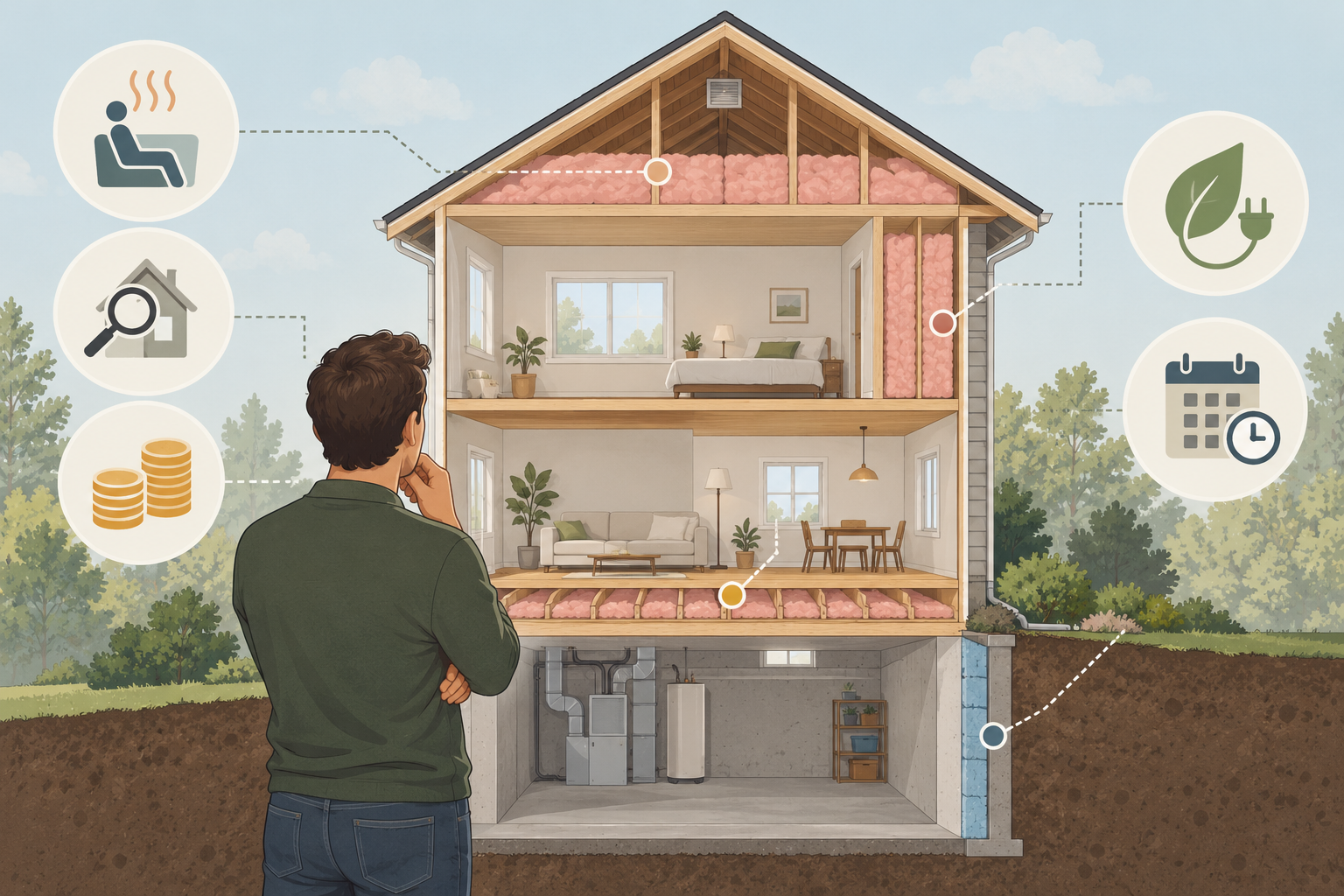
Start with the condition of the house
Adding insulation to an empty attic cavity can have a different value from adding another layer to an already deep, evenly distributed attic. A drafty house may benefit more from air sealing than from more insulation in the first phase. A cold floor may be caused by missing insulation, air leakage, wind washing, an unconditioned crawl space, or HVAC distribution. A damp assembly needs moisture-source correction before an energy upgrade.
Ask what was inspected and what evidence supports the proposed measure. A useful assessment identifies the assembly, existing depth or condition, leakage, access, and competing causes. Without that information, a price may be easy to calculate but the expected result remains uncertain.
A simple payback model
The basic calculation is:
simple payback = project cost ÷ estimated annual energy-cost reduction
The difficult term is the annual reduction. It depends on pre-project leakage and insulation, heating and cooling equipment, weather, thermostat settings, occupancy, fuel and electricity prices, and how the work is installed. If an estimate uses a modeled savings figure, ask for the assumptions and whether it describes a typical case, a range, or a guarantee. Do not treat an average result from a broad program or guide as a promise for one house.
For example, a project may appear attractive if the starting attic is nearly empty, leakage is measured, energy prices are high, and access is inexpensive. The same insulation depth may be poor value in an attic that is already adequately covered, difficult to reach, or scheduled for a future roof or siding project. A range of outcomes is more honest than one exact payback period.
Energy savings are not the only benefit
Air sealing and insulation can improve surface temperatures, reduce drafts, make rooms more even, and support a more predictable HVAC load. Correcting a moisture path or preventing condensation can protect materials, although no insulation project should be credited with solving moisture without a diagnosis. A quieter interior, fewer cold surfaces, or better use of a room may matter to the homeowner even when the bill savings do not repay the work quickly.
Separate these benefits from energy savings. Comfort is real but difficult to value in dollars. Durability value depends on the cause and the quality of the correction. If a quote uses those benefits to justify a high price, ask which condition is being addressed and how the result will be checked.
Air sealing versus more insulation
Insulation slows heat transfer; air sealing controls uncontrolled airflow. ENERGY STAR and DOE guidance treat them as related measures, especially in attics, but they are not substitutes. Sealing an accessible bypass before adding insulation may improve the value of the later insulation. Adding material over a wet, contaminated, or poorly detailed assembly can create a different problem.
Compare an air-sealing-first scope, an insulation-only scope, and a coordinated option when the evidence is incomplete. If the project involves combustion equipment, ventilation, roof lines, vapor control, or difficult moisture conditions, technical review matters more than a simple payback spreadsheet.
Diminishing returns and timing
The first correction in a deficient assembly may produce more value than the last increment of material. That does not mean one R-value is universally correct; climate, assembly, and local requirements matter. ENERGY STAR’s retrofit examples are U.S.-specific guidance and not a Canadian code table. Use them as context, not as a substitute for local requirements.
Timing can change the economics. Insulation may be cheaper to add while siding, roofing, interior walls, a basement, or an addition is already open. A standalone job can still be sensible if the current comfort or moisture problem is significant, but compare the avoided demolition and duplicated mobilization with the cost of waiting. A future project is not a reason to postpone a condition that is causing damage or unsafe performance.
Incentives and market context
Incentives can change the owner-paid cost, but eligibility, deadlines, and measures change by jurisdiction. In the United States, the Department of Energy says Home Energy Rebates are available in select states; ask the state or territory energy office about current availability and eligibility. The separate Weatherization Assistance Program uses state, territorial, or Tribal application routes and local providers. In Canada, Natural Resources Canada’s Canada Greener Homes Affordability Program page currently directs eligible households to participating provincial and territorial programs for no-cost retrofit pathways; the federal site does not accept household applications. Review the U.S. Home Energy Rebates status, U.S. Weatherization Assistance application route, and Canadian CGHAP pathways before counting any assistance. These routes do not guarantee household eligibility, a particular measure, or a payment.
U.S. and Canadian labor and energy markets also differ. Do not convert a U.S. installation price or savings estimate into Canadian dollars. Use local quotes, local energy prices, and market-specific program information. A program-funded scope may not be the same as a private comprehensive retrofit.
For U.S. projects, do not count the federal Section 25C Energy Efficient Home Improvement Credit toward work placed in service after December 31, 2025. The IRS says the credit is not allowed after that date. This federal cutoff does not decide eligibility for state, utility, or local assistance; verify those programs separately before using them in a payback estimate.
When insulation may not be the best first spend
The value may be weak when the assembly is already adequate, the primary problem is a roof leak or HVAC distribution, the work would disturb sound finishes, or the proposed material is incompatible with the moisture and drying behavior of the wall or roof. It may also be weak when the quote is too vague to know what is being corrected.
The answer is stronger when the homeowner can state: this assembly is deficient; this measured or observed condition is the reason; this sequence corrects it; this price includes the access and restoration; and this is how the result will be checked. Insulation is worth it when it solves a real, prioritized building problem at a cost that matches the household’s goals—not simply because more material sounds efficient.
A decision table in plain language
Insulation is more likely to be worthwhile when the target assembly is clearly deficient, the proposed work is accessible, the installation corrects a meaningful comfort or durability problem, and the price is reasonable for the expected life of the improvement. Air sealing may move to the front when measured leakage is high. A renovation-triggered opportunity may improve the economics because demolition and restoration are already planned.
The case is weaker when the existing assembly is already adequate, the proposed method is technically uncertain, the quote excludes access and restoration, or the main complaint points to a roof, opening, moisture, or HVAC problem. A project can still be worthwhile for comfort, but the owner should not justify it with a made-up payback period.
Ask for a range, not a promise
Request the assumptions behind projected savings: starting insulation, leakage, area, climate, energy prices, equipment, occupancy, and operating conditions. Ask how sensitive the result is if the work reaches fewer areas or if the house uses a different fuel. If the contractor cannot explain the baseline, treat the number as a marketing estimate rather than a project-specific forecast.
The same discipline applies to rebates. A program payment can change the owner’s cost, but it may have deadlines, eligible measures, audit requirements, or income and property rules. Confirm current availability before approving work. Keep incentives, comfort value, energy savings, and durability value as separate parts of the decision.
Decide on the result and the next trigger
Sometimes the best first step is smaller: seal the largest bypasses, insulate an exposed floor, correct a moisture source, or wait until siding is removed. A staged plan can preserve capital and provide information for the next decision. It should not defer a condition causing ongoing damage or a safety risk, but it can avoid spending on assemblies not yet shown to need work.
“Worth it” may mean lower energy use, better comfort, less condensation risk, fewer drafts, improved durability, or making use of renovation access. Ask which result the project is expected to produce and how it will be checked. A homeowner can reasonably choose comfort even when simple energy payback is long, but the quote should not promise savings that have not been measured or modeled.
Compare insulation with the next-best repair, including air sealing, moisture correction, equipment service, duct work, or planned window and siding access. Price removal, restoration, and future access when they matter. If the work is phased, name the trigger for considering the next phase: a test result, a planned opening, a persistent symptom, or a newly observed condition. Keep comfort, durability, incentives, and energy savings as separate parts of the decision.