
Closed-wall insulation can reduce interior demolition, but it does not remove uncertainty. Contractors may drill small access holes and blow or inject material into cavities, then patch the holes. The actual cost depends on wall construction, number of cavities, access from inside or outside, siding or finish repair, obstructions, and how the installer verifies coverage. There is no dependable national price for every closed-wall retrofit; compare the work method and assumptions rather than a single square-foot rate.
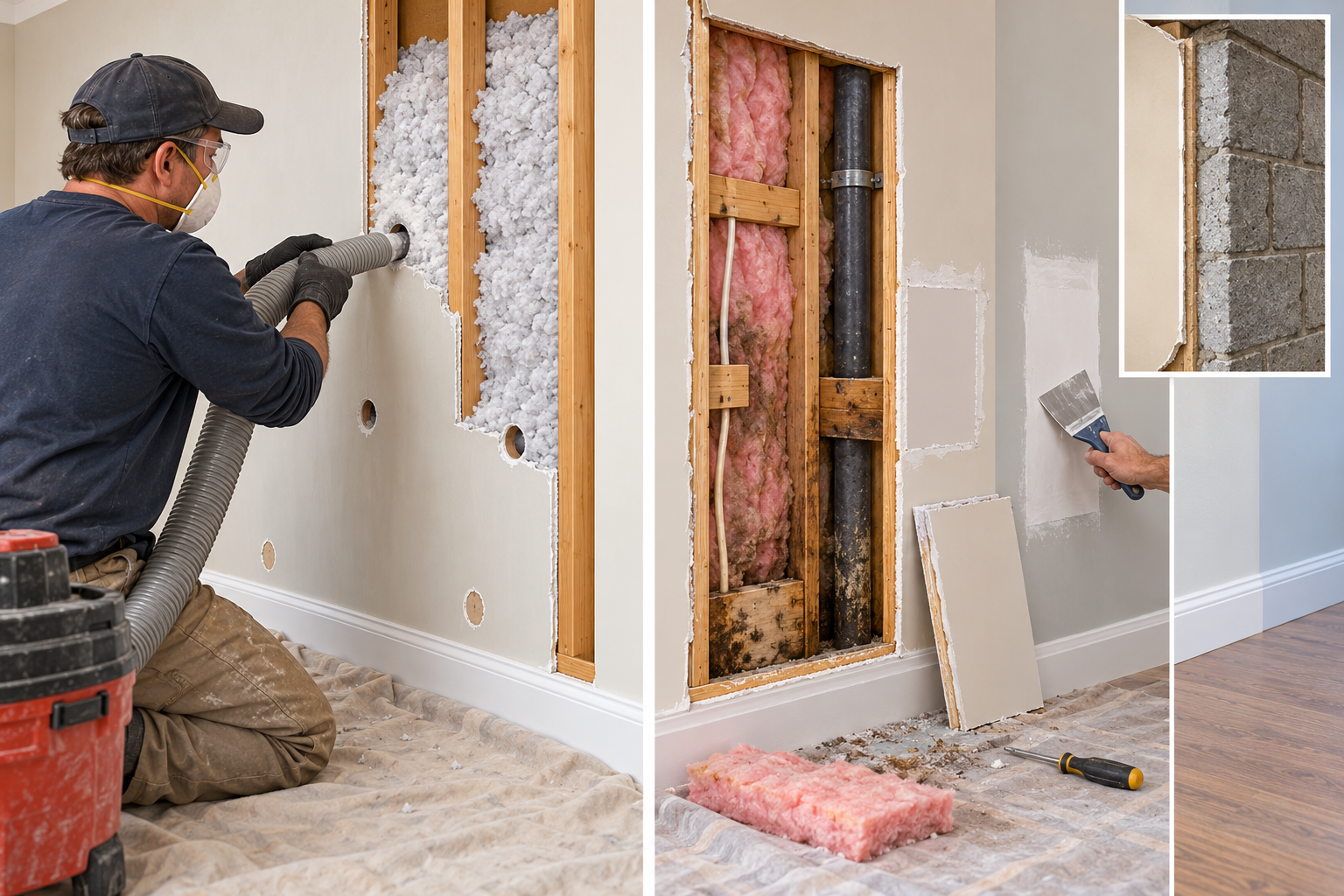
How installers reach the cavities
This guide’s drill-and-fill cost model assumes an identified framed wall with a suitable cavity. Solid load-bearing masonry is a different assembly; brick or stone on the exterior does not by itself establish either a framed cavity or a safe fill route. Confirm the wall construction before pricing cavity work. A masonry insulation guideline explains how interior insulation can change moisture and drying behavior in mass masonry, so use a wall-specific professional assessment instead of applying a generic cavity method.
Interior drilling can mean small patches in drywall or plaster, followed by texture matching and painting. Exterior drilling may reduce indoor disruption but can require patching siding, masonry, shingles, or trim. Some projects use a row of access points while others open a larger section to inspect and repair the wall. The quote should identify where holes will be made and what finish restoration is included.
The choice depends on the cladding, the interior finish, the planned renovation, and the confidence needed in the result. A wall that is already open may be cheaper to insulate correctly than a closed wall that requires exploratory work and repeated patching.
Material and method families
Dense-pack cellulose or fiberglass may fill suitable cavities when the installer understands the wall and controls the installation density. Injection foam is a product-specific method with its own expansion, moisture, and compatibility questions. A material’s marketing description does not establish that it belongs in every old wall, every climate, or every cavity condition.
Insulation is only one layer. The retrofit should explain how air leakage, vapor diffusion, bulk water, and drying are treated. Adding insulation to a wet or poorly draining wall can make the symptoms harder to see without correcting the source.
Cost layers
Separate the quote into investigation, access, insulation, patching, finish restoration, and any control-layer or cladding work. A small wall section may carry a contractor minimum. A whole-house project may cost more because of floor-by-floor setup, furniture protection, exterior access, and the number of openings. Add-ons can include cavity probes, borescopes, removal of failed material, electrical or plumbing coordination, and post-work inspection.
Low-disruption does not mean low-cost. The labor saved by avoiding full demolition may be partly replaced by drilling, moving equipment, filling around obstructions, cleaning, and matching the existing finish. Ask whether the quote covers both sides of an exterior wall and what happens when a cavity cannot be filled.
Conditions that make closed-wall work uncertain
Older or altered walls may contain partial insulation, rubble, sheathing, fire blocking, knob-and-tube wiring, plumbing, ducts, or multiple cavities. Additions may use a different assembly. The installer may not know the fill condition until exploratory holes are opened. Request the method for checking coverage and the remedy for voids.
If moisture staining, rot, pest damage, or hazardous material is found, stop treating the job as a routine insulation fill. Water management, structural repair, pest work, or hazard abatement may be required first. Those scopes have different professionals and costs.
For paid work that disturbs painted surfaces in covered pre-1978 U.S. housing or a child-occupied facility, EPA’s Renovation, Repair and Painting rule may apply. Its January 2026 FAQ says drill-and-fill access is counted by the combined painted surface area of the holes, not by the wall area insulated. The minor-repair exception is six square feet or less of paint per interior room over any 30-day period, or twenty square feet or less total exterior paint for the property; prohibited practices, window replacement, and demolition of painted surfaces are outside that exception. Confirm the rule and any stricter state or local requirements with the hired firm before work. These U.S. thresholds do not establish Canadian requirements or whether a surface contains lead. See the EPA lead-based paint FAQ.
When opening the wall is better
Open-wall work may be the better economic choice when the interior is already being renovated, the wall needs wiring or plumbing changes, the existing assembly is damaged, the cavity fill must be verified, or the exterior will be stripped for siding work. It may also make it easier to build a continuous air-control layer and repair sheathing or flashing.
The lower-disruption option is often attractive when finishes are valuable or the homeowner needs to remain in the house. Compare disruption, quality confidence, future repair access, and finish cost—not only the initial invoice.
U.S. and Canadian context
The U.S. and Canada share the challenge of heterogeneous existing walls but not the same construction practices, codes, and labor markets. General U.S. building-science guidance should not be treated as Canadian code. Request local advice for vapor-control and product compatibility, and compare local quotes in their original currencies rather than inferring Canadian pricing from U.S. quotes.
Questions for the contractor
Ask how the wall is identified, how empty and partly filled cavities are distinguished, which side will be drilled, how obstructions are handled, how fill is verified, and how holes will be patched. Ask for the intended air and moisture strategy, the assumptions about drying, and the boundaries for wiring, plumbing, windows, doors, and cladding.
Closed-wall insulation can be a sensible way to limit disruption when the assembly is suitable and the fill can be responsibly verified. It is a poor bargain when a low initial price hides unknown cavities, incomplete coverage, unresolved moisture, or a finish repair that was never included.
What the contractor should know before drilling
Ask how the wall was built, where framing and services are located, whether the cavities are empty or partly filled, and how the installer will test or verify the result. One outlet or one exploratory hole does not represent every wall, addition, floor, or renovation era in a house. Older construction, masonry, unusual sheathing, dense wiring, plumbing, and previous repairs can change the feasibility.
The access plan matters. Interior drilling can reduce exterior disruption but leaves patching and painting. Exterior drilling can protect interior finishes but may affect siding, trim, weather barriers, and opening details. A quote should show hole repair, color or texture matching assumptions, and whether the surface can be restored invisibly.
When a low-disruption method is not enough
Closed-cavity filling may be a poor choice when moisture is entering, the cavity has debris or damage, the wall is difficult to verify, or a broader exterior renovation will soon expose the sheathing. Opening the wall can cost more initially but may allow air sealing, wiring or plumbing correction, sheathing repair, and a more complete assembly. Exterior insulation may provide continuity where cavity fill cannot.
Do not let the phrase “no drywall removal” imply no demolition or no uncertainty. A wall can remain visually intact while the contractor drills, patches, removes siding, or encounters concealed conditions. Compare the complete disturbance and restoration costs of each path.
Technical and market boundaries
Dense-pack cellulose, fiberglass, injection products, and foam have different installation and moisture implications. Product-specific claims require current manufacturer information and qualified review. A generic price guide cannot decide whether a material is suitable for a particular cavity or climate. The available market evidence is directional and does not establish a universal U.S. or Canadian range.
The best closed-wall proposal explains how the material reaches the cavity, how gaps and obstructions are handled, how the air and moisture strategy remains sound, and how the owner will know whether the work was completed. Lower disruption is valuable only when the hidden uncertainty is managed rather than priced away.
A reasonable verification plan
Ask how the contractor will confirm which cavities were reached and whether the material filled the intended areas. The plan may use measured quantities, access holes, photographs, probing, or another method appropriate to the product. No verification method can make an inaccessible wall completely known, so the report should identify remaining uncertainty.
Ask how patches will be finished and whether later siding, window, door, or electrical work can disturb the repair. A no-drywall-removal promise may still involve exterior holes, trim removal, drilling, dust, and paint matching. Put those effects in the scope before comparing it with an open-wall option.
The best low-disruption project is not the one that hides the most information. It is the one that limits demolition while explaining the assembly, the installation limits, the moisture boundary, the finish work, and the result the homeowner can reasonably expect.
Name the uncertainty that remains
Drilling, dense-pack, exterior access, or targeted openings can reduce disruption, but each method has limits. Ask how the contractor will find framing, detect obstructions, confirm cavity fill, protect wiring and plumbing, and handle bays that cannot be reached. If the existing wall has unknown moisture, fire blocking, or previous repairs, a low-disruption approach may leave more uncertainty than the homeowner expects.
The estimate should distinguish exploratory openings, installation, patching, painting, and any exterior or interior finish work. It should state how incomplete fill or unexpected cavities will be reported and whether the work changes the wall’s air or vapor-control behavior. Photos, a hole map, and product information give future contractors useful context without requiring the entire wall to be opened again.