
Attic frost, damp insulation, water stains, or visible condensation are symptoms, not a single repair. The paid-work path may involve air sealing at the ceiling plane, insulation correction, a roof or flashing repair, exhaust relocation, humidity control, ventilation work, drying, or environmental remediation. A useful budget begins with diagnosis and separates those possibilities rather than assigning one “attic moisture” price.
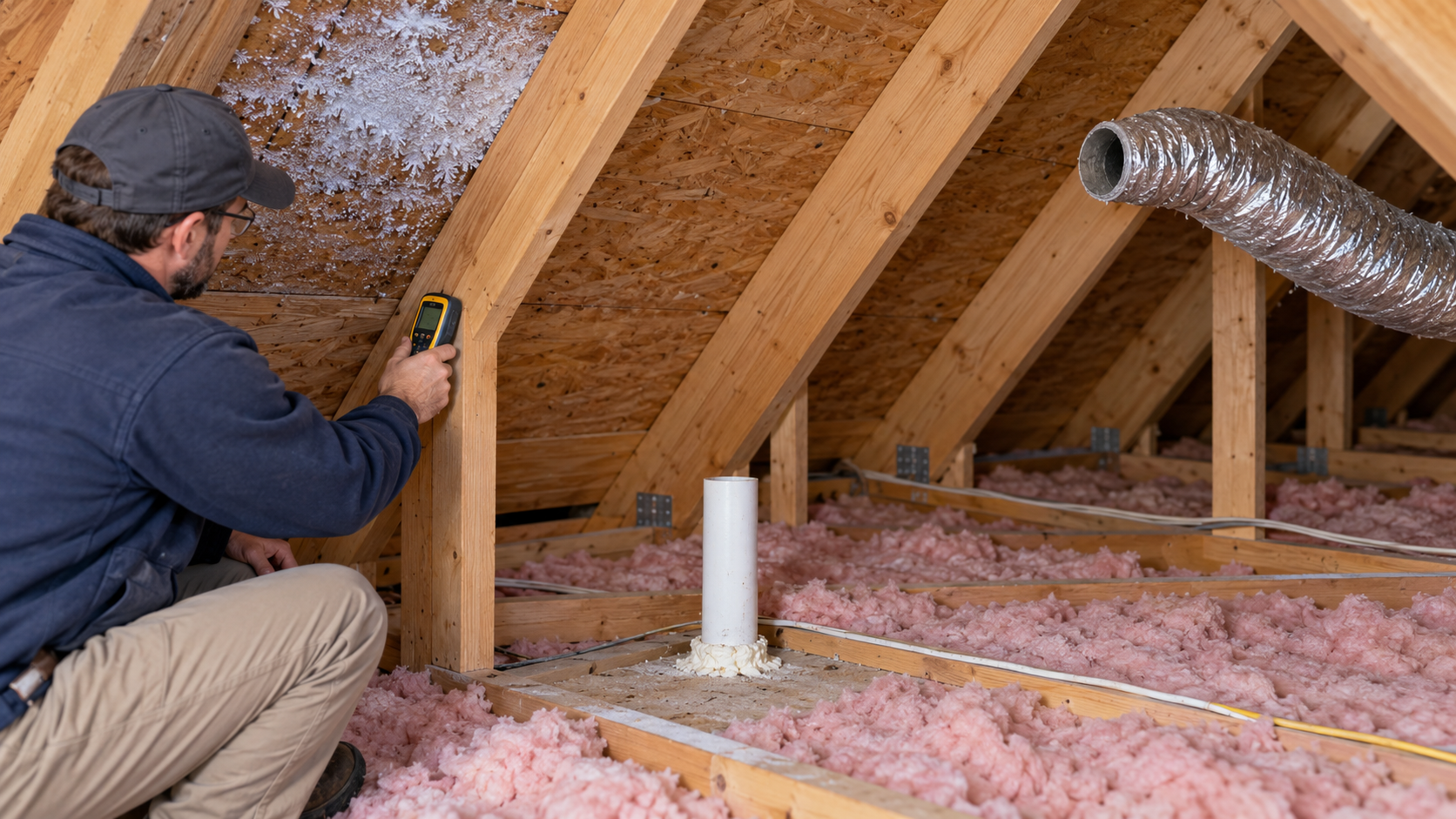
Illustrative planning scenario
For a modest U.S. attic, a useful first model is a diagnostic visit plus one accessible correction: budget roughly $300–$700 for assessment, then $1,000–$3,000 for limited air sealing, insulation handling, or exhaust correction. A roof repair, drying, removal, or remediation scope is additional. These are planning assumptions, not a national price; Canadian homeowners should request a local quote in CAD.
Why attic moisture is difficult to price
Warm indoor air can carry moisture through ceiling penetrations into a cold attic. A roof leak can wet the same insulation from above. Bathroom, kitchen, or dryer exhaust that terminates in the attic can add a direct moisture source. High indoor humidity, blocked or inadequate ventilation, cold thermal bridges, and damaged roof details can also contribute. More than one cause may be present.
The visual location of a stain does not prove where water entered. A professional may inspect the roof covering and flashing, insulation distribution, penetrations, exhaust routes, ventilation, indoor humidity, and framing condition. A moisture meter, thermal imaging, or limited opening may help, but no single measurement automatically identifies the full repair.
Typical cost paths
A limited diagnostic visit is the smallest project class. It may produce observations and recommendations but not include corrective work. A straightforward enclosure correction may then involve sealing bypasses, moving or adding dry insulation, and improving a hatch or penetration. A roof-driven problem may require flashing or roof repair. An exhaust-driven problem may require duct routing or mechanical work. A contaminated or structurally damaged attic can become a remediation or carpentry project.
The cost rises when the source cannot be reached without removing insulation, when the attic is cramped, when finishes below need protection, or when several trades must coordinate. Drying, disposal, replacement insulation, and finish restoration are often separate lines. Ask whether the estimate includes only investigation, a defined correction, or a complete source-to-restoration scope.
Air leakage and insulation corrections
ENERGY STAR recommends completing attic air sealing before the attic insulation project. Sealing can address penetrations, dropped soffits, chases, ceiling fixtures, and other paths that move heat and moisture. Insulation may then be redistributed, topped up, or replaced if it is dry and sound but inadequate. Dry, undamaged insulation may remain when coverage, depth, and contamination are acceptable.
Do not cover wet material before the source is corrected and the assembly is dry. Wet or heavily contaminated insulation can require different handling. Suspect vermiculite or asbestos, mold remediation, pest contamination, or post-loss drying does not belong in an ordinary insulation allowance. Those conditions should be referred to qualified environmental, pest, or restoration professionals.
Roof leaks, exhaust, and ventilation boundaries
Roof leaks and flashing failures belong to the roofing scope when they are the dominant cause. Bathroom, kitchen, or dryer exhaust problems may require HVAC or ventilation work. Attic air sealing should not block designed ventilation paths or conceal a flue, wiring hazard, rot, or an exhaust outlet. A contractor should identify which condition is being corrected and which other trade is needed.
Ventilation is not a universal cure for every moisture symptom. It has to work with the assembly, roof form, insulation, exhaust paths, and climate. A quote that promises to “vent the attic” without explaining the source and the intended airflow may simply add work without correcting the leak or air bypass.
Indoor humidity and urgency
EPA homeowner guidance identifies condensation as a possible sign of elevated humidity and recommends controlling moisture sources and drying damp materials promptly. Its general indoor relative-humidity guidance is below 60%, ideally around 30–50%, but a single humidity reading does not diagnose an attic assembly. Occupancy, weather, climate, and building operation affect what the number means.
Urgency rises when water is actively entering, framing is soft or rotted, insulation is saturated, mold is extensive, a ceiling is sagging, or a combustion appliance or flue is involved. Stop treating the job as an insulation upgrade when the condition may affect health, fire safety, structure, or the building envelope’s ability to dry.
How to compare estimates
Ask each contractor to separate:
- diagnostic inspection and measurements;
- roof, flashing, or exterior water correction;
- exhaust or ventilation correction;
- attic air sealing;
- insulation movement, removal, disposal, and replacement;
- drying, cleaning, or environmental remediation;
- framing or finish repair; and
- follow-up inspection or testing.
Ask for the competing causes considered, the evidence for the selected cause, and the condition that would trigger additional work. A quote that starts with “replace all insulation” may be reasonable in some cases, but it should explain why leaving dry material in place is not suitable. A quote that starts with spray foam or ventilation should explain how the roof assembly and drying path will behave afterward.
Map the moisture pattern before pricing a fix
A useful inspection records the location and extent of the dampness, whether it appears after rain or during cold weather, and whether nearby materials are wet, stained, frosted, or merely discolored. Ask the assessor to look at roof sheathing, framing, insulation, ceiling penetrations, and exhaust ducts as separate clues. A stain at one rafter or one patch of insulation can reflect a different path from condensation across a broad roof surface.
The pattern helps choose the next test, but it is not a diagnosis by itself. A moisture meter reading, indoor humidity measurement, or infrared image needs context from the material, weather, and assembly. Ask which observation supports the proposed cause and what would change the plan. If the estimate recommends removing insulation, replacing ventilation, or applying foam, have it explain how that measure addresses the observed pattern and what moisture source it leaves outside the scope.
Also ask whether the proposal will change the attic’s air boundary or ventilation strategy. Sealing a ceiling bypass, moving an exhaust termination, and changing roof-deck insulation address different paths; doing one without checking the others can leave the original moisture mechanism active. A scope should identify the intended sequence and the point at which the contractor will stop for a qualified review.
U.S. and Canadian context
The building-science principles are shared across the two markets, but roof assemblies, weather, code requirements, contractor practice, and prices differ. The available research supports multiple possible correction paths, not a universal U.S. or Canadian attic-moisture price. Keep currencies separate and request a local diagnosis. Do not use a converted price as evidence of the other market.
The right budget is the one that identifies the source, makes the moisture boundary understandable, and states what happens if the first hypothesis is wrong. Moisture correction should make the attic drier and more durable; it should not merely make the stain less visible.
Record evidence before choosing the repair
A contractor should note where moisture was observed, whether the material was wet at the visit, recent weather, and which surfaces or penetrations were checked. Frost in one roof area, a dark patch in insulation, and a ceiling stain can have different explanations. Ask whether the proposed cause is confirmed, likely, or one of several hypotheses, and what further inspection would distinguish them.
If insulation must be lifted or removed, agree on a pause point before disposal. Request photographs and a short condition record showing whether the substrate is dry, framing appears sound, and the material can be reused. A contingency should name the condition that triggers added work, its unit price or allowance, and who must approve it. This helps prevent an opening from turning into an undocumented roof, environmental, or structural project.
Set a follow-up condition
Tie the post-repair check to the suspected mechanism. A roof or flashing correction may need observation after heavy rain; an attic bypass or exhaust correction may need checking during cold weather or after the next period of high indoor humidity. Ask who will perform the check, when it will occur, and which locations will be revisited. One visit cannot prove that every moisture mechanism has been eliminated, so the scope should describe what the inspection can and cannot confirm.
Keep the repaired locations, photographs, weather conditions, and humidity readings when available with the invoice. If the symptom returns, those records help a later specialist test the original hypothesis before opening more of the assembly. If the attic remains dry, they also help the owner decide when a planned insulation upgrade can proceed.