
Key points
Check the water path before choosing a system
Walk the yard after a meaningful rain and mark where water begins, where it concentrates, and how long it remains. Note roof downspouts, low areas, slope breaks, retaining walls, paved edges, foundation walls, and any outlet that backs up. A contractor can price a collection system more honestly when the source and destination are visible.
Ask whether the proposal is correcting the source, the conveyance route, the receiving area, or only the visible puddle. Keep those scopes separate. The best budget comparison is between complete water paths with the same assumptions for excavation, access, disposal, restoration, and local review.
- Price the water-management function, not the label “drainage.”
- U.S. market signals are approximate and should not be converted into Canadian dollars.
- Outlet feasibility, excavation, soil, access, and restoration often matter as much as pipe or aggregate.
- A wet foundation or progressive slope movement needs separate diagnosis rather than a guaranteed French-drain fix.
U.S. price signal for one drainage component
HomeGuide’s French drain cost guide lists about $10–$35 per linear foot for an exterior yard French drain. Treat this as a narrow U.S. planning signal for that drain configuration, not as a whole-yard drainage budget or a rate for deep foundation drains, grading, catch basins, swales, dry wells, outlet work, or Canadian projects. Soil, excavation, outlet feasibility, access, and restoration can change a proposal substantially.
A complete drainage scope
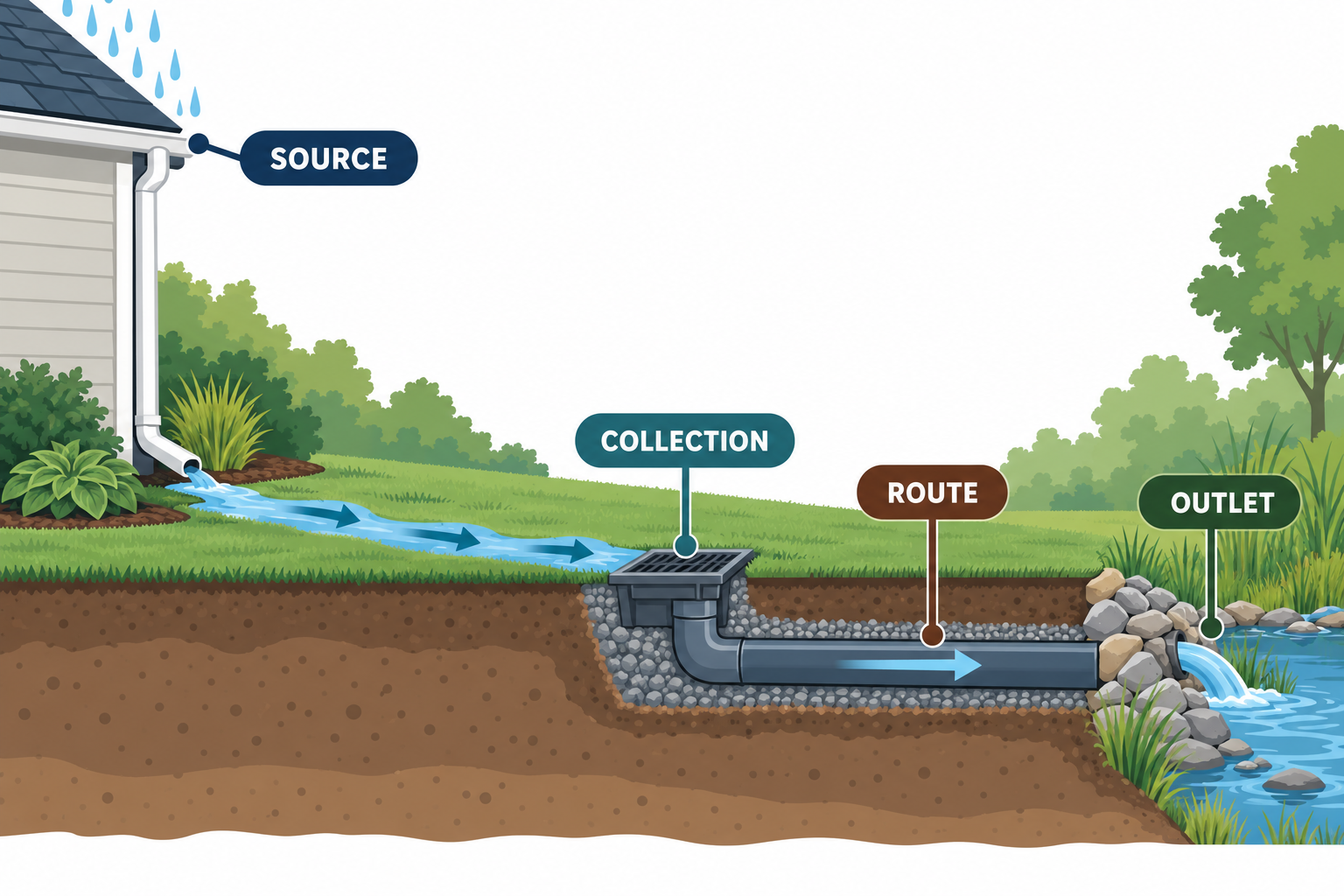
Before comparing totals, divide the project into four questions: where water comes from, how it is collected, how it travels, and where it ends. A proposal that answers only the second question may be pricing an inlet rather than a working drainage system. For example, a catch basin at a low point still needs pipe capacity, a stable route, an outlet, and access for sediment removal.
The same distinction helps when a contractor recommends a French drain. Ask whether the perforated pipe is intended to intercept water in the soil, collect surface flow, or manage one concentrated discharge. Those purposes can require different trench locations, restoration, and outlet assumptions. If the answer is simply that the product is commonly used for drainage, the system has not yet been matched to the property.
Choose the function before the product
Grading changes the surface path; a swale guides surface water; a catch basin collects water at a defined low point; a channel drain intercepts water at a hardscape edge; a French drain can intercept water in soil; and a dry well or other infiltration feature receives water only where site conditions and local rules allow it. A project may combine several functions. The useful comparison is not which label is cheapest, but whether every proposal addresses the same source, route, receiving point, and restoration boundary.
Ask each bidder to separate investigation, collection, conveyance, outlet or infiltration, excavation, disposal, surface restoration, and future access. An inexpensive inlet or pipe allowance is not a complete price if the proposal does not say where collected water goes or what will be restored afterward. Where soil, groundwater, property boundaries, an outlet, or grade conflicts are uncertain, a paid site assessment can be a better first expense than choosing a product and discovering the constraint after digging.
What to document before work starts
Make a simple sketch showing the house, roof downspouts, paved areas, low spots, slopes, retaining walls, property boundaries, existing inlets, and any visible discharge point. Add photographs after rain and note whether water arrives from an adjoining property or a higher part of the lot. This record is not a substitute for a survey or inspection, but it gives every bidder the same starting information.
Ask the selected contractor to return a marked-up version showing the proposed route and finished elevations. Keep the route record, outlet description, maintenance points, and restoration scope with the project documents. That information matters if a later fence, patio, tree, utility repair, or foundation investigation crosses the drainage line. It also helps separate a maintenance problem from a failed design when performance changes.
Check who owns the route and which costs sit outside the bid
Before pricing a private yard drain, identify the route it connects to and who maintains that route. A private drain, municipal drain, roadside ditch, storm sewer, and shared swale have different owners and approval paths. Ask the municipality or drainage authority which current plan, bylaw, easement, or maintenance record applies before changing a grade or outlet. Ontario’s municipal-drain guidance explains the statutory assessment and access questions; the property-record and cost guide details which records to request. This process does not price a private French drain or decide a property’s assessment by itself.
Keep public charges and assistance separate from the contractor’s installation price. A recurring stormwater bill, bill credit, project rebate, or reduced- price service can follow different eligibility and payment rules. Confirm the program and account terms before subtracting a benefit from the gross quote; the stormwater budget guide compares those mechanisms across drainage choices.