
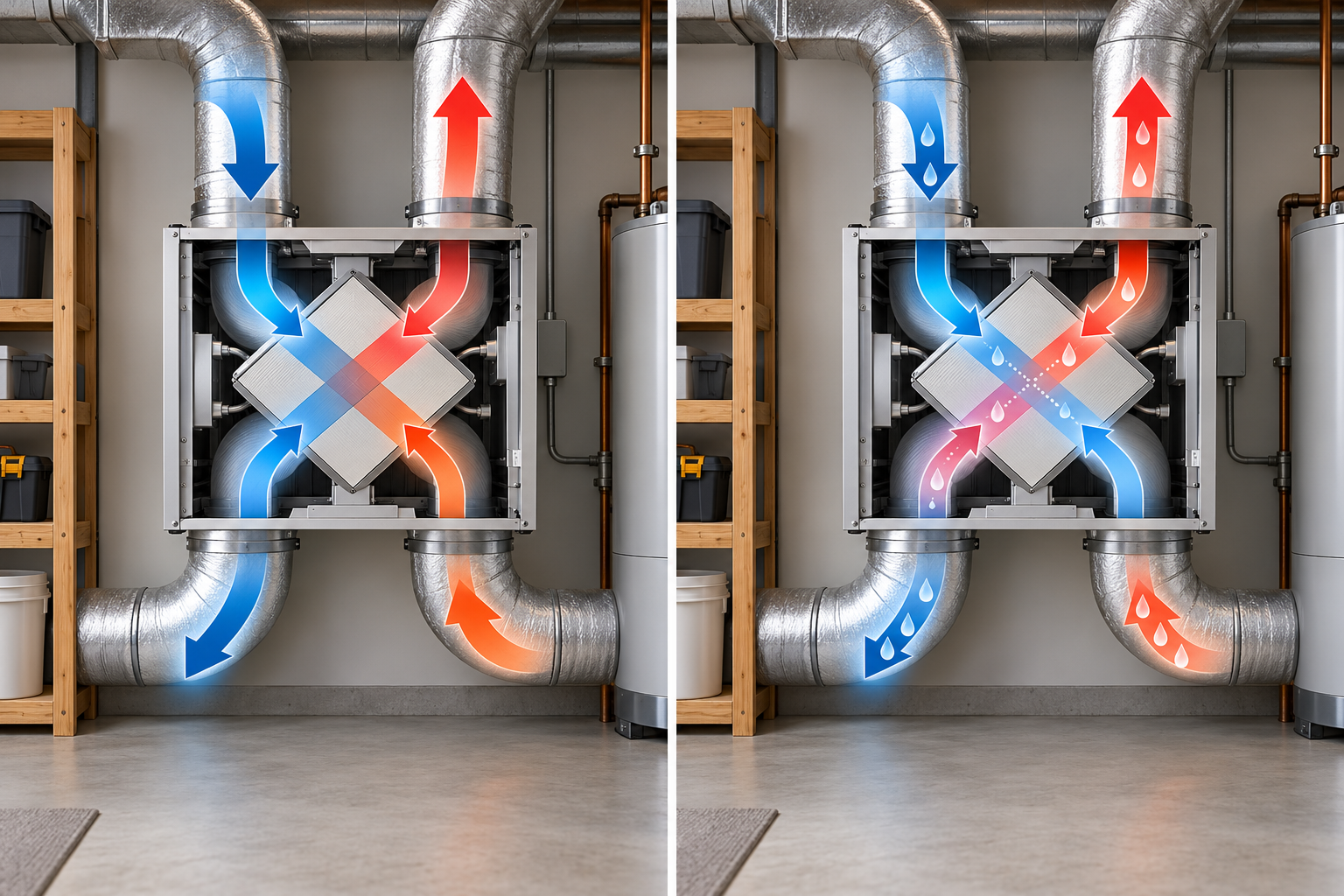
An HRV primarily recovers heat. An ERV recovers heat and transfers some moisture. The better choice depends on climate, indoor moisture, cooling load, building enclosure, occupancy, duct design, controls, and maintenance—not a one-line climate label. The installed cost difference may be smaller than the cost of ducting, access, balancing, and commissioning shared by either system.
Illustrative planning scenario (U.S. dollars, September 2026)
This is a worked comparison, not a product-price claim: assume identical $3,000 equipment allowances for an HRV and ERV, then compare $3,500 of shared duct and installation work plus $1,000 for balancing and controls. Each illustrative installation is $7,500 before tax; the climate and moisture objective should decide the equipment.
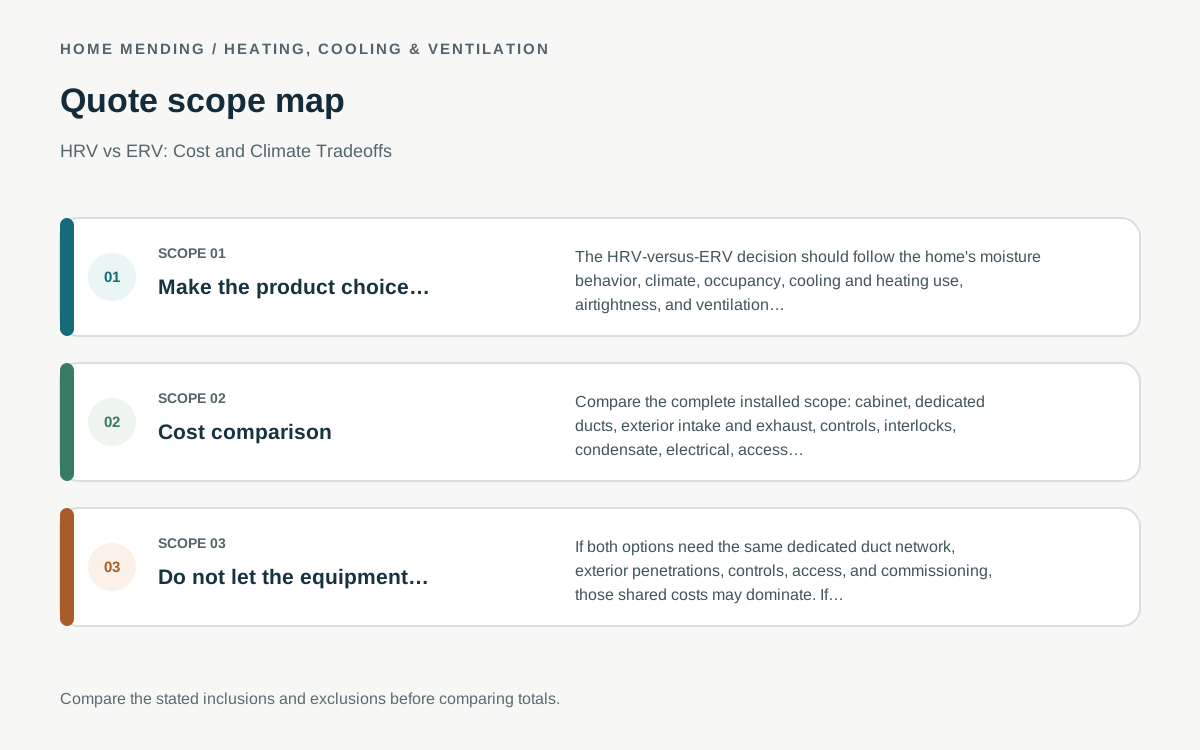
Make the product choice subordinate to the design
The HRV-versus-ERV decision should follow the home’s moisture behavior, climate, occupancy, cooling and heating use, airtightness, and ventilation objective. An ERV transfers some moisture as well as heat; an HRV primarily transfers heat. Neither fact selects a product without the home’s conditions.
Compare the complete shared scope first, then the incremental equipment and service difference. Include ducts, penetrations, controls, balance, commissioning, filters, core access, fan service, and future parts. Ask what observation would change the choice. This produces a more useful decision than a universal geographic rule.
Compare the decision over a season and a service call
The equipment choice affects more than heat transfer. Consider how occupants use ventilation, whether the home already struggles with dryness or humidity, how often filters and cores can be serviced, and whether the system will be operated continuously or intermittently. A unit that is technically suitable but noisy, inaccessible, or confusing to control may deliver less value because it is not used as intended.
Normalize the proposals by separating cabinet, duct routes, penetrations, controls, electrical, balancing, commissioning, access, and warranty. Then compare the incremental HRV-versus-ERV choice. If the installation scope changes with the product, the extra duct or control work may matter more than the cabinet. Ask what evidence would justify changing the selection and what outcome will be checked after installation.
An HRV can be attractive when heat recovery is the main objective and moisture transfer is not desired. An ERV can be useful when transferring moisture out during cooling or retaining some moisture during dry heating conditions matters. NRCan notes that excessive dryness may reflect over-ventilation or incorrect adjustment, and that system choice should consider climate and indoor moisture.
Neither device corrects a water leak, mold problem, unsafe combustion condition, or poor building-envelope design. Ventilation and hazard or moisture-source correction remain separate decisions.

Cost comparison
Compare the complete installed scope: cabinet, dedicated ducts, exterior intake and exhaust, controls, interlocks, condensate, electrical, access, balancing, commissioning, filters, and maintenance access. If both options use the same duct network, the incremental equipment and control difference may be less important than the design and installation quality.
An ERV’s moisture-transfer behavior is model-specific. Ask for performance information for the actual product and climate; do not generalize one model’s rating to all ERVs.
Climate and moisture scenarios
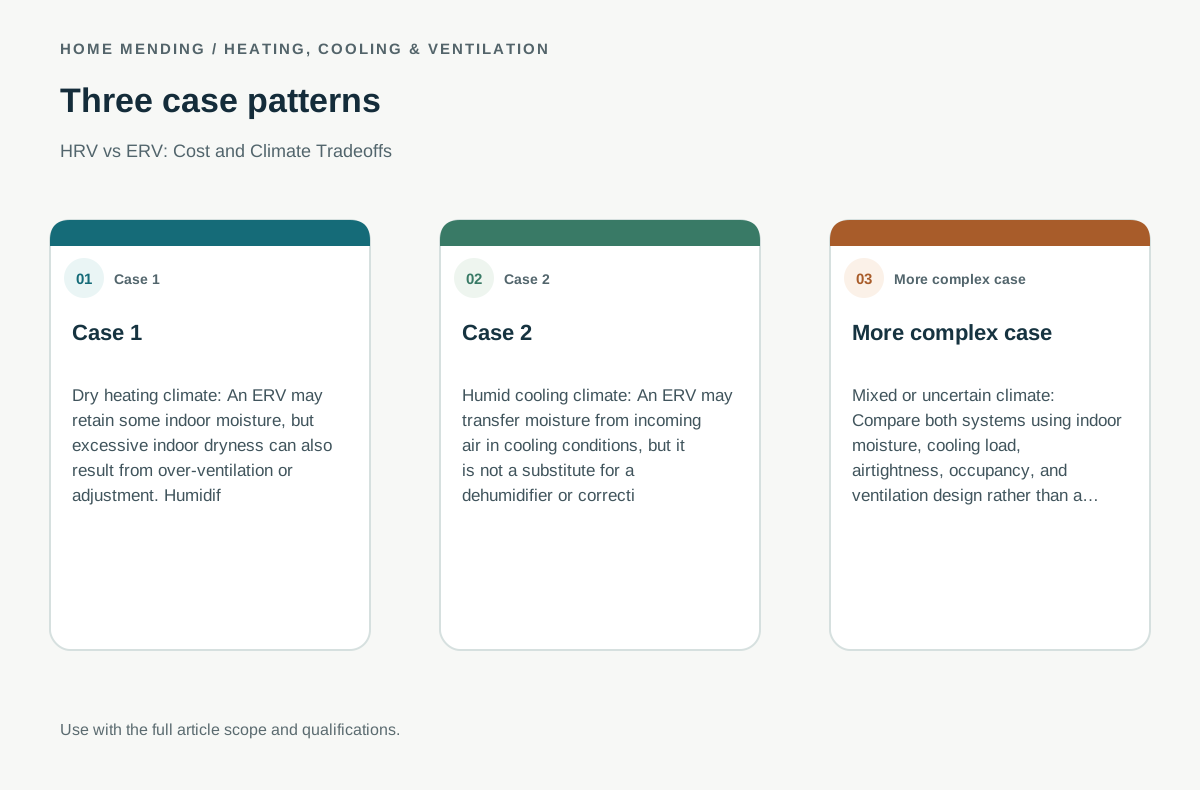
Dry heating climate: An ERV may retain some indoor moisture, but excessive indoor dryness can also result from over-ventilation or adjustment. Humidifier and envelope decisions may be separate.
Humid cooling climate: An ERV may transfer moisture from incoming air in cooling conditions, but it is not a substitute for a dehumidifier or correction of bulk moisture.
Mixed or uncertain climate: Compare both systems using indoor moisture, cooling load, airtightness, occupancy, and ventilation design rather than a simplistic rule.
Ownership tradeoffs
Both systems need filter and core attention and proper balancing. A system that is difficult to access may cost more to maintain and perform poorly when neglected. Controls, sensors, defrost or frost behavior, service availability, and replacement parts matter over the ownership horizon.
Decide what moisture behavior the home needs
The useful distinction is not simply that one product is for one climate. Consider indoor moisture, outdoor conditions, occupancy, cooling and heating seasons, building airtightness, and the ventilation objective. An ERV transfers some moisture as well as heat; an HRV primarily transfers heat. That changes the design conversation, but does not establish a universal winner.
If the same ducts, penetrations, controls, balancing, and commissioning apply to both, compare the equipment, service access, filters, core maintenance, controls, and expected operating behavior. If the proposals use different layouts, the duct and access premium may dominate. Ask for the assumption that drives the selection and what would change it.
Choose HRV when heat recovery is the priority and the moisture behavior fits the home. Choose ERV when moisture transfer has a clear climate and indoor-condition rationale. If the recommendation is based only on geography or product marketing, ask for the load, moisture, and ventilation assumptions.
Request a comparable quote with room coverage, equipment data, ducts, controls, penetrations, balancing, commissioning, warranty, and exclusions. The right choice is the system that resolves the home’s ventilation and moisture decision at an acceptable installed and ownership cost.
Do not let the equipment difference hide the project
If both options need the same dedicated duct network, exterior penetrations, controls, access, and commissioning, those shared costs may dominate. If one option requires a different duct or condensate arrangement, isolate that incremental scope. Ask for the total installed difference and the assumptions behind it.
Use the ownership horizon
For a long-horizon owner, moisture behavior, maintenance access, service availability, and replacement parts may matter more than a modest initial premium. For a short horizon, a simpler system may be reasonable if it fits the climate and building. Do not assume a future owner will value a particular device without documentation and a clear performance rationale.
Decision-changing questions
Ask what indoor moisture condition, cooling load, airtightness, and occupancy assumption drives the recommendation. If those inputs change, the choice may change. A climate label alone is not enough to justify HRV or ERV.
Make ownership visible
Include filter and core maintenance, service access, controls, fan replacement, balancing, and future equipment availability in the comparison. A modest equipment premium can be worthwhile when it fits the moisture problem; a cheaper unit can be poor value when it is difficult to service or poorly commissioned.
The final decision should state the home’s climate and moisture rationale, shared installation scope, incremental price, and uncertainty. Do not promise that either product will solve humidity without source and ventilation evaluation.
Use scenarios instead of a universal winner
An HRV may fit a home where heat recovery is the main objective and indoor moisture is already high enough that additional moisture transfer is not desired. An ERV may be more attractive when transferring some moisture helps manage the balance between dry heating conditions and humid cooling conditions. Those are design questions tied to the home’s climate and moisture behavior, not labels that apply to every region.
If both proposals use the same ducts, controls, exterior penetrations, balancing, and commissioning, compare the incremental equipment and service implications directly. If the systems use different duct strategies, the installation difference may outweigh the cabinet difference. Ask what observation would cause the designer to change the selection and what maintenance access each option requires.