
A building-envelope assessment commonly costs less than the retrofit it is intended to scope, but the price depends on what the assessor actually does. A visual walk-through, a measured energy assessment, a blower-door test, infrared imaging, moisture investigation, and a written retrofit plan are different services. In the United States, a current specialist guide reports roughly USD 200–700 for an audit package that includes a blower-door test, infrared scan, and utility-bill analysis. In Canada, Natural Resources Canada reports that a pre-retrofit and post-retrofit EnerGuide evaluation pair may average CAD 600–1,000, with provider and province or territory affecting the price. These figures describe different packages, not a North American rate card.
What you are paying for
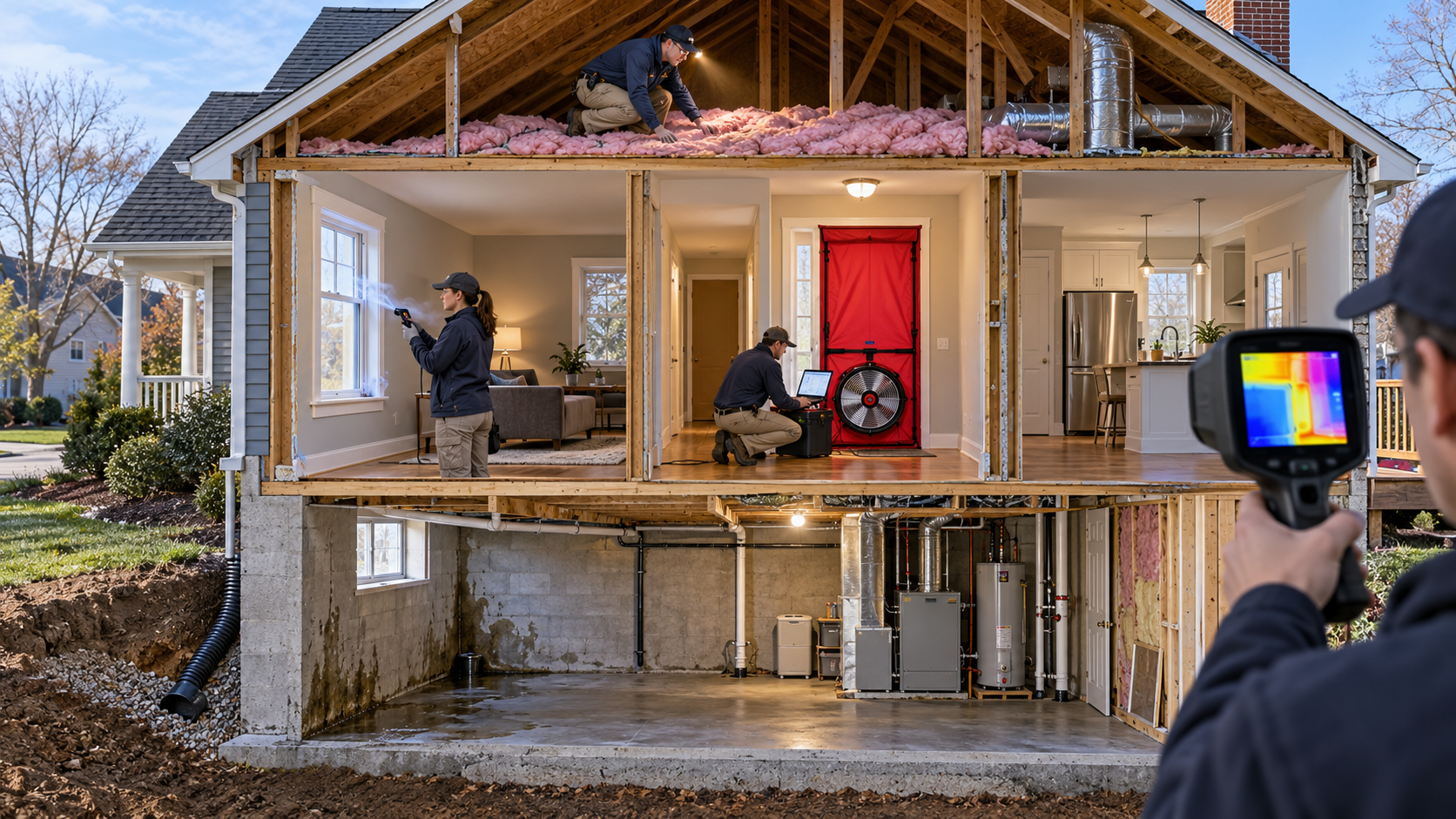
A useful assessment connects observations to a decision. It may include a visual inspection of attic, basement, crawl-space, wall, floor, and opening conditions; an inventory of insulation depth and coverage; a search for obvious air paths; a review of moisture clues; and a discussion of household comfort, energy use, and project goals. A written report should identify limitations, likely priorities, and what needs a specialist rather than pretending every defect has been diagnosed.
Measured testing can add value when the next project is broad or expensive. A blower-door test measures whole-house airtightness under a controlled pressure difference. It does not, by itself, tell you which individual opening should be sealed. Infrared imaging can reveal temperature differences that help locate missing insulation or leakage clues under suitable weather and operating conditions. It is not proof of moisture, mold, or a single cause. Testing is most useful when the assessor explains how the result changes the proposed scope.
Typical price structures
The lower-cost end is usually a limited visual visit or a contractor estimate tied to a known repair. The middle range is a structured assessment with measurements and a report. The higher end may involve a large or unusual house, multiple buildings, difficult access, detailed modeling, pre- and post-work testing, or several specialists. A contractor may credit an assessment fee against later work, but ask whether the report is independent, what happens if you do not hire that contractor, and whether the credit changes the scope.
For a Canadian EnerGuide project, contact a registered service organization and verify the current program process. The reported CAD 600–1,000 figure is for the pair of pre- and post-retrofit evaluations, not a standalone blower-door test and not a guarantee that a rebate is available. In either country, ask whether the quote is for one visit or a complete evaluation sequence.
What changes the cost
Home size matters, but it is not the only driver. A small house with a finished attic, tight crawl space, multiple additions, or inaccessible mechanical chases can take longer than a larger, straightforward home. Cost also changes with:
- whether the assessor must move through finished areas or protect contents;
- the number of attics, crawl spaces, additions, and roof lines;
- the need for blower-door setup, pressure testing, or infrared equipment;
- utility-bill analysis, energy modeling, or a detailed written report;
- moisture instruments, follow-up visits, or coordination with a contractor;
- combustion appliances, fuel-burning equipment, or ventilation questions;
- travel, rural access, and local professional availability.
An assessment should not be sold as mold testing, structural engineering, a full roof inspection, or a detailed HVAC service call. Those scopes may be recommended when the envelope observations point elsewhere.
When an assessment changes the project decision
An assessment is most useful before a large or multi-assembly retrofit, before opening finished walls, or when contractors offer incompatible explanations. It may be unnecessary when the defect is visible and the repair is small, or when you only need a quote for a known component. It is less useful when the assessor cannot reach the assembly that needs investigation.
The findings can change the scope or sequence: they may show that attic bypasses or duct distribution deserve attention before window replacement, that a roof leak or exhaust problem should be corrected before adding insulation, or that a wall needs exploratory work before cavity fill can be quoted. Ask for recommendations ranked by urgency, expected benefit, access opportunity, and uncertainty, with each tied to a location and intended result.
Testing cannot eliminate concealed-building uncertainty or guarantee that every defect has been found. Choose a service that can answer the next decision, such as whether to investigate further, which work should come first, or whether a proposed retrofit is justified.
Questions to ask before booking
Confirm the assessor’s qualifications, the exact tests, and whether the fee includes a return visit. Ask whether fuel-burning appliances must be shut down or tested, who is responsible for preparing the home, and what conditions make infrared results unreliable. Ask for separate prices for optional blower-door, thermal-imaging, moisture, and modeling services. If the company also sells the retrofit, request the assessment findings before reviewing a construction proposal.
Comparing independent and contractor-led assessments
An independent assessment may provide a clearer separation between diagnosis and construction sales. A contractor-led assessment may be efficient when the same company has the qualifications and equipment to inspect and complete the work. In either case, ask whether the assessment fee is credited toward a project and whether that financial relationship affects the recommendations.
Compare the scope, not the equipment list. One provider may include a visual inspection and report; another may include blower-door testing, infrared imaging, moisture measurements, utility-bill analysis, and a return consultation. Those are different services. Request prices for the base assessment and optional tests so you can see what you are actually buying.
U.S. and Canadian context
DOE consumer guidance includes an older U.S. approximate assessment figure, while current specialist observations and NRCan’s current EnerGuide material describe different market and program contexts. Canadian pre- and post-retrofit evaluation prices are a bundle affected by the provider and province or territory; they are not a universal standalone envelope-assessment price. Keep all figures attributed and in their original currency.
The right assessment budget is the smallest service that can answer the homeowner’s actual next decision. It should leave the owner with a prioritized scope, explicit uncertainty, and a clear boundary between envelope work and the roof, HVAC, structural, water, or environmental work that may follow.
Check for a no-cost evaluation route
In British Columbia, BC Hydro’s Energy Conservation Assistance Program page currently routes eligible households to a free home energy evaluation, personalized advice, and any recommended upgrades that the program approves. The application path depends on the household’s utility and heating service area. The evaluation determines which upgrades are suitable, and eligibility alone does not guarantee installation; the program is first-come, subject to available funding, and its terms can change. Start with the current program page and confirm the live requirements before budgeting for a privately paid assessment. This route is specific to eligible BC households, not a general Canadian benefit.
Include health and safety in the assessment scope
An envelope assessment should flag conditions that may affect people or the home’s durability before recommending broader tightening or insulation. The U.S. Department of Energy’s Building America guidance presents safety and durability first, followed by fresh air, moisture protection, draft control, and thermal comfort. EPA’s voluntary retrofit guidance also helps identify indoor-air-quality and health considerations, but it is not a property inspection or a complete hazard-abatement protocol. Ask what was checked, what remains uncertain, and whether a qualified ventilation, combustion, radon, lead, asbestos, or mold specialist is needed. U.S. guidance does not replace Canadian or local requirements.
Tell the assessor about persistently stuffy air, condensation on cold surfaces, or recurring mold or mildew. EPA lists these as possible ventilation warning signs, not a diagnosis. For a U.S. home, EPA recommends fixing it when a radon test is above 4 pCi/L; an envelope assessment should refer that result to an appropriate radon professional rather than treating insulation or air sealing as radon mitigation.
What a useful assessment report should include
Before booking, ask whether the report will identify the areas and assemblies inspected, include photographs and observations, list measurements and tests performed, and explain access limits. It should distinguish direct findings and measured results from hypotheses, identify conditions that need more investigation, and describe what the assessment did not cover. A list of products or possible upgrades without that context is closer to a sales proposal than an assessment.
Recommendations should be ranked by urgency, expected benefit, access opportunity, and uncertainty. Each should identify the location, intended result, and any further inspection or specialist needed before pricing. The report should help you decide what to do first, what can wait, and which work belongs to another trade; compare construction quotes after that diagnostic scope is clear.
An envelope assessment is not automatically a structural engineering report, HVAC service diagnosis, mold test, asbestos assessment, or roof inspection. It may appropriately refer those scopes to qualified specialists. Keep the report with later quotes, test results, and completion records so the project has a traceable starting point.