
A major Canadian renovation may involve a new addition, an extensively rebuilt home, a secondary suite, or a new detached dwelling. The project’s construction price is not enough to determine whether a GST/HST rebate route applies. The actual work, ownership, intended residential use, claimant, tax paid or payable, and transaction dates can point to different rules. This guide helps identify the question to take to the Canada Revenue Agency (CRA) or a qualified tax professional; it does not calculate a household’s entitlement.
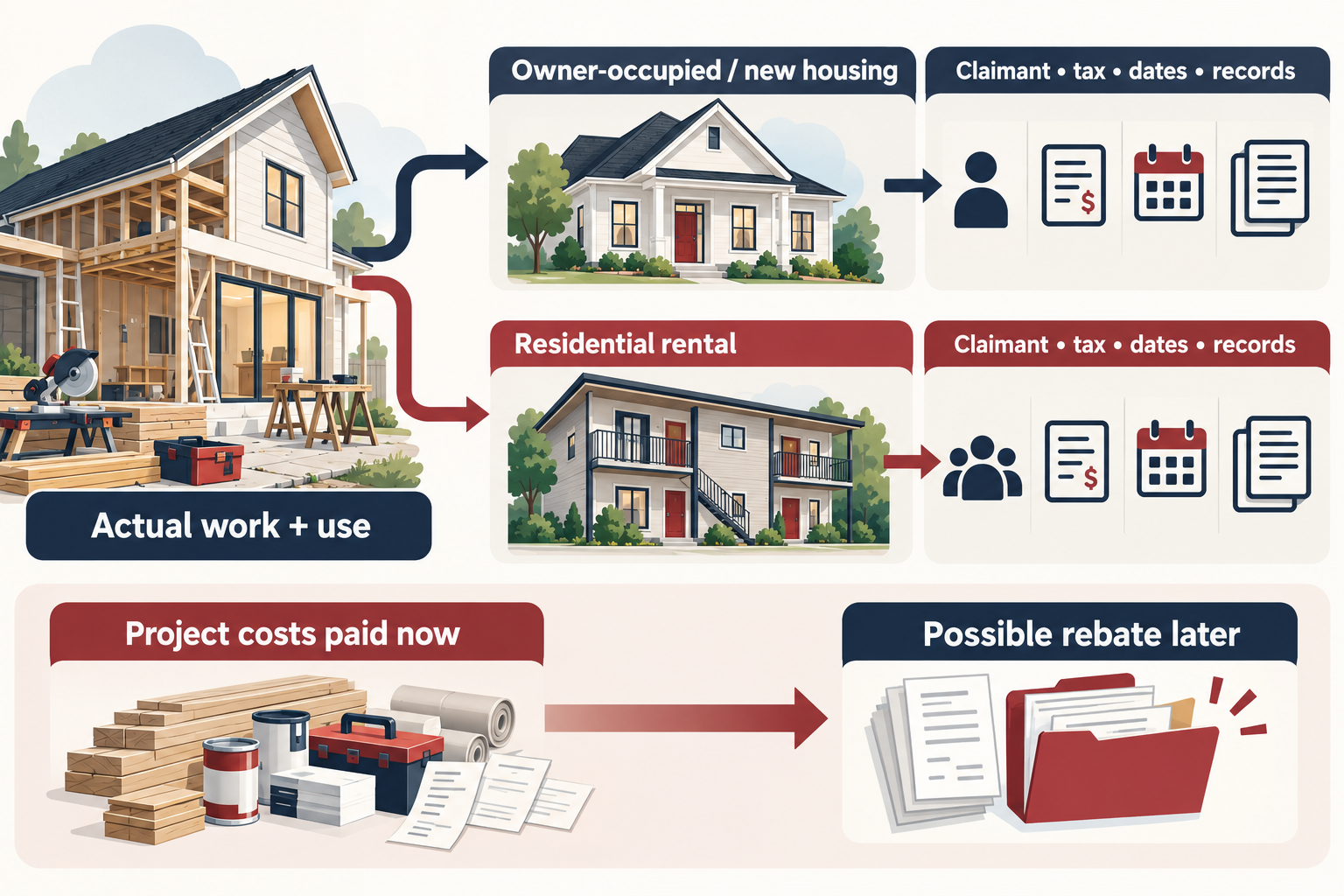
Start with use, ownership, and the actual work
Write down what exists today, what will be built or changed, who owns the property, who will occupy each unit, and whether any unit will be rented for residential use. Also record who contracts for and pays for the work, whether the property is purchased or owner-built, and when construction, completion, first occupancy, or a lease is expected. These facts help identify the route before a possible rebate is put into the project budget.
Owner-occupied housing and rental housing do not share one simple application path. A homeowner who builds or substantially renovates a home intended as a primary place of residence may need to review the owner-built/new-housing rebate rules. A landlord who purchases or builds qualifying residential rental housing, or accounts for tax under a self-supply rule, may need to review the new residential rental property (NRRP) rebate instead. Different rules can apply to a unit in a larger rental complex. The person who may claim, the transaction, and the tax accounted for matter; ownership of a home alone does not answer the question.
Substantial renovation is a tax test, not a project label
CRA’s test has two separate parts. First, all or substantially all of the existing building—generally 90% or more—must be renovated to at least a minimum degree. CRA uses a fair and reasonable method to assess the interior; only habitable areas count, so a finished basement may be included while a garage or unfinished area generally is not. Second, all or substantially all—generally 90% or more—of the existing building must be removed or replaced. The foundation, exterior walls, interior supporting walls, floors, roof, and staircases are excluded from the required removal or replacement, although work on some excluded elements may sometimes count. Patching, painting, or surface refinishing alone does not satisfy the removal-or-replacement requirement. An addition is generally not included when measuring the existing building. Creating a self-contained suite inside an existing home usually does not meet the test by itself, and a major addition raises a separate question about whether the original home is also substantially renovated.
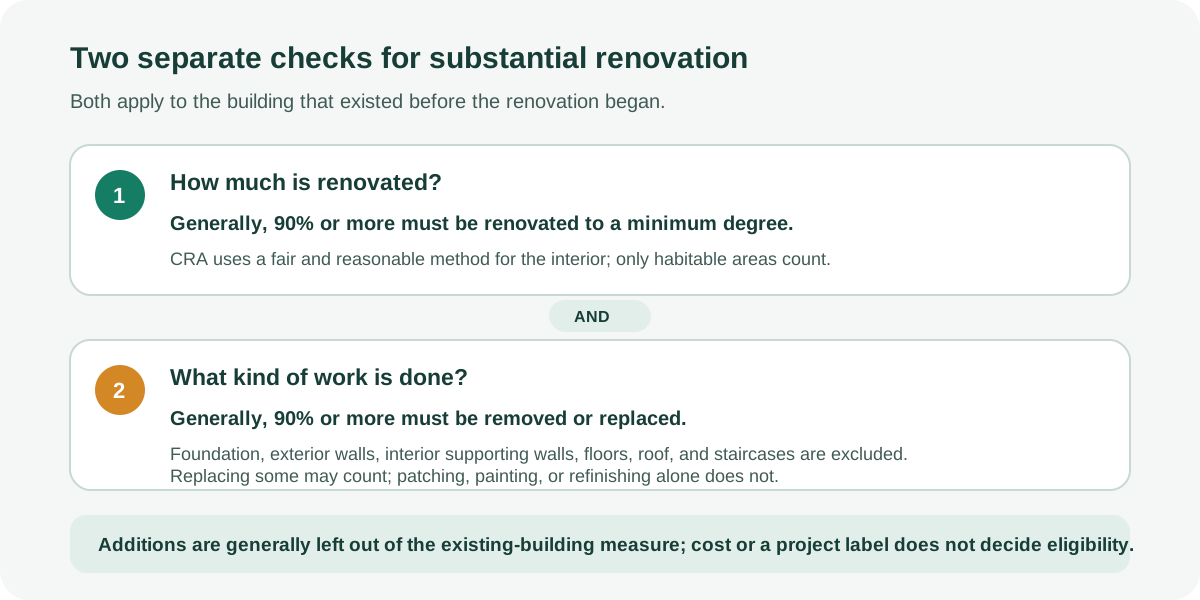
That is why “gut renovation,” “full remodel,” “basement apartment,” and “ADU” are useful construction descriptions but not tax conclusions. An expensive project can fall short of a tax threshold, and a contractor’s estimate cannot establish the proper classification. An entirely new dwelling or a converted non-residential property may follow new-housing rules rather than the same route as renovating an existing owner-occupied home. Confirm the facts against the CRA guide and interpretation that apply to the actual transaction.
Choose a route to investigate
| Project facts | Route to investigate | Keep separate |
|---|---|---|
| You or a qualifying relation will use the rebuilt or newly created home as a primary residence | CRA owner-built/new-housing rules for the specific renovation, conversion, or qualifying addition | Who is eligible to claim, the form, tax paid or payable, valuation, and the applicable deadline depend on the transaction. |
| The new or substantially renovated unit will be rented as a long-term residence | CRA NRRP rules and any applicable provincial rental rebate | The claimant, self-supply or purchase facts, unit type, rental intent, property value rules, and dates can change the route. |
| A basement or garage suite is being added inside an occupied home | First classify the work and intended use; then ask whether any particular new-housing or rental route can apply | A suite alone is not proof of substantial renovation or entitlement. Local permit status is a separate question. |
| A detached unit is being built or a non-residential building is converted | Ask whether the facts fit a new residential complex, owner-built home, or rental-property route | Do not assume the rules for improving an existing house automatically cover a separate unit. |
| You build or substantially renovate a home for your primary residence and may meet CRA’s first-time-buyer test | Check the separate first-time home buyers’ GST/HST rebate as well as the ordinary owner-built route | Project timing, first occupancy, ownership history, claimant, home value, and the ordinary rebate rules all matter. |
A separate route for some first-time home buyers
CRA describes an additional federal GST/HST rebate for an eligible first-time home buyer who builds or substantially renovates a qualifying single-unit home or residential condominium for use as their primary residence and is its first occupant after the work begins. The claimant must also meet the applicable ordinary owner-built new-housing rebate conditions (or the specific alternative value test). “First-time” is a defined test: among other requirements, the individual and any spouse or common-law partner generally must not have occupied a home they owned as a primary residence during the calendar year of the test or the four preceding calendar years. Age, citizenship or permanent-resident status, claimant identity, and the exact test date also matter.
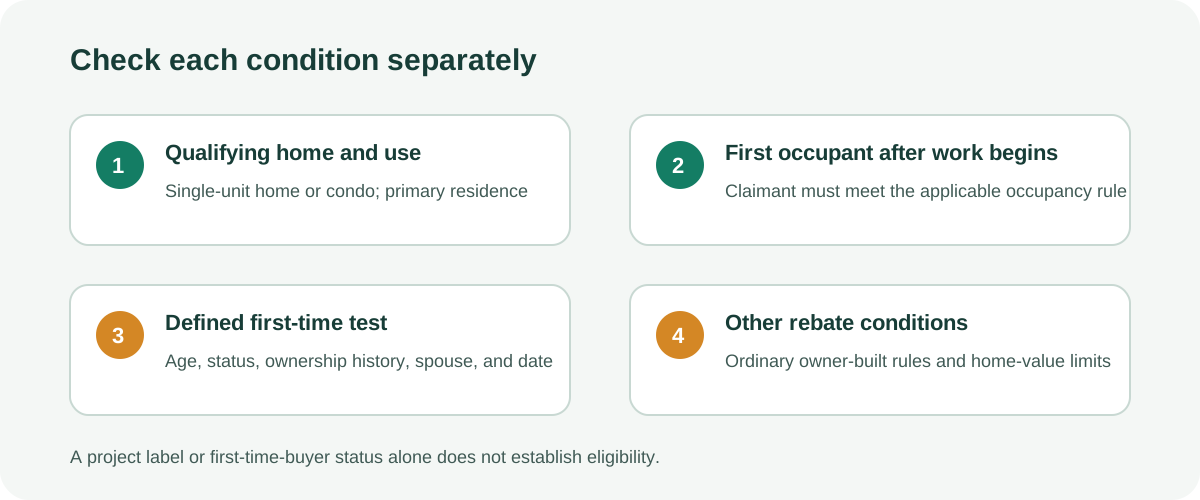
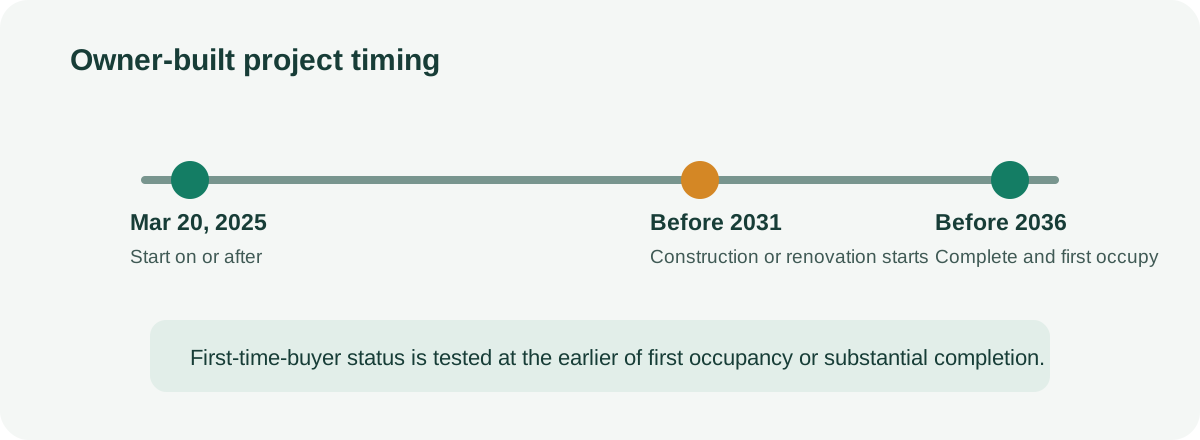
For an owner-built home, CRA’s published window requires construction or substantial renovation to begin on or after March 20, 2025 and before 2031, with substantial completion and first occupancy before 2036. The first-time-buyer test is applied at the earlier of first occupancy after work begins or substantial completion. The rebate is generally limited to eligible GST or the federal part of HST, with a maximum of $50,000 and a reduction for homes valued between $1 million and $1.5 million; it is unavailable at or above $1.5 million. The ordinary new-housing rebate may affect the calculation. Ontario has separate provincial rebate rules. These thresholds do not establish that a particular renovation, claimant, or home qualifies.
The table is a starting screen, not a complete eligibility test. A project can involve more than one unit or tax event, and the owner, builder, landlord, or purchaser may be treated differently under the relevant rules. If use could change between personal occupancy and rental, describe that plan before selecting a form or treating a possible benefit as available.
Check provincial measures separately
The CRA’s Ontario enhanced NRRP rebate is a time-limited provincial example for qualifying rental housing. One published construction-start pathway covers work beginning between April 1, 2026, and March 31, 2027; certain purchases where construction began earlier have a separate route. The applicable pathway may also depend on completion, tax payable, the claimant, use, and other transaction facts. Do not apply one date window or summary condition to every landlord, project, or unit. Check the current eligibility page for the exact transaction and confirm whether the property is within the measure before including it in a forecast.
A provincial rental rebate is not the same as an owner-occupied new-housing rebate. Nor does an Ontario rule establish a benefit in another province. If the project crosses jurisdictions or mixes personal and rental units, identify which tax authority and which property or unit each question concerns.
Keep a possible rebate outside the construction price
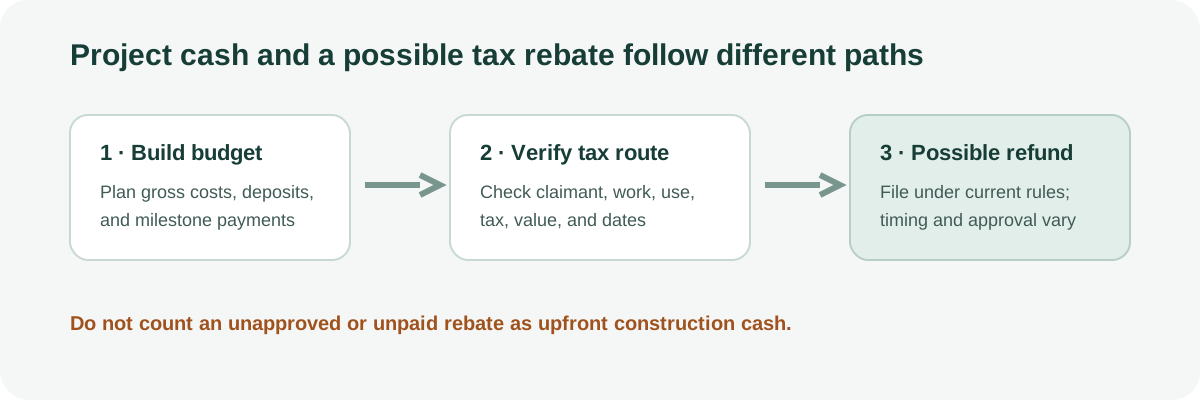
Build the project estimate at the gross contract level. Alongside it, keep a separate tax worksheet with the possible route, claimant, tax amount actually paid or payable, qualifying work, intended use, key dates, application evidence, and the date a refund could realistically arrive. Until eligibility and timing are confirmed, budget deposits, contractor invoices, temporary housing, and lender payments without assuming a rebate is approved or paid.
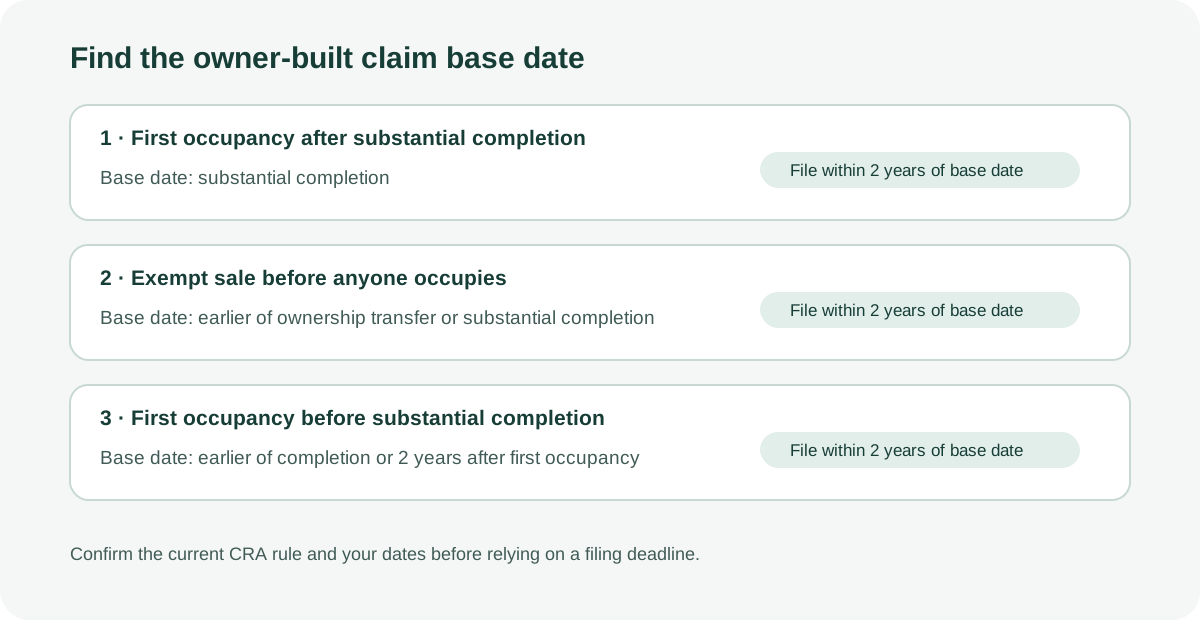
For the owner-built first-time-buyer route, CRA generally allows up to two years after the applicable base date to file. The base date depends on whether the home is occupied after substantial completion, sold exempt before anyone occupies it, or first occupied before the work is substantially complete. The filing rules also identify online and mail routes; use the current CRA instructions to determine the correct date and form for the transaction. A late claim is not automatically accepted.
A refund claimed after paying suppliers may leave a cash gap during construction. Ask the tax professional how the applicable filing works, who must submit it, what evidence is required, and whether a later change in use or sale could affect the claim. Keep contracts, invoices, proof of payment, plans, change orders, construction and occupancy dates, and rental or personal-use records together. The CRA forms and instructions for the correct route control; a broad project summary cannot replace them.
Questions to take to a tax professional
Before demolition or a major payment, ask:
- Which existing or new housing unit is being assessed, and who is the potential claimant?
- Is the project an owner-occupied renovation, a new-housing project, a residential rental property, or more than one of these?
- What part of the existing interior counts for the substantial-renovation test, and how are additions or a new detached unit treated?
- Which construction, completion, purchase, occupancy, lease, and tax dates apply to this route?
- What tax has been paid or is deemed payable, and what records or forms support the claim?
- Does a provincial measure apply, and could a later sale or use change require repayment or another adjustment?
Do not alter safe construction scope or schedule solely to pursue a possible rebate. A local authority still decides permits and code compliance, while CRA rules decide tax treatment. For project financing, compare Major Renovation Financing Options; for the physical gut-work budget, see Gut Renovation Cost. The Multigenerational Home Renovation Tax Credit is a separate income-tax measure with different qualifying facts. A rebate or credit is not a contractor discount, permit approval, or loan commitment.